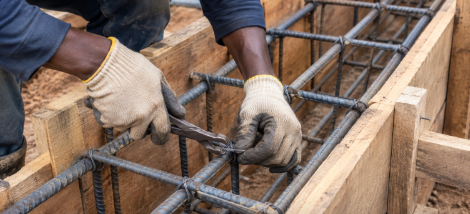
Every civil engineer knows that steel and concrete work together to create strong structures. Consequently, you must apply the minimum and maximum reinforcement limits to balance structural safety with site constructability. If you use too little steel, a beam might fail suddenly under load. On the other hand, if you pack too much steel into a mold, the concrete cannot flow properly. Therefore, understanding these limits ensures you build safe and practical structures.
Why Do We Need Minimum Reinforcement Limits ($A_{s,min}$)?
Why do engineers specify minimum limits? Initially, plain concrete can handle some bending because it has a small amount of tensile strength. However, once the bending moment exceeds the uncracked concrete cracking moment ($M_{cr}$), the concrete cracks. At this exact moment, the steel must take over the tension.
If the steel area is too small, the steel will snap immediately, causing an instant collapse. Therefore, engineers set minimum and maximum reinforcement limits to guarantee the steel can carry the load after the concrete cracks. The codes use the concrete tensile strength ($f_{ctm}$) and the steel yield strength ($f_{yk}$) to calculate this safe minimum limit.
Why Do We Need Maximum Reinforcement Limits ($A_{s,max}$)?
Furthermore, we must look at the upper bounds. Why do codes restrict the highest amount of steel? The main reason is practical site construction. If you crowd a beam with too many bars, you cause severe rebar congestion.
Consequently, the wet concrete cannot pass through the gaps between the steel bars during the pour. This blockage causes honeycombing, which leaves weak air pockets in your structure. To avoid poor concrete compaction, codes limit the steel to 4% of the gross concrete area ($A_c$). However, at lap splices where bars overlap, you can safely increase this limit to 8%.
BS 8110 vs. Eurocode 2: Minimum and Maximum Reinforcement Limits
Now, let us compare the British Standard (BS 8110) and the Eurocode (EC2). Both codes aim for the exact same safety goals, yet they use slightly different equations to find the minimum and maximum reinforcement limits.
BS 8110 uses a simplified table based on the concrete grade and steel type. For a rectangular beam, BS 8110 often sets the minimum limit around 0.13% to 0.24% of the cross-sectional area.
In contrast, Eurocode 2 uses a more detailed formula. EC2 directly links the minimum area to the concrete tensile strength ($f_{ctm}$) and the steel yield strength ($f_{yk}$). Specifically, EC2 states:
$$A_{s,min} = 0.26 \times \left( \frac{f_{ctm}}{f_{yk}} \right) \times b_t \times d$$
Both codes agree perfectly on the maximum limit. They firmly set the upper boundary at 4% of the total concrete area, rising to 8% at lap splices.
Simple Worked Example: BS 8110 Minimum and Maximum Reinforcement Limits
Let us look at a basic example using BS 8110. Imagine a rectangular concrete beam with a width ($b$) of 230 mm and a total depth ($h$) of 450 mm. We use high-yield steel with a yield strength ($f_y$) of 460 $N/mm^2$.
First, we calculate the gross cross-sectional area ($A_c$).
$$A_c = b \times h = 230 \times 450 = 103,500 \text{ } mm^2$$
BS 8110 states that for this specific steel type, the minimum reinforcement is 0.13% of $A_c$.
$$A_{s,min} = 0.0013 \times 103,500 = 134.55 \text{ } mm^2$$
Next, we find the maximum limit. BS 8110 sets this strictly at 4% of $A_c$.
$$A_{s,max} = 0.04 \times 103,500 = 4,140 \text{ } mm^2$$
Therefore, your designed steel area must stay between 134.55 $mm^2$ and 4,140 $mm^2$.
Simple Worked Example: Eurocode 2 Limits
Similarly, let us solve a similar beam using Eurocode 2. The beam has a width ($b$) of 230 mm, an effective depth ($d$) of 400 mm, and a total depth ($h$) of 450 mm. We use concrete class C25/30 (meaning $f_{ctm}$ is 2.6 $N/mm^2$) and steel with $f_{yk}$ equal to 500 $N/mm^2$.
First, we use the primary EC2 formula for the minimum limit:
$$A_{s,min} = 0.26 \times \left( \frac{2.6}{500} \right) \times 230 \times 400$$
$$A_{s,min} = 0.26 \times 0.0052 \times 92,000 = 124.38 \text{ } mm^2$$
Also, EC2 states $A_{s,min}$ must not be less than $0.0013 \times b \times d$.
$$0.0013 \times 230 \times 400 = 119.6 \text{ } mm^2$$
Since 124.38 is larger, we confidently use 124.38 $mm^2$ as our minimum limit. Finally, the maximum limit remains 4% of the gross area.
$$A_{s,max} = 0.04 \times 230 \times 450 = 4,140 \text{ } mm^2$$
Conclusion and Next Steps
In conclusion, mastering the minimum and maximum reinforcement limits protects your structures from catastrophic failure and severe construction defects. By properly applying the rules of BS 8110 and Eurocode 2, you guarantee that your concrete cracks safely and pours smoothly without honeycombing. For more detailed reading on advanced concrete design practices and structural behavior, you can visit The Concrete Centre.
References
- British Standards Institution. (1997). BS 8110-1:1997 Structural use of concrete – Part 1: Code of practice for design and construction.
- European Committee for Standardization. (2004). Eurocode 2: Design of concrete structures – Part 1-1: General rules and rules for buildings (EN 1992-1-1).