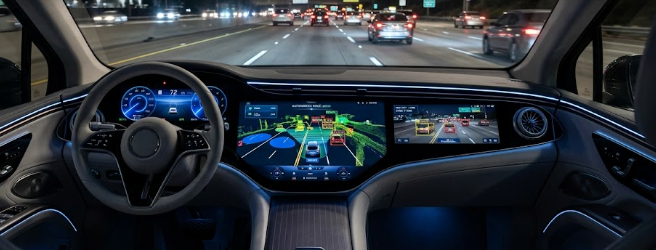
At the MOVE 2026 tech event in London, industry giants like Rivian’s RJ Scaringe and autonomy pioneer Wayve completely changed how we define “car health.” Today, a healthy car is no longer just about a solid engine, clean oil, or good brake pads. Instead, engineers focus heavily on the complex software layers that control how a car sees the world. Because of this shift, real-time software mapping has become the ultimate test for modern automotive safety and integrity. Software-defined vehicles (SDVs) rely heavily on a complex mix of cameras, radars, and LiDARs to navigate roads safely. Therefore, keeping these digital eyes perfectly aligned is now far more critical than checking for physical mechanical wear.
Understanding the Perception Layer and Real-Time Software Mapping
The “perception layer” acts as the digital brain segment that handles how a vehicle scans its surroundings. For instance, when a car automatically brakes for a pedestrian, it uses a process called sensor fusion. This process combines data from cameras, radar, and LiDAR arrays simultaneously to create a complete picture of the road. However, this system is incredibly sensitive. If your car hits a nasty pothole, a camera module might shift by just a fraction of a millimeter. While that seems tiny, it can cause the sensor fusion algorithm to miscalculate obstacle distances by several meters. Consequently, manufacturers use real-time software mapping to constantly verify that all sensors point exactly where they should, preventing dangerous visual errors.
Fixing Alignment Errors on the Go
In the past, a misaligned vehicle camera required an expensive and inconvenient trip to a specialized dealership calibration bay. Technicians would park the car in front of physical targets and manually reset the internal systems. Fortunately, next-generation SDV architecture handles this issue completely internally through edge computing. While the vehicle moves down the highway, the onboard computer monitors consistency across all sensors at the same time. If it detects a small misalignment, it automatically creates a software compensation patch. The vehicle then applies this fix Over-the-Air (OTA) to realign its own “vision” instantly. As a result, real-time software mapping eliminates the need for garage visits, keeping your car safe during your daily commute.
Securing Sensor Fusion with ISO 21434
As artificial intelligence takes full control of autonomous driving perception, digital safety has become a massive priority for automakers. For example, malicious hackers could attempt to intercept or manipulate sensor signals to fool the car’s computer into seeing fake obstacles. To prevent this, modern diagnostic tools strictly follow the ISO 21434 cybersecurity standard. Mechanics and automated diagnostic systems must now query the vehicle’s secure gateway using localized cybersecurity tokens. This process confirms that nobody has altered or corrupted the incoming sensor data. By combining these strict security checks with real-time software mapping, the car guarantees that its digital updates are both accurate and completely secure from outside threats.
Predictive Diagnostics for Fleet Management
This new software-centric approach offers massive benefits for commercial and high-end consumer fleets. Fleet managers can now track cloud-aggregated diagnostic data from hundreds of vehicles simultaneously. By doing so, the central system can easily flag an individual sensor array for degradation long before it actually fails. For instance, if a sensor begins to drift repeatedly on a specific delivery truck, the cloud software catches the pattern early. Therefore, the fleet manager can schedule maintenance before the driver ever sees a malfunction light on the dashboard. Ultimately, real-time software mapping turns reactive repairs into predictive maintenance, ensuring fleet vehicles remain safe and active. To learn more about how software-defined vehicles are transforming modern transportation, check out the detailed automotive tech insights on Wired.
References
- MOVE 2026 London Automotive Technology Event Proceedings.
- International Organization for Standardization. (2021). Road vehicles — Cybersecurity engineering (ISO/SAE Standard No. 21434:2021).
- Rivian Automotive Tech Keynote on SDV Architecture, London 2026.
- Wayve Autonomous Mobility Perception Layer Whitepaper.