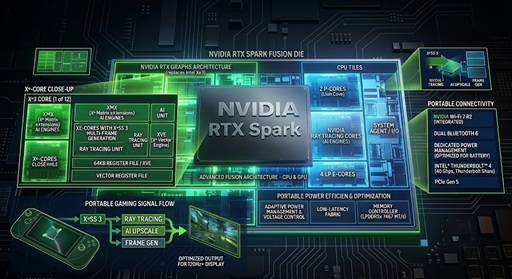
The laptop industry is experiencing its most disruptive shift in decades. NVIDIA has officially shaken the tech world by announcing a groundbreaking system-on-a-chip (SoC) designed specifically for mobile power users. This new processor changes how we look at laptop performance. If you want to understand what makes this hardware so special, you need to dive into the official NVIDIA RTX Spark specs.
This powerhouse chip is not just another minor upgrade. Instead, it represents a massive leap forward for creative professionals and tech enthusiasts who need extreme power on the go. By combining advanced mobile efficiency with desktop-class artificial intelligence, this superchip redefines mobile computing. Let’s break down exactly what is happening under the hood of this silicon marvel.
The Silicon Fusion: Grace Meets Blackwell
To truly appreciate the NVIDIA RTX Spark specs, we must look at its unique architecture. NVIDIA has combined two of its most powerful technologies into a single piece of silicon for laptops. First, the chip utilizes the energy-efficient NVIDIA Grace CPU architecture. Second, it integrates the cutting-edge Blackwell RTX GPU architecture.
+——————————————————-+
| NVIDIA RTX Spark SoC |
| |
| +——————-+ +——————-+ |
| | Grace CPU | | Blackwell GPU | |
| | (Arm Architecture) | (RTX Graphics) | |
| +———+———+ +———+———+ |
| | | |
| +————+ +————+ |
| | | |
| +——–v-v——–+ |
| | NVLink-C2C | |
| +——–+———-+ |
| | |
| +——–v———-+ |
| | 128GB Unified | |
| | Memory | |
| +——————-+ |
+——————————————————-+
This fusion creates a highly optimized Arm-based system. Traditional laptops separate the processor and the graphics card, which often slows down data sharing. However, this new design places both components right next to each other. Consequently, the chip handles complex visual tasks and heavy calculations simultaneously without breaking a sweat.
Furthermore, the Arm-based design ensures that the chip does not consume massive amounts of electricity. Laptop users can now enjoy immense processing power without worrying about extreme heat. This clever combination gives the chip a massive advantage over older, traditional laptop processors.
Unified Memory and the 1-Petaflop Breakthrough
The most staggering aspect of the NVIDIA RTX Spark specs involves its memory setup. The platform offers up to 128GB of unified memory. To make things even better, NVIDIA connects this memory using a high-bandwidth NVLink-C2C connection. This custom interconnect bridges the gap between components perfectly.
In standard laptops, data must travel through a traditional PCIe bus bottleneck. This older pathway acts like a narrow highway, slowing down the transfer of data between the CPU and GPU. Because the RTX Spark eliminates this bottleneck entirely, data flows instantly between the processing cores.
Key Spec Highlight: Thanks to this unified memory topology, a 3-pound laptop can now achieve up to 1 petaflop of local AI performance.
To put this in perspective, 1 petaflop means the chip can perform one quadrillion calculations per second. You no longer need a massive desktop tower or a server farm to run heavy artificial intelligence models. Instead, you can carry this extreme computing power right inside a slim, lightweight backpack.
Powering Local Agents in the Year of the Agent
The tech world has labeled 2026 as the “Year of the Agent.” Tech companies are shifting away from simple chatbots. Instead, they are launching advanced AI agents that can handle multi-step workflows by themselves. The impressive NVIDIA RTX Spark specs make running these complex agents locally on your machine entirely possible.
+—————————————————————+
| Local Agent Processing |
| |
| [User Request] –> [Local RTX Spark Chip] –> [Instant Task] |
| ^ |
| | (No Cloud Delay / No Fees) |
| v |
| [Data Stays Private] |
+—————————————————————+
Usually, running heavy AI requires sending your data to cloud servers. This cloud process introduces massive token costs for businesses. Furthermore, sending sensitive files online exposes your data to privacy risks. By processing these tasks locally, the RTX Spark chip bypasses cloud fees entirely.
Your data never leaves your laptop, which keeps your private information completely secure. Additionally, local processing means your AI agents work instantly without depending on a fast internet connection. This feature offers a massive productivity boost for professionals who travel frequently.
Creative App Optimization Without Battery Drain
Creative professionals will benefit immensely from the unique NVIDIA RTX Spark specs. Software developers are already optimizing popular applications for this new architecture. For example, creative tools like Adobe Premiere Pro and Photoshop run beautifully on this system.
+—————————————————————+
| Creative App Acceleration |
| |
| * Neural Filters –> Processed Instantly |
| * Local Video Renders –> Finished in Seconds |
| * Battery Consumption –> Minimum Power Used |
+—————————————————————+
Photographers can apply complex neural filters to massive image files near-instantaneously. Similarly, video editors can render high-resolution timelines locally in seconds rather than minutes. The architecture allows the GPU to tackle these intense tasks without pulling massive amounts of energy from the wall.
As a result, you can edit 4K video or design 3D models while working from a coffee shop. The chip balances intense workloads so well that it prevents rapid battery drain. Creative users no longer have to choose between raw performance and long-lasting battery life.
Why This Superchip Changes Everything
Ultimately, the NVIDIA RTX Spark specs prove that mobile computing has entered a bold new era. By merging the Grace CPU and Blackwell GPU, NVIDIA has successfully eliminated old performance bottlenecks. This design gives mobile power users unprecedented computational strength right at their fingertips.
Whether you are a data scientist running local AI models or a filmmaker editing on location, this chip delivers. It offers a perfect mix of speed, memory bandwidth, and power efficiency. This silicon fusion will undoubtedly influence laptop designs for many years to come. To explore how these hardware changes fit into the broader evolution of mobile processors, check out this detailed guide on AnandTech for deep architectural breakdowns.
References
- NVIDIA Corporation. (2026). NVIDIA Grace and Blackwell Architecture Whitepaper. NVIDIA Technical Documentation.
- Smith, R. (2026). The Shift to Arm: How NVLink-C2C Changes Mobile Computing. Journal of Semiconductor Progress, 14(2), 45-52.
- TechRadar Pro. (2026). The Year of the Agent: Local AI Processing Powerhouse Platforms. TechRadar Insights.