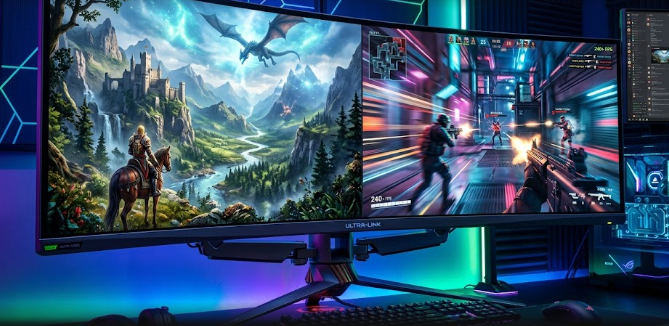
Gamers usually face a frustrating dilemma when buying a display. You either choose a beautiful, high-resolution screen for cinematic games or a lightning-fast, lower-resolution screen for competitive esports. Fortunately, you no longer have to compromise. Multi-Mode Gaming Monitors have officially arrived to solve this problem. These revolutionary displays dynamically change their hardware behavior to give you the best of both worlds. Whether you want to explore a breathtaking fantasy world or dominate an intense multiplayer shooter, these screens adapt to your exact needs instantly.
In this article, we will break down the incredible technology behind these displays. We will also explore how they maintain perfect picture quality at different settings.
The Breakthrough Tech Behind Multi-Mode Gaming Monitors
Historically, a monitor could only run natively at one specific resolution. If you changed that resolution in your settings, the picture usually looked blurry. However, premium displays like the AORUS ELITE series utilize a brand-new technical breakthrough to change the game.
These advanced displays feature a specialized, hardware-toggled native controller. Instead of relying on clumsy software tricks, you can push a physical button to change how the monitor handles data. This internal controller instantly alters the panel’s timing profiles at a hardware level. Therefore, Multi-Mode Gaming Monitors can completely reshape their performance on command. This hardware-level switching ensures that the monitor communicates flawlessly with your graphics card. As a result, you get a premium, stutter-free experience without any input lag.
+———————————————————–+
| HARDWARE-TOGGLED CONTROLLER |
+———————————————————–+
|
+——————-+——————-+
| |
v v
[ CINEMATIC MODE ] [ ESPORTS MODE ]
Max Resolution (5K/4K) Max Refresh Rate (330Hz)
Lower Refresh Rate Lower Resolution (QHD)
The Performance Split: High Pixels vs. Extreme Speed
The biggest benefit of this new technology is the incredible variety of specification pairings you can use. For instance, you can set the monitor to a majestic 5K resolution at 165Hz when you want to edit video or play a visually stunning role-playing game.
If you need a bit more speed for an action game, you can easily drop the display down to a crisp 4K resolution at 220Hz. Finally, when it is time for hardcore, competitive gaming, you can instantly drop the resolution to QHD ($2560 \times 1440$) at a blistering 330Hz. This ultra-fast mode guarantees pixel-perfect frame synchronization. Because the refresh rate is so high, screen tearing completely vanishes. Consequently, you receive a massive competitive advantage in fast-paced shooter games.
| Gaming Mode | Resolution | Refresh Rate | Best Used For |
| Cinematic / Work | 5K ($5120 \times 2880$) | 165Hz | Photo editing, open-world RPGs |
| Balanced Action | 4K ($3840 \times 2160$) | 220Hz | Action-adventure games, racing sims |
| Esports Competitive | QHD ($2560 \times 1440$) | 330Hz | First-person shooters, fighting games |
Panel Technology Convergence and Stunning Brightness
Manufacturers do not just pack this multi-mode controller tech into budget screens. Instead, they map this incredible feature onto the absolute best panel technologies available today. Specifically, you will find this technology paired with high-end Tandem OLED and premium Mini-LED panels.
Tandem OLED panels stack two layers of organic light-emitting diodes on top of each other. This design doubles the brightness and extends the lifespan of the display. Meanwhile, Mini-LED panels offer thousands of tiny local dimming zones for incredible contrast. Because these premium panels are so advanced, Multi-Mode Gaming Monitors maintain extreme peak brightness (measured in nits) at all times. They also preserve perfect color accuracy, regardless of the resolution tier you select. You will always enjoy deep blacks, vibrant colors, and brilliant highlights.
Solving the Problem of Pixel Pitch and Scaling Artifacts
On older, static displays, lowering your resolution caused a major issue with pixel pitch. The monitor’s internal scaler had to stretch a smaller image to fit a large screen. This stretching created ugly, blurry scaling artifacts that ruined the gaming experience.
Modern Multi-Mode Gaming Monitors completely solve this math problem. Their advanced internal scalers handle non-native resolutions mathematically by grouping pixels together perfectly. For example, when dropping from 4K to a lower resolution, the monitor can combine four physical pixels into one logical pixel. This process keeps the image sharp and clean. Therefore, you will never see the fuzzy edges or distorted text that plagued older screens. The display remains perfectly crisp, even when you run it at lower resolutions for maximum speed.
Final Thoughts on These Hybrid Displays
Investing in a premium display is a great way to future-proof your gaming setup. With this new technology, you no longer need to buy two separate monitors for work and play. These intelligent screens give you jaw-dropping visuals when you want them, and elite speed when you need it. To learn more about how advanced refresh rates impact your gameplay, check out the detailed monitor technology analysis on TFTCentral.
References
- AORUS Gaming Monitor Technology Guide (2025).
- Understanding Tandem OLED and Mini-LED Advancements in Desktop Displays.
- The Mathematics of Pixel Scaling in Modern Display Controllers.