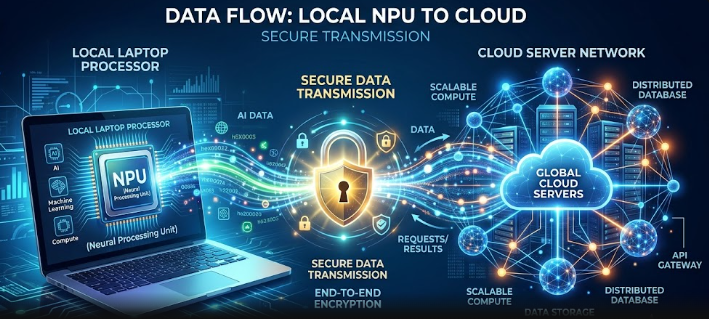
Artificial Intelligence is changing fast, and the way our computers handle it must change too. In the early days of AI, your computer sent every single prompt to a distant cloud server. The cloud did all the heavy lifting and sent the answer back. Today, this model is breaking down because we use autonomous AI agents that work constantly in the background. If you rely solely on the cloud, your operational costs will skyrocket. This financial pressure is driving the rise of the Hybrid Compute Continuum.
[Your Device (Local NPU)] <—> [Smart Software Layer] <—> [The Cloud (Heavy LLMs)]
(Fast, Private, Low Cost) (Routes Tasks Dynamically) (Expensive, Massive Power)
To solve this issue, modern PC hardware uses a specialized chip called a Neural Processing Unit (NPU). Tech companies often measure NPU performance in “TOPS” (Trillion Operations Per Second). However, TOPS metrics only matter if your system knows how to distribute the workload. The Hybrid Compute Continuum represents a smart shift where your local device and the cloud work together as one unified system.
The Economic Reality of the Cloud-to-Edge Problem
Why can’t we just keep using the cloud for everything? The answer comes down to economics and infrastructure. Early chatbots only processed a few sentences at a time, which was relatively cheap to maintain. In contrast, modern AI agents constantly read your screen, predict your needs, and write code in the background.
Because these agents operate continuously, they consume a massive number of data units called tokens. Processing billions of tokens in the cloud requires an immense amount of server power and electricity. Tech companies cannot sustain these high costs without charging users fortunes. Therefore, the industry had to find a way to shift the processing burden back to your local device.
Defining the Hybrid Compute Continuum Spec
The Hybrid Compute Continuum relies on a strict software-and-hardware protocol to manage this balance. This specification acts like a smart traffic controller inside your computer’s operating system. When you give your AI agent a task, the protocol instantly analyzes the request to see how much processing power it requires.
Is the AI task complex?
/ \
YES NO
/ \
[Route to Cloud Server] [Route to Local NPU]
(High power, high cost) (Instant, free, private)
If the task is simple, the protocol routes the workload directly to your local NPU. If the task requires a massive language model, the system sends it to the cloud. This split happens seamlessly in milliseconds without the user ever noticing a delay. As a result, your PC saves battery power and reduces internet bandwidth usage.
Saving Money with the Token Reduction Metric
Keeping smaller tasks on your local device yields massive financial benefits for developers and consumers alike. Developers use a metric called “token reduction” to measure how much data they save by avoiding the cloud. For example, your local NPU can easily handle basic code validation, text structuring, and initial image preparation.
- Local NPU Tasks: Code syntax checking, text formatting, basic data filtering.
- Cloud Server Tasks: Complex logic reasoning, massive database searches, high-resolution rendering.
Real-world testing shows that processing these foundational steps locally can result in up to a 60% token reduction. By cutting cloud reliance by more than half, companies can drastically slash web page generation costs. Consequently, web applications become much cheaper to run, and those savings get passed down to the tech buyer.
Privacy Guardrails at the Hardware Level
Privacy is another critical reason to embrace the Hybrid Compute Continuum on modern PCs. When your AI agent reads your personal documents, you do not want that sensitive information traveling over the internet. Modern hardware solves this problem by creating strict local security boundaries right on the chip.
Systems now use secure local environments, such as OpenShell runtimes, to protect your personal identity. The OpenShell runtime acts as a digital scrubber on your local NPU. It completely cleans your data and removes names, addresses, and account numbers before any external cloud synchronization occurs. This hardware-level protection ensures that your private life stays strictly on your device.
Why NPU TOPS Matter to PC Buyers
When you shop for a new computer today, you will see stickers advertising high NPU TOPS metrics. These numbers represent the raw muscle your computer has for local AI processing. A higher TOPS rating means your device can handle larger local models without lagging.
Understanding the Hybrid Compute Continuum helps you see why these hardware specs actually matter in real-world conditions. A high-TOPS NPU ensures your computer can run advanced AI features locally, safely, and for free. Without a strong NPU, your system will constantly lag as it relies on expensive, slow cloud connections. For further reading on how modern chip design influences AI performance, check out this detailed guide on AnandTech.
References
- Intel Corporation. (2025). The Evolution of the NPU and AI PC Architecture. Intel Technology Journal.
- Microsoft Mechanics. (2025). Inside the Hybrid Compute Protocol for Windows Advanced AI.
- OpenShell Runtime Consortium. (2026). Hardware-Level Privacy Guardrails in Modern Silicon.