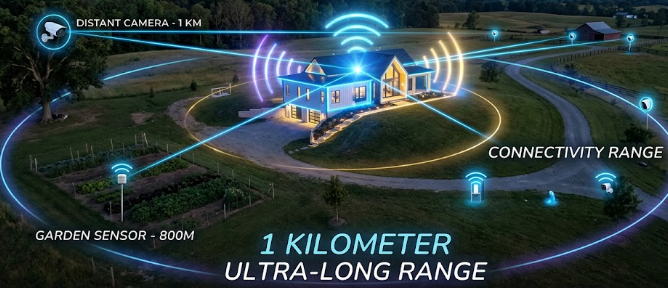
Are you tired of your smart home devices losing connection the moment they step outside your front door? You are certainly not alone. Therefore, understanding the new Wi-Fi HaLow specs is crucial for every home automation DIYer. In this article, we will explore how this incredible technology changes everything. Unlike your regular router, this new standard easily reaches devices located far away from your house. Consequently, it perfectly suits expansive outdoor security systems and complex Internet of Things (IoT) projects. Let us dive into the amazing details of this 1-kilometer smart home standard.
The Sub-1 GHz Frequency Band in Wi-Fi HaLow Specs
Most traditional routers use the 2.4 GHz and 5 GHz frequency bands. While these common bands provide fast internet speeds, they consistently struggle to pass through thick walls. On the other hand, the Wi-Fi HaLow specs reveal a completely different and highly effective approach. This advanced technology operates strictly in the sub-1 GHz spectrum, specifically between the 902 and 928 MHz frequencies.
Because it uses a lower frequency, Wi-Fi HaLow easily punches through thick masonry walls, concrete blocks, and dense foliage. As a result, it gives you a massive 10x range advantage over standard Wi-Fi. For example, if you place a water sensor in your garden behind a heavy brick shed, your regular Wi-Fi will definitely fail. However, a HaLow connection will easily reach that sensor without any trouble.
Throughput vs. Range: Balancing the Wi-Fi HaLow Specs
Furthermore, developers designed this standard to balance data speed and physical distance perfectly. The Wi-Fi HaLow specs include highly flexible channel widths ranging from 1 MHz up to 16 MHz. This built-in flexibility allows smart devices to dynamically shift their connection speeds based on exactly what they need at any given moment.
For instance, a distant soil moisture sensor located one kilometer away does not need fast internet. Thus, the network system drops the speed to a rock-solid 150 kbps to maintain that long-distance connection. Conversely, if you install a high-definition driveway security camera closer to your house, the system ramps up the speed. In this specific case, it can provide up to 86.7 Mbps to stream crystal-clear video to your phone.
Massive AP Capacity for Your Smart Home
Have you ever noticed your internet slowing down when too many devices connect at once? Standard home routers often buckle under the heavy pressure of just 50 smart home devices. Luckily, the Wi-Fi HaLow specs solve this frustrating problem entirely for IoT developers and homeowners alike.
Engineers mathematically designed Wi-Fi HaLow access points (APs) to handle a massive number of network connections. Specifically, a single AP can comfortably support up to 8,191 connected devices simultaneously. Therefore, you will never experience network congestion again, even if you build the most complex and device-heavy IoT network imaginable in your home.
Battery Life and Target Wake Time
Another major benefit of the Wi-Fi HaLow specs is the extraordinary battery life it offers to small, wireless devices. Traditionally, continuous Wi-Fi connections drain small batteries incredibly fast. However, HaLow introduces extreme power-saving protocols like Target Wake Time (TWT) to combat this issue.
TWT efficiently tells the sensor exactly when to wake up and send its data. Immediately after sending the data, the device goes back to a deep sleep state. As a result, small sensors powered by simple coin-cell batteries can run continuously for several years on a single charge.
Conclusion
In conclusion, embracing the Wi-Fi HaLow specs will significantly upgrade your future home automation projects. It offers unmatched signal range, incredible device capacity, and truly outstanding battery life for all your gadgets. If you want to dive deeper into the technical networking details of this standard, you can read more about it on the Wi-Fi Alliance official website.
References
- Wi-Fi Alliance. (n.d.). Wi-Fi HaLow: Extended range, low power Wi-Fi for the Internet of Things. Retrieved from wi-fi.org.
- IEEE Standards Association. (2016). IEEE 802.11ah-2016 – IEEE Standard for Information technology–Telecommunications and information exchange between systems.