When people hear about a disease, they often wonder how they might catch it. However, you cannot catch sickle cell disease like you catch a cold. It is completely impossible to get it from being around someone who has it. Instead, we must look at the genetics of sickle cell to understand how a person gets this condition. This blood disorder passes down through families. In this article, we will explain exactly how this inheritance works in simple terms.
Understanding the Genetics of Sickle Cell
To understand the genetics of sickle cell, you first need to know a little about genes. Genes act like an instruction manual for your body. They decide your eye color, your hair type, and how your body makes blood. You inherit these instruction manuals directly from your parents. Therefore, sickle cell disease is an inherited condition. You are born with it. It happens because of a specific set of instructions that tell the body to make abnormal, sickle-shaped red blood cells instead of normal, round ones.
Why the Genetics of Sickle Cell Prove it is Not Contagious
Many people ask if sickle cell disease is contagious. We need to strongly emphasize that it is not contagious at all. For example, if you hug, kiss, or share food with someone who has the disease, you will absolutely not catch it. Contagious illnesses, like the flu or a cold, spread through viruses or bacteria. Meanwhile, genetic conditions only come from your parents. Because the genetics of sickle cell rely entirely on the genes you inherit at birth, you can never “catch” it from another person.
The Role of Parents in the Genetics of Sickle Cell
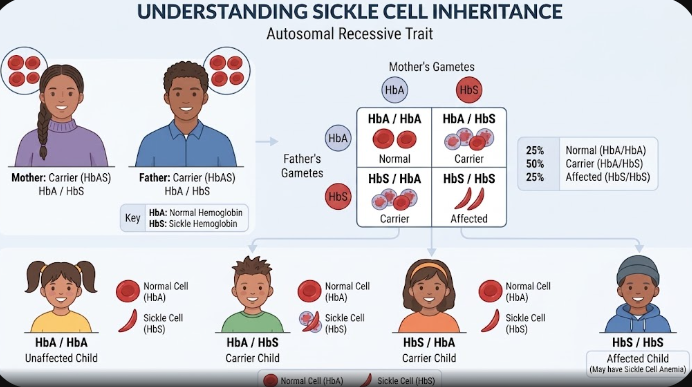
So, how do you actually get it? A child must inherit two faulty genes to have sickle cell disease. Specifically, the child must receive one sickle cell gene from the father and one sickle cell gene from the mother. If a child only gets one faulty gene, they will not have the full disease. Therefore, both parents must carry at least one copy of the faulty gene for their child to be born with sickle cell disease. This is a fundamental rule in the genetics of sickle cell.
What is the Sickle Cell Trait?
Sometimes, a child inherits only one faulty gene from one parent and a normal gene from the other parent. Medical professionals call this condition the “Sickle Cell Trait.” People with the sickle cell trait are generally asymptomatic, meaning they do not show any signs of the disease. They live completely normal, healthy lives. However, they are still carriers of the sickle cell gene. Consequently, they can pass this single faulty gene down to their own children in the future.
Passing the Genetics of Sickle Cell to the Next Generation
When two parents with the sickle cell trait have a baby, the genetics of sickle cell create a few different possibilities. First, there is a 25% chance the child will inherit two normal genes and be completely free of the trait. Second, there is a 50% chance the child will inherit one faulty gene, making them a carrier like the parents. Finally, there is a 25% chance the child will inherit two faulty genes and have full sickle cell disease. Understanding these odds helps families plan for their future.
To sum up, the genetics of sickle cell clearly show that the disease comes from inherited genes, not from infections. You cannot catch it from someone else, and you only get it if both of your parents pass the faulty gene to you. If you want to learn more about how genetic traits work and explore further details about this blood disorder, you can visit the Centers for Disease Control and Prevention (CDC) Sickle Cell page for further reading.
References
- Centers for Disease Control and Prevention (CDC). “What is Sickle Cell Disease?”
- World Health Organization (WHO). “Sickle Cell Disease.”