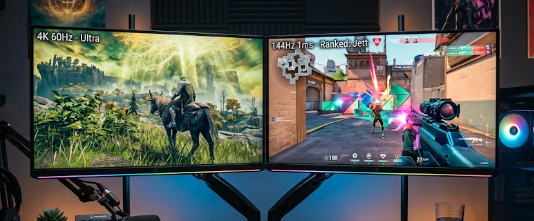
Gamers and creative professionals often face a tough choice. You either buy a 4K display for crisp visuals, or you buy a 1080p display for lightning-fast speeds. Consequently, many people crowd their desks with a dual-monitor setup. However, the display industry has finally solved this problem. The latest multi-refresh-mode gaming panels offer a single, highly adaptive solution. These innovative displays give you the best of both worlds in one sleek package. Whether you are editing a video or competing in an esports tournament, you get exactly what you need. In this article, we will explore how these monitors work and why they are replacing traditional desktop setups.
The Dual and Triple Persona Profile of Multi-Refresh-Mode Gaming Panels
During the Computex 2026 event, major brands revealed impressive 2026 dual-mode and triple-mode panels. For example, the newest Tandem OLED and Mini-LED displays operate with distinct “personas.” You can run the monitor in a pristine 4K resolution for cinematic gaming or creative work. Then, you simply press a dedicated hardware hotkey on the monitor bezel. Instantly, the display firmware switches the panel to a high-speed esports configuration.
Furthermore, this toggle happens entirely inside the monitor itself. You do not need to restart your computer or dig through confusing Windows display settings. The hardware communicates the new profile directly to your graphics card in seconds. Therefore, hardcore esports players can easily practice tracking targets at ultra-high speeds, and creative professionals can instantly switch back to a gorgeous canvas for photo editing.
Pixel Binning and Scaled Timing Metrics
To understand how multi-refresh-mode gaming panels achieve this, we must look closely at the display physics. Normally, a standard monitor forces your computer to stretch a low-resolution image across a high-resolution grid. This stretching creates a blurry, soft image. However, modern dual-mode displays use pixel binning and scaled timing metrics to fix this fundamental issue.
When you shift the panel from its native creation mode (like 4K UHD at 240Hz) down to an aggressive esports tournament configuration (like 1080p at 480Hz or 540Hz), the monitor groups the physical pixels together. It applies strict integer scaling to map one logical pixel directly onto a 2×2 block of physical pixels. As a result, the image remains incredibly sharp. You get the blistering speed of a 1080p monitor without losing the crisp edges you expect from a premium display.
Dynamic Frequency and Resolution (DFR) Logic
The real magic lives inside the scaler hardware running inside the monitor. This underlying technology is known as Dynamic Frequency and Resolution (DFR). Instead of relying on fuzzy, blurry software-level GPU upscaling, the display handles everything natively. The monitor pools adjacent subpixels directly on the Timing Controller (T-CON) chip.
Additionally, the T-CON chip automatically adjusts its internal timing clocks. By lowering the resolution, the hardware frees up massive amounts of processing bandwidth. The monitor then uses this extra bandwidth to double or triple the refresh rate. For instance, some 2026 triple-mode panels can even run at 1440p at 360Hz or drop to 1080p at a staggering 680Hz. Because the hardware controls this DFR logic, you experience zero input lag and perfect motion clarity.
Subpixel Layout and Text Clarity Fixes in Multi-Refresh-Mode Gaming Panels
Historically, high-refresh OLED gaming monitors struggled heavily with everyday office productivity tasks. Older panels used unusual subpixel configurations that caused severe text fringing and blurry letters. Creative professionals hated this artifacting when writing articles or reading spreadsheets. Thankfully, 2026 RGB-stripe Tandem OLED variations have altered their subpixel configurations completely.
These new multi-refresh-mode gaming panels remove the problematic white subpixel found in older WOLED displays. Instead, they use a traditional RGB-stripe layout. This vital structural change completely eliminates fringing and text-blurring artifacts. Consequently, the monitor renders sharp, clear text that easily rivals any professional IPS display. You can comfortably read code, manage your websites, or design graphics all day without straining your eyes.
Conclusion
Ultimately, multi-refresh-mode gaming panels represent a massive leap forward for desktop technology. You no longer need to compromise between visual fidelity and competitive speed. By integrating advanced DFR logic, integer scaling, and perfected RGB-stripe subpixel layouts, these monitors handle everything flawlessly. If you are ready to declutter your desk and upgrade your digital workspace, you should definitely consider these adaptive displays. For further reading on display scaling and refresh rate technologies, check out this comprehensive guide on monitor refresh rate advancements.
References
- Laptop Outlet. (2026). Dual Mode vs Standard Gaming Monitors: Which One Should You Choose?
- TFTCentral. (2026). The Future of Dual-mode Monitors – New Displays and Improved Specs Explored.
- ViewSonic Library. (2026). What is a Dual Mode Monitor?