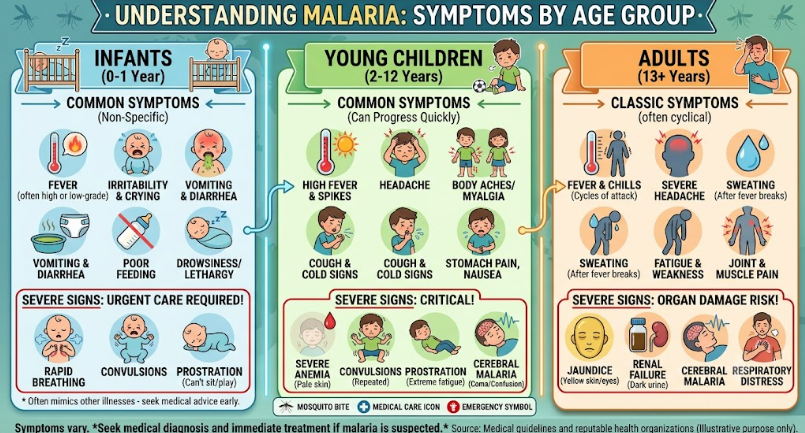
Malaria remains one of the most common and dangerous tropical diseases worldwide. However, many people do not realize that the disease presents differently depending on a person’s stage in life. Consequently, understanding malaria symptoms by age helps parents, caregivers, and individuals spot the warning signs before the infection becomes severe. While adults often experience classic chills and body shaking, infants and young children frequently show subtle or atypical signs. Therefore, knowing what to look for in each age group can save lives.
Spotting Malaria Symptoms by Age in Babies and Infants
Infants and babies under one year belong to the highest risk group for severe complications. Unfortunately, babies cannot speak or tell us where they feel pain. For instance, instead of complaining about headaches or sore muscles, an infected baby may simply become unusually sleepy or extremely restless. Furthermore, you might notice that your baby refuses to feed, vomits milk, or cries persistently without any obvious comfort.
In addition to extreme irritability, babies with malaria often suffer sudden high fever spikes, rapid breathing, and pale skin. Because infants have small body masses, malaria can cause rapid dehydration and severe anemia very quickly. Therefore, if your infant displays extreme lethargy, sunken eyes, or cold limbs alongside a fever, you must visit a health clinic immediately.
Recognizing Malaria Symptoms by Age in Young Children
Children under five years old also face extreme risks from malaria. Unlike infants, young children often display noticeable digestive distress alongside classic fever patterns. For example, a child with malaria usually suffers from recurrent high fever, cold shivering fits, and sudden stomach pain. Moreover, nausea, frequent vomiting, and watery diarrhea occur very commonly in this age group.
As the infection progresses, dangerous complications can develop within hours. Parents should watch for severe warning signs, such as convulsions, seizures, or an inability to sit up or stand independently. Additionally, yellowing of the eyes and skin—known as jaundice—indicates serious liver stress and blood cell loss. Consequently, any child showing these severe signs requires emergency medical care right away.
How Malaria Symptoms by Age Present in Adults
Adults generally experience the classic pattern of malaria attacks. Usually, this condition unfolds in three distinct stages over several hours:
- The Cold Stage: First, the adult feels intense cold and uncontrollable shivering, even in a warm room.
- The Hot Stage: Next, a hot fever stage follows, bringing severe headaches, high body temperature, and skin flushing.
- The Sweating Stage: Finally, a sweating stage occurs, where the body temperature drops rapidly as the person sweats profusely.
Besides these cyclical attacks, adults frequently experience severe exhaustion, deep muscle aches, joint pain, and continuous nausea. Although adult immune systems fight the parasite better than a child’s immune system, malaria still weakens the body significantly. Therefore, adults should seek prompt testing and proper medication rather than attempting to work through the illness.
What To Do When You Suspect Malaria
Because malaria symptoms by age vary so widely across family members, you should never rely on guesswork alone. Instead, visit a certified healthcare provider or medical laboratory to perform a rapid diagnostic test (RDT) or blood smear test. Early testing ensures that you receive the correct antimalarial treatment before complications develop.
In conclusion, paying close attention to age-specific warning signs empowers families to act quickly and effectively against malaria. If you want to learn more about global malaria prevention strategies and clinical treatment guidelines, you can visit the World Health Organization.
References
- World Health Organization (WHO). (2023). Malaria Fact Sheet. Geneva: World Health Organization.
- Centers for Disease Control and Prevention (CDC). (2022). Disease & Symptoms: Malaria. U.S. Department of Health & Human Services.
- White, N. J. (2014). Severe Malaria. Malaria Journal, 13(1), 471.
- UNICEF. (2021). Malaria in Children: Epidemiology and Progress Towards Elimination. UNICEF Data & Analytics.