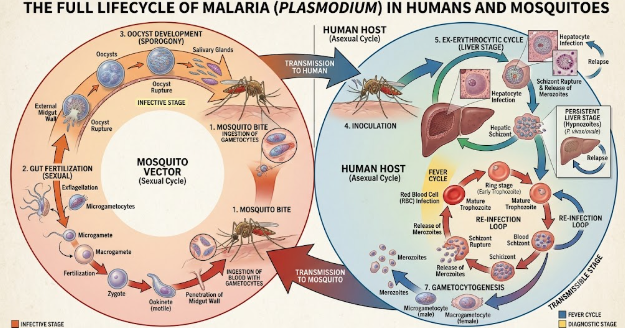
Malaria affects millions of people across the globe every year, yet many individuals do not fully understand how this disease spreads. Scientists carefully study the lifecycle of malaria to create effective treatments and vaccines. Understanding this process helps us prevent infections and protect our communities. In this article, you will learn about the parasites that cause the infection, the mosquitoes that spread them, and the exact steps the infection takes inside the human body.
What Causes Malaria?
Single-celled microscopic parasites cause malaria infections in humans. Specifically, these organisms belong to a scientific group called Plasmodium. While scientists have identified several species within this group, two primary types cause the vast majority of human cases:
- Plasmodium falciparum: This species is the most dangerous and deadly variant. It spreads rapidly and causes severe medical complications if doctors do not treat it quickly.
- Plasmodium vivax: This species is the most widespread globally. Although it is generally less lethal than falciparum, it can remain dormant in the human liver for months or years, causing sudden illness relapses later in life.
These tiny parasites cannot survive on their own for long periods. Consequently, they depend on two specific hosts to complete their biological growth: female mosquitoes and human beings.
The Vector: How Mosquitoes Transmit the Parasite
Many people believe that all mosquitoes spread disease, but this is a common myth. Only infected female mosquitoes from the Anopheles species transmit the parasite to humans.
Female mosquitoes require protein to nourish their developing eggs. Therefore, they bite humans and animals to collect blood meals. Male mosquitoes, on the other hand, feed exclusively on plant nectar and never bite humans.
When an infected female mosquito bites a person, it injects saliva into the skin to prevent the blood from clotting. Consequently, parasite forms called sporozoites flow directly from the insect’s salivary glands into the human bloodstream. This bite marks the official start of the infection inside a person.
The Silent Liver Stage of the Lifecycle of Malaria
Once the parasites enter your bloodstream, they move quickly toward your internal organs. In less than an hour, they reach the liver and invade liver cells.
During this liver stage, you will not feel sick at all. The parasites incubate silently and multiply exponentially inside your liver tissue for 10 to 14 days. Think of your liver as a hidden factory during this phase. A single invading parasite can produce tens of thousands of new forms inside a single liver cell.
Eventually, the infected liver cells rupture under the intense pressure. As a result, thousands of newly multiplied parasites burst directly back into your circulatory system.
The Blood Stage: How Parasites Destroy Red Blood Cells
After leaving the liver, the parasites begin the most dangerous phase of the lifecycle of malaria. They target and invade your red blood cells (RBCs), which normally carry vital oxygen throughout your body.
Inside the red blood cells, the parasites consume hemoglobin and grow rapidly. Within 48 to 72 hours, the infected red blood cells burst open, releasing a fresh wave of parasites that immediately attack surrounding healthy cells.
This destructive destruction cycle triggers the severe clinical symptoms of malaria, including:
- High fevers and intense sweating
- Severe shivering and muscle chills
- Anemia caused by the loss of healthy red blood cells
- Extreme physical fatigue and headache
If a healthy female Anopheles mosquito bites you during this blood stage, it ingests the parasites along with its blood meal. Consequently, the parasites reproduce inside the mosquito’s stomach, travel to its mouthparts, and prepare to infect the next human host.
Alternative Transmission Routes
Although mosquito bites cause almost all malaria cases, the parasite can occasionally bypass the insect host entirely. Because the parasites live directly inside human red blood cells, any direct blood-to-blood contact can transmit the infection.
For instance, blood transfusions using unscreened donor blood can pass parasites directly into a recipient. Similarly, healthcare workers or drug users who share contaminated needles can accidentally spread the disease. In rare cases, pregnant mothers can pass the infection through the placenta to their unborn babies during pregnancy or delivery.
Despite these alternative routes, controlling mosquito populations remains the most effective strategy to stop the disease. You can explore more detailed scientific research on parasite biology on the World Health Organization Malaria Portal.
References
- World Health Organization. (2023). Malaria Fact Sheet. WHO Guidelines for Malaria.
- Centers for Disease Control and Prevention. (2022). About Malaria: Disease and Biology. CDC Division of Parasitic Diseases.
- Cowman, A. F., Healer, J., Marapana, D., & Marsh, K. (2016). Malaria: Biology and Disease. Cell, 167(3), 610-624.