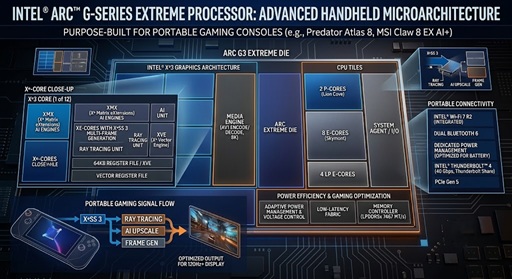
The world of portable gaming is changing fast, and Intel is leading the charge this year. For a long time, mobile gamers had to choose between a heavy laptop or a weak handheld console. However, the arrival of the Intel Arc G-Series Extreme has officially shattered those limitations.
Intel built this new processor family from the ground up specifically for portable devices. Instead of reusing old laptop chips, engineers created a unique design that focuses on what mobile players need most. Devices like the MSI Claw 8 EX AI+ and the Acer Predator Atlas 8 are already teasing incredible performance using this fresh hardware.
The Core Architecture Behind the Breakthrough
To understand this chip, we must look at the layout of the Intel Arc G-Series Extreme processor. Intel utilizes its advanced Panther Lake architecture to build a highly efficient 14-core system. This system completely removes old hyper-threading technology to save valuable battery life while keeping processing power high.
+————————————————————-+
| Intel Arc G-Series Extreme |
| (14 Cores) |
+——————————+——————————+
| Compute Tile | Graphics Tile |
| (Intel 18A Node / PowerVia) | (Xe3 Battlemage / B390) |
| | |
| – 2 Performance Cores | – 12 Xe-Cores |
| – 8 Efficient Cores | – Ray Tracing Units |
| – 4 Low-Power Cores | – XeSS 3 AI Matrix |
+——————————+——————————+
| NPU Tile |
| (NPU Gen 5 – 46 Dedicated TOPS) |
+————————————————————-+
The silicon layout divides work into three distinct core types to optimize performance. First, two Performance Cores (P-Cores) handle heavy game engine calculations and real-time logic. Second, eight Efficient Cores (E-Cores) manage general background tasks and physics processing smoothly.
Finally, four Low-Power Efficient Cores (LP E-Cores) handle basic system operations while the device idles. This smart division of labor ensures that the processor never wastes power on simple tasks. Consequently, your handheld stays cool and runs much longer on a single charge.
Massive Upgrades with Xe3 Graphics
The true star of the Intel Arc G-Series Extreme is its integrated graphics engine. Intel packs the new Arc B390 graphics chip into this tiny piece of hardware. This graphics processing unit (GPU) features 12 next-generation Xe3 cores built on the Battlemage architecture.
+——————————————————-+
| Xe3 Battlemage (Arc B390) |
+——————————————————-+
| [Xe-Core 1] [Xe-Core 2] [Xe-Core 3] [Xe-Core 4] |
| [Xe-Core 5] [Xe-Core 6] [Xe-Core 7] [Xe-Core 8] |
| [Xe-Core 9] [Xe-Core 10] [Xe-Core 11] [Xe-Core 12] |
+——————————————————-+
| Hardware Ray Tracing Modules |
+——————————————————-+
These specific numbers mean you can enjoy native 1080p gaming on demanding open-world titles. For example, heavy games run at stable, fluid frame rates without needing a hot discrete GPU. Furthermore, the chip includes dedicated hardware ray tracing modules to produce realistic lighting and reflections on the go.
Players can also benefit from the brand-new XeSS 3 frame generation technology. This software uses artificial intelligence to insert extra frames into your game automatically. As a result, you get a visual experience that mirrors a full desktop computer while using very little power.
Smart Gaming with OpenVINO Edge AI
Modern handhelds require more than raw graphics strength, and that is where the built-in Neural Processing Unit (NPU) shines. The Intel Arc G-Series Extreme includes a powerful Gen 5 NPU that delivers 46 dedicated TOPS of AI performance. This specific component relies on the OpenVINO framework to optimize gaming workflows.
Instead of wasting your main graphics cores on background tasks, the NPU handles them entirely. For instance, it runs localized background upscaling algorithms and tracks game-state data simultaneously. This means your graphics engine can focus entirely on rendering beautiful pictures.
Additionally, the NPU coordinates with Intel’s Intelligent Bias Control to distribute workloads instantly. If a game suddenly requires more physics processing, the AI adjusts the chip behavior in real time. This automated optimization ensures your gameplay remains silky smooth during heavy action scenes.
Understanding TDP and Frame Scaling
When shopping for a 2026 handheld, you must understand the Thermal Design Power (TDP) spec sheet. The Intel Arc G-Series Extreme operates on a flexible scale that typically runs between 15W and 28W. However, some manufacturers allow the chip to push up to 35W or 45W in turbo modes.
+—————————————————————–+
| TDP vs. Performance Scaling Table |
+—————————————————————–+
| TDP Setting | Target Frame Rate Range | Battery Lifespan |
+—————+————————-+———————–+
| 12W – 15W | 30 – 45 FPS (Medium) | Maximum (3+ Hours) |
+—————+————————-+———————–+
| 17W – 25W | 60+ FPS (High / XeSS) | Balanced (2 Hours) |
+—————+————————-+———————–+
| 35W – 45W | 120+ FPS (Ultra/Docked) | Low (Plug-in Recommended)|
+—————————————————————–+
Adjusting these wattage levels directly affects your actual battery runtime and gaming frame rates. Running the handheld at a restricted 17W limit represents a fantastic sweet spot for travel. In fact, tests show it beats older architectures by clear margins while drawing half the power.
If you plug your console into a wall outlet, you can safely crank the TDP to maximum limits. This extra juice unlocks maximum clock speeds and pushes your frame rates even higher. Therefore, understanding this variable spec sheet helps you balance battery life and performance perfectly.
Summary of Next-Gen Benefits
To wrap things up, Intel has created something truly special for portable gaming enthusiasts this year. The combination of efficient processing cores, advanced graphics, and AI hardware sets a high standard. You no longer have to sacrifice performance to play your favorite PC games while traveling.
Devices sporting this hardware will continue to roll out to retail stores over the coming months. If you want a smooth, high-fidelity gaming experience in the palm of your hand, keep your eyes on these specs. For a deeper look at upcoming portable computer hardware designs, check out the detailed technical analysis over at AnandTech.
References
- Intel Corporation. (2026). Intel Arc G-Series Processors Set a New Standard for Handheld PC Gaming. Intel Newsroom.
- TechPowerUp. (2026). Intel Arc G3 CPU Family Officially Released for Handheld Gaming PCs. TechPowerUp Forums.
- Wccftech. (2026). Intel Arc G3 Extreme Performance Benchmarks Show Clear Disruption In The Handheld Segment. Wccftech Hardware Reviews.