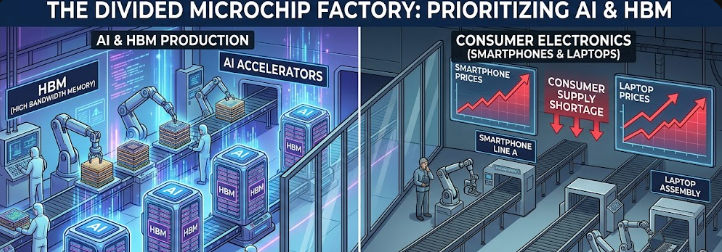
Global tech headlines are warning buyers about a major market bottleneck called “RAMageddon.” Tech companies are aggressively shifting factory capacity away from standard components to build massive artificial intelligence data centers. Consequently, this sudden shift is driving up consumer tech prices on everyday items like smartphones and laptops.
The AI Hardware Tax and Rising Consumer Tech Prices
Silicon fabricators heavily prefer making high-margin High Bandwidth Memory (HBM) chips for AI giants. Therefore, standard client PC and mobile memory lines are starving for parts. Because basic component costs are inflating rapidly, global laptop and smartphone shipments will drop significantly throughout 2026.
Manufacturers pass these extra factory costs directly to you. For instance, a budget laptop that cost a reasonable price last year will demand a premium today. This hidden “AI tax” forces everyday buyers to fund the enterprise chip war.
The On-Device Memory Conflict
To make matters worse, modern 2026 devices now require more memory to run local Large Language Models (LLMs) and offline AI agents. For example, newer smartphones need a minimum of 12GB of RAM, while laptops require at least 16GB to handle basic AI tasks.
Consequently, manufacturers must buy larger amounts of memory exactly when RAM prices are peaking. This technical dilemma creates a massive squeeze on the tech industry, which inevitably increases consumer tech prices even further for the average shopper.
Smart Buying Strategies: The Modular CAMM2 Pivot
How can you protect your wallet against these soaring consumer tech prices? You should look for modular laptop architectures, specifically devices that feature CAMM2 memory slots. This new, flat memory standard allows you to upgrade your laptop’s memory easily at home.
Instead of paying a massive premium for a high-spec model right now, you can purchase a lower-spec base configuration today. Later, when the data-center component squeeze stabilizes, you can buy cheaper RAM and upgrade the device yourself.
Premium Divergence in the Laptop Market
We are also seeing a strict structural split between different consumer tiers. While the volume of entry-level laptops is shrinking, high-end “creator” laptops and workstations are expanding. These premium machines must support complex AI models with over 30 billion parameters locally.
Therefore, tech companies are focusing most of their energy on high-end hardware. This division means budget buyers will face fewer choices, while premium buyers must pay unprecedented amounts for top-tier performance.
Final Thoughts on Navigating Rising Tech Costs
Navigating the current tech market requires patience and a good strategy. As long as the AI boom continues to hoard factory resources, consumer tech prices will likely remain high. For a deeper look into global semiconductor trends and financial audits, you can read the latest industry analysis on DIGITIMES to stay ahead of the market.
References
- DIGITIMES Semiconductor Supply Chain Reports (2026)
- British Telecom (BT) Financial Audits and Market Sourcing Data (2026)