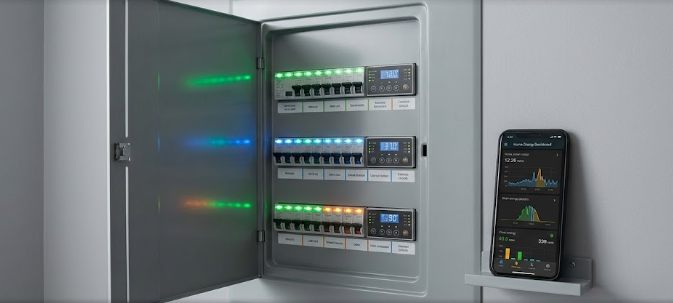
The residential energy landscape is shifting rapidly. Homeowners are moving away from simple, standalone smart devices. Instead, they are embracing holistic, structural energy setups. This shift happens because municipal utility grids are becoming increasingly unstable, even after a massive 86GW national grid expansion this season. Consequently, the home automation focus has shifted entirely toward advanced smart electrical panels. Brands like Span, Lumin, and Schneider Electric are leading this revolution. These modern systems inject IoT monitoring directly into your home’s foundational circuit breaker level. Ultimately, intelligent breaker panels serve as the true backbone of 2026 home microgrids.
Understanding Circuit-Level Fingerprinting
To appreciate these systems, you must understand their core hardware capabilities. Standard electrical setups only track the total energy your entire home consumes. In contrast, intelligent breaker panels track energy draw down to individual breaker circuits in real-time.
[Main Grid/Solar] ──> [Intelligent Breaker Panel] ──> Circuit 1: HVAC (High Draw)
──> Circuit 2: Kitchen (Medium Draw)
──> Circuit 3: Fridge (Critical Draw)
For example, the panel separates the high power demands of your HVAC compressor from your everyday kitchen loop. This continuous tracking maps your home’s precise operational energy signature. By identifying these unique electrical footprints, the panel can alert you if an appliance begins to malfunction or waste power.
Dynamic Load Shedding with Intelligent Breaker Panels
Managing your power efficiently becomes vital if you plan a home battery retrofit or a solar installation. Intelligent breaker panels excel at managing backup power during a black-out. If the main grid drops, the smart panel automatically “sheds” non-essential, heavy-amperage breakers.
Example: The system instantly shuts off power to your hot tub, EV charger, or secondary cooling zones.
By cutting off these heavy loads, the panel conserves your lithium iron phosphate ($LiFePO_4$) backup battery runtime. Consequently, your critical medical equipment, home security systems, and refrigeration stay online much longer.
Managing Your Home via App-Enforced Digital Breakers
Modern home energy management goes far beyond basic automation. In the past, a tripped switch forced you to walk to a dark utility closet with a flashlight. Today, 2026 panels utilize solid-state or remote-actuated internal relays to eliminate this hassle.
These advanced components allow you to manage your entire electrical system via an encrypted smartphone dashboard. From this app, you can easily isolate specific circuits and diagnose appliance electrical faults. You can also adjust your load profiles on the fly without ever touching a physical switch.
EV and Solar Infrastructure Integration
Investing in this technology significantly boosts your property value and futureproofs your home. Installing an intelligent panel pre-wires your house for advanced vehicle-to-home (V2H) bidirectional charging arrays and microgrid loops.
If you buy an electric vehicle later, you will not need to pay for expensive sub-panel additions. The smart panel already possesses the logic and hardware to route power from your car back into your home. Therefore, these systems save you thousands of dollars in future electrical renovation costs.
Building a Resilient Energy Future
As we navigate 2026, energy independence has transformed from a luxury into a necessity. Traditional electrical boxes simply cannot handle the complex demands of modern solar and battery setups. By upgrading your home infrastructure, you gain unmatched control, safety, and efficiency over your power grid. To learn more about how these systems integrate with renewable energy, check out this detailed guide on clean energy solutions.
References
- Span, Lumin, and Schneider Electric Product Specifications (2026 Architectural Energy Reports).
- National Grid Expansion Database: 2026 Residential Infrastructure Review.
- Data on $LiFePO_4$ battery optimization via automated load-shedding relays.