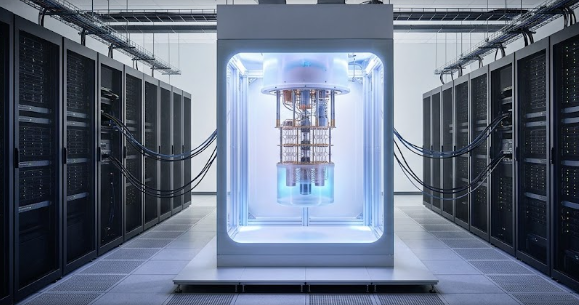
Recent federal funding allocations signed into law on May 21–22, 2026, have triggered a massive shift in the tech world. Investors are moving huge amounts of capital into next-generation data centers. Because of this, companies are changing how they build powerful computers. The main driver behind this shift is quantum-hybrid architecture. This new technology changes the standard for complex calculations and data security. Tech giants like IBM and D-Wave are leading the race by putting these advanced systems into regular server rooms. Consequently, the high-performance compute standard is changing faster than ever before.
Understanding the Quantum-Hybrid Architecture Spec
To understand this shift, we must look at how these computers actually work. Traditional silicon chips are great at executing regular software code, but they struggle with massive math problems. A quantum-hybrid architecture does not replace your standard computer chips. Instead, it pairs regular classical servers with an attached quantum annealing co-processor.
An Easy Analogy: Think of the classical server as an assembly line manager and the quantum processor as a genius math specialist. The regular server handles the basic tasks but offloads complex, multi-variable sorting math to the quantum chip.
As a result, businesses can solve problems in seconds that used to take days.
| Feature | Classical Servers | Quantum Co-Processors |
| Primary Role | Raw code execution & logic | Multi-variable sorting math |
| Core Tech | Standard silicon chips | Quantum annealing nodes |
| Best Used For | Everyday applications & data storage | Complex cryptographic calculations |
Achieving Stability in Quantum-Hybrid Architecture
In the past, quantum computers were too fragile for everyday business use. However, enterprise clusters in 2026 are hitting record-high stability metrics. Scientists achieved this breakthrough by improving cryogenic cooling and shielding. This special shielding protects the delicate quantum bits, or qubits, from ambient electromagnetic interference. Therefore, the systems drastically minimize quantum decoherence, which is the breakdown of quantum information. Thanks to this stability, modern quantum-hybrid architecture systems can run continuous computational calculations without falling apart.
Securing Devices with Quantum-Hybrid Architecture Standards
This tech upgrade does not just stay inside giant data centers; it also protects consumer-facing devices. As commercial networks deploy quantum-assisted decoding infrastructure, our daily tech must adapt. Therefore, consumer laptops and secure smartphones are transitioning their onboard software. These devices now enforce NIST-approved post-quantum cryptography (PQC) standards. Even though your phone does not have a quantum chip, it uses defense methods built to resist quantum attacks. Thus, adopting a quantum-hybrid architecture at the network level upgrades security for everyone.
Energy Savings with Quantum-Hybrid Architecture
Environmental efficiency is another massive benefit of this computing shift. Traditional supercomputer arrays consume enormous amounts of electricity because they use brute force to solve multidimensional logic matrices. Conversely, quantum co-processors solve these complex formulas in fractions of a second. While they do require extreme cryogenic cooling to stay functional, they use a tiny fraction of the electrical wattage that old supercomputers need. Therefore, investing in quantum-hybrid architecture helps tech companies lower their carbon footprints while drastically increasing their processing power.
The Future of High-Performance Computing
The recent infrastructure investments of 2026 prove that the computing world is changing permanently. By combining the reliability of classical servers with the raw speed of quantum processors, businesses get the best of both worlds. This quantum-hybrid architecture protects our data, saves energy, and solves impossible math problems daily. To explore how these cryptographic shifts protect your personal data, you can read more about post-quantum security on the official NIST Computer Security Resource Center.
References
- IBM Quantum Computing Research & Commercial Systems (2026 Data Reports).
- D-Wave Systems: Practical Quantum Annealing Co-processors for Enterprise Clusters.
- National Institute of Standards and Technology (NIST): Post-Quantum Cryptography (PQC) Transition Guidelines.