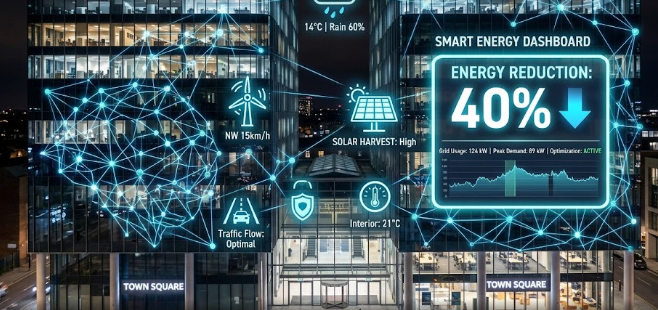
Smart homes used to be the gold standard for modern property owners. However, a massive shift occurred on May 20, 2026, when Trane Technologies and BrainBox AI officially opened their global AI Lab. This exciting launch marks the commercial acceleration of true Autonomous Building Architecture.
Property owners are now moving away from user-programmed thermostats. Instead, they are embracing fully self-optimizing “neural” control. As a result, AI-driven autonomous buildings are completely changing how we manage energy in residential and commercial properties alike.
Moving Beyond Simple Smart Thermostats
Many people confuse smart thermostats with autonomous systems. However, standard smart thermostats are purely reactive devices. For instance, they only change the indoor temperature after it gets too hot or too cold. Consequently, your HVAC system works harder to correct the temperature, which wastes precious energy.
In contrast, AI-driven autonomous buildings use predictive AI models to stay ahead of the curve. These systems constantly process local weather forecasting and indoor occupancy data. Furthermore, they analyze real-time energy grid pricing to adapt HVAC flow two hours in advance. Because of this proactive approach, the system prevents temperature spikes before they ever happen.
Slashing Carbon Footprints by 40 Percent
If you want to maximize your property’s efficiency, the latest data from the newly opened lab is highly encouraging. Real-world validation shows that edge-computed autonomous HVAC systems reduce total energy consumption by up to 20% to 40%. Therefore, this technology represents the highest-ROI green retrofit available on the market today.
Furthermore, a 40% reduction in energy overhead drastically lowers your monthly utility bills. For example, a commercial facility spending $10,000 monthly on climate control could save up to $4,000 every single month. This incredible efficiency makes AI-driven autonomous buildings a premier choice for eco-conscious investors.
Micro-Grid Synchronization and Solar Energy
Another amazing feature of this technology is how it talks directly to residential energy storage systems. The smart software syncs effortlessly with local solar arrays and lithium iron phosphate ($LiFePO_4$) batteries. Consequently, the building becomes its own smart micro-grid.
[Solar Panels / Battery] ──> [AI Predictive Engine] ──> [Optimized HVAC Flow]
▲
[Weather & Grid Tariffs]
The system automatically pre-cools or pre-heats a home using free, excess solar energy. It strategically does this right before a peak tariff utility window kicks in. Therefore, you avoid buying expensive electricity from the power grid during peak hours.
Upgrading Legacy Hardware with Mixed Protocols
Fortunately, you do not need to replace your entire physical HVAC framework to enjoy these benefits. These new edge controllers connect across mixed protocols like BACnet, Matter, and Modbus. As a result, older compressors and ventilation setups easily adapt to the new system.
This high level of hardware interoperability means that older buildings can quickly become AI-driven autonomous buildings. You simply retrofit your existing setup with smart edge controllers. Ultimately, this lowers your initial installation costs while delivering immediate energy savings.For a deeper look into the future of green construction and automated property management, read this comprehensive guide on sustainable building technologies and smart energy infrastructure.