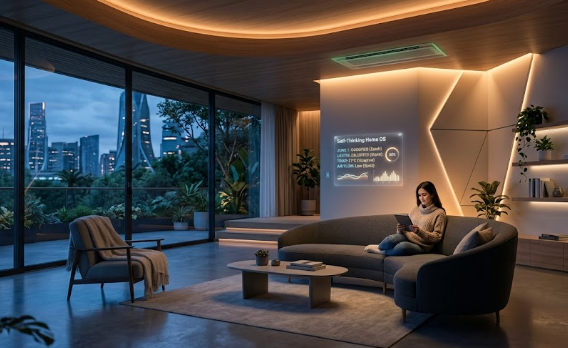
For years, we defined a smart home by how well it followed orders. You walked into a room, said a command, and waited for the lights to flicker on. However, as of May 2026, the industry has shifted toward the Self-Thinking Home. This new era moves away from reactive voice commands and toward “Intent-Based Control.” Instead of you managing the house, the house manages itself by learning your habits and anticipating your next move.
The End of the Fragmented App Experience
In the past, owning a smart home meant having a folder on your phone filled with twenty different apps. You had one app for the lights, another for the heater, and a third for the security cameras. The Self-Thinking Home eliminates this clutter through unified operating systems like Yubii OS and ELAN OS.
These platforms create a “Human-Car-Home” ecosystem. This means your car tells your house you are five minutes away, and the house responds by opening the garage and brewing your coffee. Because one brain controls everything, you no longer need to flip between screens to get things done.
Occupancy Intelligence and Predictive Climate
We are seeing a massive shift from house-based settings to room-based intelligence. Modern AI hubs now use “Occupancy Intelligence” to track exactly who is in a room. A Self-Thinking Home recognizes that you prefer a cool 20°C while your partner might prefer 24°C.
For example, if you sit in the home office to work, the AI adjusts the lighting to a bright “focus” mode and sets the temperature to your historical preference. When you leave the room, the sensors detect the absence of motion and heat. Consequently, the system dims the lights and cuts the airflow to save energy without you touching a single button.
The AI Energy Broker: Saving Money Automatically
One of the most impressive features of the Self-Thinking Home in 2026 is its financial intelligence. Most modern homes now connect directly to dynamic energy grids where electricity prices change hourly. Your home now acts as an AI Energy Broker.
Instead of running the dishwasher right after dinner when rates are high, the AI waits until 2:00 AM when electricity is cheapest. It also manages your home battery storage, charging it when the sun is bright or rates are low. This automation ensures your home runs at the highest efficiency while keeping your utility bills at an absolute minimum.
Increasing Your Property Resale Value
If you are a homeowner or a developer, these upgrades are more than just fancy gadgets; they are solid investments. Recent market reports show that a Self-Thinking Home can see a 15% boost in valuation compared to traditional “dumb” homes.
Buyers in 2026 actively look for integrated AI systems that offer security, comfort, and energy savings. They see these homes as “future-proofed” assets. Therefore, investing in predictive AI technology today ensures that your property remains competitive and highly desirable in the real estate market for years to come.
References
- Smart Home Technology Trends 2026 Report.
- International Journal of Ambient Intelligence and Humanized Computing.
- Real Estate Valuation Standards for AI-Integrated Properties.
To learn more about the latest updates in smart technology, visit The Verge for in-depth tech reviews and industry news.