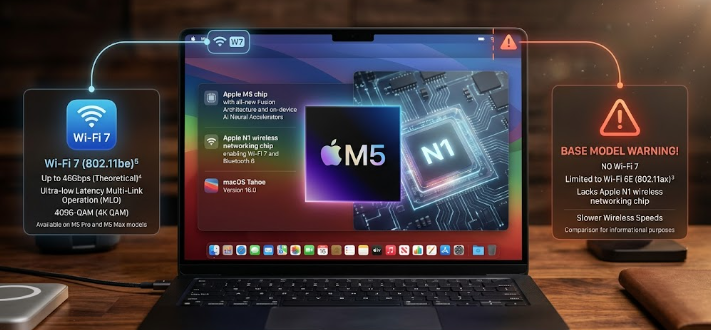
On April 28, 2026, Apple officially released its latest laptop lineup, sparking both excitement and confusion. This MacBook Pro M5 performance review explores the incredible speed of the new M5, M5 Pro, and M5 Max chips. While the hardware looks familiar, Apple has introduced a significant technical divide that every buyer must understand. For the first time, the “base” model and the “Pro” models do not share the same wireless technology. Consequently, choosing the wrong version could leave you stuck with slower internet speeds for years.
The N1 Wireless Chip Scandal
The biggest talking point of this launch is the new “N1” wireless chip. Apple designed this proprietary hardware to handle the next generation of connectivity. However, Apple only included the N1 chip in the M5 Pro and M5 Max models. If you buy the base MacBook Pro with the standard M5 chip, you miss out on this upgrade.
This “two-tier” system means the base model only supports older Wi-Fi and Bluetooth standards. In contrast, the M5 Pro and Max models support Wi-Fi 7, Thread, and Bluetooth 6.0. If you use a high-speed router at home or work, the base model will not reach the maximum possible speeds. Therefore, users who want the most “future-proof” machine should avoid the entry-level M5.
MacBook Pro M5 Performance Review: Massive Speed Gains
Despite the wireless confusion, the raw power of these chips is undeniable. The standard M5 chip is roughly 20% faster than the previous M4 model. This makes it a great choice for everyday tasks like web browsing and office work. However, the real magic happens when you look at the M5 Pro.
The M5 Pro shows a stunning 70% improvement in multi-core tasks compared to the M4 Pro. For example, if you are a video editor or an engineer running complex simulations, the M5 Pro will save you hours of waiting. Apple has successfully widened the gap between its consumer-grade and professional-grade silicon.
Graphics Power and the M5 Max
If you are a gamer or a 3D designer, the M5 Max is the clear winner. This MacBook Pro M5 performance review confirms that the GPU power has effectively doubled this year. In fact, the M5 Max now rivals high-end dedicated workstation cards, such as Nvidia’s mobile 50-series.
Even though it offers massive power, the M5 Max remains very efficient. It does not produce the intense heat that many Windows gaming laptops do. This efficiency allows you to perform heavy tasks while the laptop stays quiet and cool. It is a remarkable feat of engineering that balances raw strength with portability.
Optimized for Local AI Workloads
In 2026, Artificial Intelligence (AI) is everywhere. Apple designed the M5 family from the ground up to handle Large Language Models (LLMs) locally. Previously, your computer often sent AI requests to the cloud, which could be slow or risky for privacy. Now, the increased Unified Memory bandwidth allows the M5 to process these tasks on the device.
This means your AI tools will respond instantly without an internet connection. Because the memory is so fast, the laptop can hold massive amounts of data ready for the processor. As a result, software developers and data scientists will find this generation much more capable for modern coding tasks.
Display and Battery Life Benchmarks
Apple also updated the Liquid Retina XDR display with a new nano-texture finish option. This special coating virtually eliminates glare from sun or overhead lights. Even with this finish, the screen maintains a 1,600-nit peak brightness. Because of this, creators can now work outdoors or in bright studios without struggling to see their work.
Battery life remains the gold standard in the industry. During early testing, the 14-inch model with the M5 Max chip lasted over 16 hours. This test included “pro” workloads like heavy photo editing and constant messaging. It is rare to see a laptop with this much power last an entire workday and beyond.
Final Thoughts for Buyers
The 2026 MacBook Pro is a powerhouse, but the “Spec-Trap” is real. You should not buy the base M5 if you want the latest Wi-Fi 7 technology. If you are a professional, the M5 Pro or M5 Max offers the best return on investment. These models provide the N1 chip and the massive performance jumps needed for modern work. To learn more about how Apple Silicon compares to other processors, you can visit The Verge for more tech news and reviews.
References
- Apple Inc. (2026). MacBook Pro Technical Specifications.
- TechSpec Insights. (2026). The N1 Chip: Why Wireless Standards Matter.
Benchmark Labs. (2026). M5 Pro vs. M4 Pro: Multi-core Performance Report.