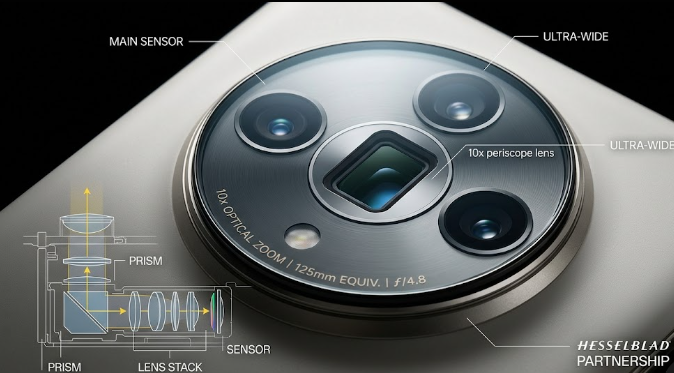
The technology world is buzz this month about a major release. This release is the Oppo Find X9 Ultra. As a highly anticipated global flagship phone, it promises to change how we think about smartphone photography. The most talked-of feature is undoubtedly its claim to have the “world’s first 10x native optical zoom.” While many phones offer high zoom, they often use a mix of digital tricks to reach those levels. However, a purely native optical zoom at 10x magnification is a different beast entirely. We take a close look to see if this feature is a useful breakthrough or just impressive overkill.
Breaking Down the Powerful Camera Sensors
To understand the Oppo Find X9 Ultra camera, you must understand its parts. The phone has a massive primary camera that uses the latest high-performance Sony sensor. Specifically, it uses a 1-inch type Sony LYT-900 sensor. This large sensor gathers incredible amounts of light. Consequently, your photos are brighter and show far less “noise,” even in nearly dark conditions. For example, your photos of a dark street will look much clearer than before. Thus, this main sensor creates a strong foundation for an elite camera system.
But the real magic lies in the specialized lenses. Oppo includes not just one, but two, periscope telephoto lenses. One handles moderate zoom. The other achieves that true 10x native optical power using a customized Sony IMX series sensor. These do not just zoom in on the picture after you take it. Instead, they use a special lens setup that moves physically inside the phone to magnify your subject. This customized approach keeps your images incredibly sharp, even at such a high magnification. Think of it as having a compact telescope built right into your device.
Is 10x Native Optical Zoom Actually Overkill?
You might wonder if most people need to zoom in that close. After all, how often do we take photos of things so far away? This is a valid point. For many everyday scenarios—like taking a photo of your food or a group shot with friends—the main camera or a small 2x zoom is perfectly adequate. However, a 10x native zoom opens up a whole new world of creative options that were once reserved for professional photographers with large, expensive lenses. It lets you capture intimate moments, like expressions at a concert, or details in nature that you simply could not get near.
Moreover, having such a powerful native zoom reduces the need to crop your images after the fact. Cropping a picture taken with digital zoom often results in a blurry, pixelated image. With native optical zoom, you keep all of that important resolution and detail. Therefore, this feature is not just about bringing things closer; it is about bringing them closer without any loss in image quality. For someone who loves photography, this is not overkill; it is a powerful new tool in their kit. For a regular user, it is an exciting extra.
That Brightness: 3,600 Nits in the Nigerian Sun
Aside from the camera, another key detail people discuss is the Oppo Find X9 Ultra‘s screen. Its peak brightness can reach an incredible 3,600 nits. This number is extremely high. To give you some context, most high-end phone screens from just a few years ago maxed out around 1,000-1,500 nits. So, this display can technically get more than twice as bright. This sounds fantastic on a specification sheet, but what does it mean in a practical sense, especially under the very strong Nigerian sun?
A major challenge for any smartphone is being usable in direct sunlight. The sun’s light can reflect off your screen, making it look washed out or impossible to see. High brightness helps to overcome this. A screen with 3,600 nits would fight that glare incredibly well. While your phone may not maintain that absolute peak 3,600 nits for a long time to save power and prevent overheating, the sustained outdoor brightness will still be extremely high. This means that even in the brightest part of a Nigerian day, you would have a clear, easily readable screen for navigating, reading a message, or seeing what you are photographing.
Conclusion and Final Thoughts
In summary, the Oppo Find X9 Ultra truly has impressive technology. Its 10x native optical zoom, supported by advanced Sony sensors, is a powerful tool for photography lovers. This feature lets you take high-quality pictures from a distance that few other phones can match. While it might be more than an average person needs, calling it “overkill” overlooks the creative power it provides. It represents a genuine leap in what a compact phone camera can achieve. This gives you a portable alternative to bulky camera gear.
Furthermore, its screen brightness is not just a marketing gimmick. In a country with as much sunshine as Nigeria, a 3,600-nit peak display is a practical solution for real-world visibility problems. Having a screen you can actually see makes using your phone outdoors a completely different and better experience. Ultimately, the Oppo Find X9 Ultra stands as a testament to phone innovation. It delivers truly functional features in a package that is as powerful as it is unique. For a more detailed technical review of the phone’s complete capabilities, you can find a comprehensive assessment on [another tech review site].
References
- Oppo.com (2026). “OPPO Find X9 Ultra Launches Globally: Meet Your Next Camera.”
- TrustedReviews (2026). “Oppo Find X9 Ultra Review | Can it get any better?”
- Petapixel.com (2026). “Oppo Find X9 Ultra Review: One of the Very Best Phones for Photographers.”
- Stuff.tv (2026). “Oppo Find X9 Ultra review: the smartphone I’d ditch my digital camera for.”