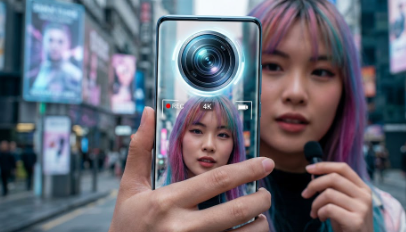
For over a decade, smartphone brands fought a fierce war over rear cameras. They competed to see who could offer the most megapixels or the longest zoom. However, by May 2026, the market has shifted its focus entirely. The 50MP “Oversized Selfie Lens” is now the most important feature for the modern buyer. This change reflects the booming “Creator Economy,” where users care more about how they look on screen than how far they can zoom into a building.
The launch of the OPPO F33 Pro highlights this massive trend. Instead of a tiny “hole-punch” dot, the phone features a professional-grade sensor on the front. This hardware allows for 4K video recording at 60 frames per second. Consequently, creators no longer need to turn their phones around to use the rear camera for high-quality vlogs. They can see themselves clearly while filming with professional clarity.
Why the 50MP “Oversized Selfie Lens” Changes Everything
Traditionally, front cameras used small 8MP or 12MP sensors. These tiny sensors often produced “noisy” or grainy images in low light. In contrast, the 50MP “Oversized Selfie Lens” uses a large-format sensor. This larger size captures significantly more light. Because it captures more data, the phone can create a “natural bokeh” effect. This means the background blurs softly while your face stays sharp, mimicking an expensive mirrorless camera.
Furthermore, this high resolution allows for “digital cropping” without losing quality. If you want a tighter shot of your face during a live stream, the software can zoom in easily. The image remains crisp because the sensor has so many pixels to work with. Therefore, the 50MP “Oversized Selfie Lens” provides a level of versatility that previous front cameras simply could not match.
Keeping Cool with Micro-Pump Liquid Cooling
Recording high-resolution 4K video generates a massive amount of heat. Since the 50MP “Oversized Selfie Lens” sits near the processor and the screen, thermal management is a challenge. To solve this, the Infinix GT 50 Pro has introduced a brilliant hardware solution. It uses an internal micro-pump liquid cooling loop. This system specifically targets the top half of the device to move heat away from the camera and the chipset.
This cooling technology ensures that the phone does not throttle or slow down during a long recording session. For example, if you are live-streaming a tutorial for an hour, the micro-pumps keep the temperature stable. Without this cooling, the high-res sensor would likely overheat and shut down the app. Consequently, manufacturers are prioritizing thermal engineering just as much as lens quality in 2026.
AI Beauty 3.0: From Filters to Studio Lighting
In the past, “beauty modes” simply smoothed out skin and made faces look like plastic. However, the 2026 version of AI Beauty 3.0 focuses on physics rather than just filters. When you use the 50MP “Oversized Selfie Lens,” the AI maps your face in 3D. It then applies “virtual 3-point studio lighting” in real-time. This means the software adds highlights and shadows to your face as if you were standing in a professional studio.
Specifically, the AI identifies where the light should hit your forehead, cheeks, and chin. It corrects harsh shadows caused by overhead room lights. In addition, it can change the “color temperature” of your skin to make you look healthy even if you are in a dark room. This technology makes every video call and vlog look like a high-budget production without requiring extra equipment.
Smooth Footage with Front-Facing OIS
One of the biggest upgrades this year is the inclusion of Optical Image Stabilization (OIS) on front cameras. In previous years, OIS was a luxury found only on rear lenses. Now, mid-range and flagship phones include it for the 50MP “Oversized Selfie Lens.” OIS uses tiny motors to physically move the lens to compensate for hand shakes.
This hardware feature is essential for vlogging while walking. Instead of shaky, dizzying footage, the OIS keeps the frame steady and smooth. For instance, a travel vlogger walking through a busy market can now record stable video using just their hand. When you combine OIS with the high pixel count, the result is cinema-quality footage from a device that fits in your pocket.
The era of ignoring the front camera has finally ended. Manufacturers now realize that for most users, the “selfie” side is the primary camera. By focusing on the 50MP “Oversized Selfie Lens,” brands like OPPO and Infinix are giving creators exactly what they need to succeed. To learn more about the latest mobile hardware trends, you can read this detailed analysis on smartphone sensor evolution.
References
Mobile Imaging Journal: The Impact of OIS on Front-Facing Video Quality (2026 Edition).
Global Tech Trends Report 2026: The Rise of the Front-Facing Sensor.
Infinix Mobile: Engineering the GT 50 Pro Thermal Systems.
OPPO Newsroom: Revolutionizing the F-Series with 50MP Optics.