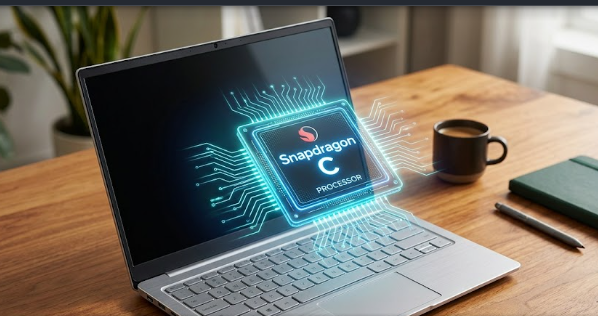
The laptop market is facing a massive shakeup that could change budget computing forever. Tech giant Qualcomm recently unveiled its brand-new processor lineup during pre-Computex press briefings. Instead of making scaled-down versions of its premium PC processors, the company is doing something brilliant. They are repurposing their phone-first Kryo chip layout to create Snapdragon C chips for entry-level Windows laptops. This clever engineering shift specifically targets the $300 to $500 price range, directly threatening low-cost Chromebooks and budget Intel Core i3 systems.
The Phone-to-PC Architecture Swap
To understand this breakthrough, we must look at how engineers build these processors. Usually, manufacturers design laptop chips from scratch, which costs a lot of money. However, Qualcomm is saving money by optimizing mobile phone silicon configurations for a much larger laptop chassis.
Because they use this existing mobile layout, factories can mass-produce these processors at a fraction of the cost of standard laptop silicon. This smart swap allows manufacturers to build incredibly cheap laptops without sacrificing basic quality. Furthermore, the larger laptop body gives the phone-based hardware plenty of room to breathe, maintaining extreme thermal efficiency.
Crushing the Competition with a 20-Hour Battery Baseline
One of the biggest complaints about cheap laptops is their terrible battery life. Luckily, Snapdragon C chips completely solve this issue because mobile chips inherently run on much lower wattages than traditional PC chips.
As a result, new ultra-budget devices are hitting a staggering 20+ hours of continuous local video playback. Manufacturers can now design thin, completely fanless laptops that run silently all day long. You can leave your charger at home, which gives these budget Windows PCs a massive advantage over power-hungry Intel alternatives.
Bringing Advanced Copilot+ AI to Budget Devices
You might think a $300 laptop would miss out on modern artificial intelligence features. Surprisingly, Qualcomm has included high-end tech inside these affordable processors. Each chip houses an integrated Neural Processing Unit (NPU) that is capable of over 40 Trillions of Operations Per Second (TOPS).
Consequently, this budget hardware fulfills the strict baseline required to run local Microsoft Copilot+ AI features. Users can enjoy advanced AI tools, live captions, and smart search features on a sub-$400 laptop. This marks the first time that premium AI capabilities have dropped into the ultra-budget price bracket.
Understanding the Emulation Penalty vs. Native Apps
Before you rush out to buy one, you should understand how software runs on this mobile-first tier. Native Arm-compiled apps, such as Google Chrome, Microsoft Edge, and Microsoft Office, will run instantly and smoothly.
On the other hand, legacy 64-bit Windows software must run through built-in translation layers. This emulation penalty slightly degrades raw performance metrics because the laptop has to work harder to translate the code. Therefore, this budget tier is perfect for web browsing, schoolwork, and office tasks, but it will struggle with older, heavy PC games and legacy apps.
Final Thoughts on the Future of Budget PCs
Qualcomm is successfully weaponizing mobile silicon to redefine what a cheap computer can do. By placing Snapdragon C chips into entry-level frames, they are offering incredible battery life and modern AI at an unmatched price point. This shift will force competitors to innovate quickly if they want to survive in the budget market. If you want to learn more about how mobile chips are changing the PC industry, you can read this detailed analysis on The Verge.
References
- Qualcomm Pre-Computex Press Briefings (2024).
- Microsoft Copilot+ Hardware Requirements Documentation.
- Benchmarks on Arm-based Windows Emulation Layers.