The computer hardware industry advances rapidly, and the jump to new data speeds naturally brings new challenges. Today, PC builders and enterprise experts closely watch the transition to next-generation components. One massive hurdle stands in the way of achieving perfect 64 GT/s speeds. Engineers call this specific problem PCIe Gen 6.0 clock jitter. When you upgrade your system, you rightfully expect flawless performance. However, microscopic timing errors can easily ruin data transmission. Therefore, understanding this concept helps you make much smarter choices when buying premium hardware.
The Tolerance Shrink of PCIe Gen 6.0 Clock Jitter
Previous generations of PCIe used simple signaling methods. Now, the new standard doubles data rates to an incredible 64 GT/s per lane. To achieve this, the architecture uses a technology called PAM4 signaling. PAM4 essentially packs more data into every electrical signal, but it severely shrinks the acceptable timing margin. Consequently, the system leaves almost no room for error. If the timing shifts even slightly, the entire connection destabilizes.
Because of this shrinking margin, the system clock must run flawlessly at all times. In fact, the acceptable PCIe Gen 6.0 clock jitter has dropped below 100 femtoseconds (fs). For context, one femtosecond equals one-quadrillionth of a second. Imagine a musician playing alongside a mechanical metronome. If the metronome ticks inconsistently, the musician misses the beat. Similarly, if your motherboard clock ticks inconsistently, the processor drops the data.
How RMS Metrics Measure PCIe Gen 6.0 Clock Jitter
To track these incredibly tiny errors, hardware engineers use Root-Mean-Square (RMS) metrics. RMS jitter calculates the average deviation of the clock signal over time. A motherboard clock generator sends millions of electrical pulses every single second. Ideally, each pulse should land at the exact right microsecond. Unfortunately, real-world electronics always experience microscopic variations in pulse timing. These variations directly represent the actual jitter in the system.
Furthermore, high RMS jitter creates devastating consequences for high-speed data transfer. When the timing shifts too much, fast-moving data packets literally crash into each other. This physical overlap scrambles the digital information completely. As a result, the motherboard triggers severe cyclic redundancy check (CRC) errors. CRC errors force the hardware to resend the exact same data, which immediately kills your performance and ruins the benefit of the 64 GT/s speed.
Fighting PCIe Gen 6.0 Clock Jitter with Premium Components
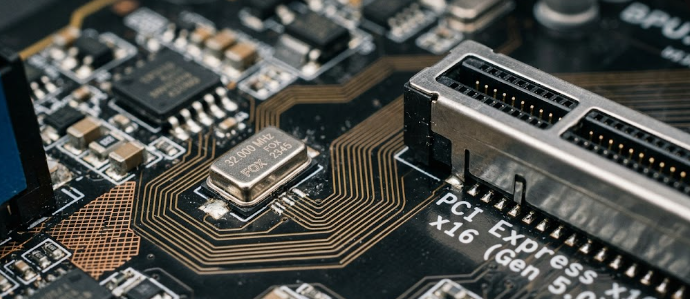
Naturally, this strict specification drastically changes how manufacturers build modern motherboards. You simply cannot achieve a stable 64 GT/s connection with cheap, basic parts. To conquer PCIe Gen 6.0 clock jitter, motherboard brands must adopt premium component requirements. First, they install highly specialized, low-jitter crystal oscillators. These expensive oscillators maintain the perfect, steady heartbeat needed for PAM4 signaling.
Additionally, manufacturers must completely upgrade the physical circuit boards. Standard boards often interfere with high-speed signals. Therefore, premium brands now use server-grade, low-loss printed circuit boards (PCBs). These advanced PCBs protect the fragile data from background electrical noise. Ultimately, extreme overclockers and builders must pay close attention to these components. Buying a cheap motherboard will severely throttle your next-gen graphics cards and storage drives.
In summary, pushing consumer hardware to 64 GT/s requires incredible electronic precision. You must understand PCIe Gen 6.0 clock jitter to truly appreciate the engineering behind next-generation motherboards. As you prepare your next extreme PC build, always verify the quality of the clock generators and the PCB material. For more detailed technical insights on PCIe architecture and electrical testing, you can read further on the PCI-SIG official website.
References
- PCI-SIG. “PCI Express 6.0 Specification.” PCI-SIG Publications, 2022.
- Tektronix. “Understanding and Characterizing Timing Jitter.” Tektronix Technical Brief.
- Keysight Technologies. “PAM4 Signaling in High-Speed Digital Systems.” Keysight Hardware Engineering Papers.