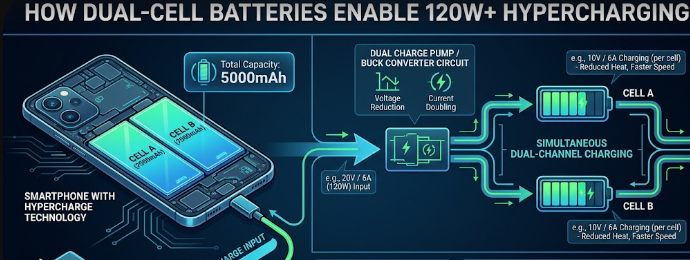
Smartphone charging speeds have increased rapidly over the last few years. If you are comparing mobile tech metrics on 2026 flagship devices, you have likely seen terms like 120W or 150W HyperCharging. Many users wonder how premium phones handle this massive power without exploding or degrading. The secret lies in an innovative engineering setup inside the phone. Manufacturers no longer use traditional single-cell power packs to achieve these speeds. Instead, modern flagships rely on Dual-Cell Smartphone Batteries to safely rewrite the rules of mobile power delivery.
Splitting the Voltage: The Core Engineering Specification
To understand why traditional setups fail at ultra-fast speeds, we must look at how electricity moves. Pushing 120W of power into a single battery cell creates massive electrical resistance. High resistance always generates extreme heat, which damages lithium-ion cells very quickly. Therefore, engineers had to redesign the internal architecture of modern mobile devices.
Instead of using one large, single block, manufacturers now split the battery into two physically separate sections. These two parts connect in a series circuit inside the phone chassis. This series connection changes how the phone handles the incoming electrical force. By utilizing Dual-Cell Smartphone Batteries, the device can split the overall voltage requirement across two paths. This design choice prevents a single cell from taking the entire workload alone.
The Physics of Series Connections
When you connect two power cells in a series, the total voltage doubles while the current remains steady. A standard single smartphone cell usually maxes out at a charging voltage of about 4.45V. If you attempt to force 120W into that single cell, the electrical current must be extremely high.
High current requires thick internal wires and creates an unbearable thermal load for a thin mobile device. Splitting the battery into two separate pieces instantly solves this physical limitation. The system treats the dual cells as a single high-voltage system during the initial power intake stage. As a result, the phone can accept much higher power inputs from the wall adapter safely.
Charge Pump Math: How 120W and 150W Delivery Works
The magic of hyper-fast charging requires perfect cooperation between your wall charger and your phone. A 120W hyper-charger does not just blindly dump raw electricity into your device. Instead, it sends electricity at a very specific high-voltage and low-current ratio. For example, a 120W wall brick typically outputs 20 volts (V) at 6 amperes (A).
20V × 6A = 120W (Total Output Power)
If 20V entered a standard phone battery directly, it would instantly destroy the delicate internal components. This is where specialized internal microchips, known as charge pumps, come into play. These advanced silicon chips act as highly efficient DC-to-DC voltage converters inside your handset.
Breaking Down the Internal Math
When the 20V at 6A current enters the phone, the internal charge pumps instantly alter the electrical metrics. The charge pumps utilize a specific 2:1 step-down ratio to alter the incoming power safely. This means the chips cut the incoming voltage precisely in half while keeping the current stable.
20V / 2 = 10V (Voltage after Charge Pump step-down)
Consequently, the power transforms from 20V at 6A down to a much safer 10V at 6A. Because the Dual-Cell Smartphone Batteries are connected in a series, this 10V stream distributes evenly. Each individual cell receives exactly 5V at 6A simultaneously.
Cell 1: 5V × 6A = 30W
Cell 2: 5V × 6A = 30W
Total Combined System Power = 60W per charge pump channel (doubled via dual channels to 120W)
This clever mathematical distribution allows both cells to fill up at the exact same time. The phone achieves extreme speeds because it charges two separate tanks at a safe, moderate pace.
Thermal and Degradation Specs: Beating the Heat
Heat is the ultimate enemy of battery health and long-term capacity retention. When a phone gets too hot during a charging session, the operating system triggers thermal throttling. Throttling forces the charging speed to drop drastically to let the device cool down.
Traditional single-cell phones throttle very early in the charging cycle because they heat up so quickly. Utilizing Dual-Cell Smartphone Batteries minimizes this internal resistance significantly. Lower resistance means the device generates far less thermal waste during high-wattage transfers.
Maintaining Peak specified Wattage
Because the dual-cell design keeps temperatures low, your phone can sustain peak wattage for much longer periods. Instead of throttling down after just two minutes, 2026 flagships can hold high speeds deep into the charging cycle.
Furthermore, minor design tweaks like Multiple Tab Winding (MTW) reduce internal resistance even more by shortening the path electricity travels. This means you can charge from zero to 100% in under twenty minutes without cooking the motherboard.
Long-Term Battery Health and Lifespan
Many buyers worry that 120W HyperCharging will ruin their battery health within a single year of use. Thankfully, the dual-cell configuration protects the lifespan of your device. Because each cell only experiences a fraction of the total stress, degradation slows down.
Most modern flagship devices using this tech retain up to 80% of their original capacity after 800 full cycles. This longevity matches or exceeds older, slower charging standards. You get the benefit of ultra-fast speeds without sacrificing the long-term usability of your premium smartphone. For a deeper technical dive into how advanced battery chemistries handle rapid power transfers, you can read the comprehensive Android Central Battery Technology Guide.
References
- ChargerLAB. (2023). Single-Cell vs. Dual-Cell Batteries: What’s the Difference? * Halo Microelectronics. (2022). Powering Smartphones with 2:1 Charge Pump Direct Charger IC. * Xiaomi Global. (2021). How Does 120W Xiaomi HyperCharge Work? Inside the Technology.