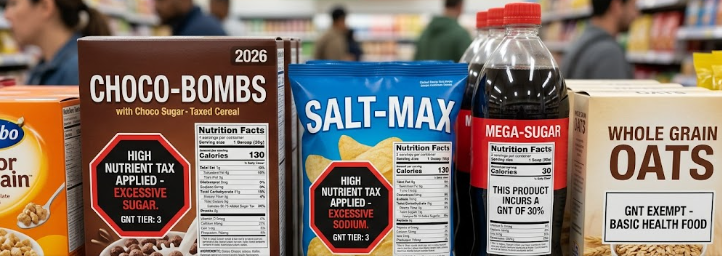
Have you noticed that your favorite snacks taste slightly different lately? This change is not an accident. Right now, governments around the world are passing strict new health laws to fight obesity and diabetes. Because of 2026 global nutrient taxes, major food companies are racing to change their recipes overnight.
Consequently, manufacturers must act quickly. The World Health Organization (WHO) has set tough guidelines targeting high fat, salt, and sugar (HFSS) foods. If a company’s product contains too much sugar or salt, the government hits it with a heavy tax. Therefore, to avoid these penalties and keep prices low, food scientists are quietly rewriting the chemical rules of our pantry staples.
The Economic Impact of 2026 Global Nutrient Taxes
In the past, making healthier food was just a marketing choice for fitness brands. Today, however, avoiding health penalties is a matter of corporate economic survival. New front-of-pack labels now grade foods based on how healthy they are. If a product gets a bad grade, sales drop immediately because shoppers see a bright warning label on the box.
For example, consider a popular brand of potato chips or breakfast cereal. If the manufacturer does not reduce the sodium or sugar content, the new health-tax laws will make the product much more expensive. As a result, brands are forced to strip out bad ingredients. They are doing this because 2026 global nutrient taxes make original recipes too costly to sell.
Invisible Innovations and New Salt Substitutes
Reducing salt is a massive challenge for food scientists because salt does more than just add flavor. It also preserves packaged food and improves its texture. Previously, companies used potassium chloride as a basic salt replacement. However, this substitute left a bitter, metallic aftertaste that consumers absolutely hated.
To solve this problem under the pressure of 2026 global nutrient taxes, food scientists are turning to invisible biotech innovations. Instead of simple chemical replacements, they now use specialized yeast extracts and botanical flavor modifiers. For instance, these natural compounds trick your tongue’s taste receptors. They fool your brain into experiencing a rich, savory mouthfeel without actually raising your blood pressure.
Precision Enzyme Engineering Tackles Sugar
Sugar is another major target for global health regulators. Food laboratories cannot just remove sugar because it provides essential structure and volume to baked goods. Instead, they are using a high-tech process called precision enzyme engineering to transform carbohydrates.
During this process, scientists use optimized enzymes to rearrange the chemical bonds inside packaged goods. For example, they can turn simple sugars into complex fibers right inside a loaf of bread. This biotransformation maintains the exact sweetness and texture that you expect. Nevertheless, it radically reduces the glycemic load, meaning it will not spike your blood sugar. This clever science allows brands to escape the heavy penalties linked to 2026 global nutrient taxes.
The Processing Paradox and Consumer Pushback
Even though these scientific breakthroughs help companies dodge the HFSS tags, they are creating a new problem. A growing group of health-conscious shoppers is pushing back against these highly engineered ingredients. This reaction is known as the “processing paradox.”
While people want less sugar and salt, they also want clean, natural labels. They do not want to eat foods filled with lab-grown enzymes and altered yeast extracts. Consequently, instead of buying chemically modified packaged goods, many consumers are turning back to minimally processed, whole ancestral staples like oats, quinoa, and raw nuts. They feel that escaping 2026 global nutrient taxes by using heavy laboratory science defeats the purpose of healthy eating.
Ultimately, the way our food is made is shifting faster than ever before. While these laboratory tricks help companies avoid warning labels, you must decide if you want to eat chemically altered foods. To stay truly healthy, it might be wiser to choose whole foods that remain untouched by corporate science. For a deeper look into how modern dietary regulations are shaping global markets, you can read more about health policies on the World Health Organization website to understand how 2026 global nutrient taxes will continue to shape our grocery stores.
References
- World Health Organization. (2025). Global Action Plan for the Prevention and Control of Noncommunicable Diseases. WHO Guidelines.
- Food Research & Action Center. (2026). The Impact of HFSS Taxes on Consumer Buying Habits and Food Reformulation. Journal of Food Policy, 14(2), 112-125.
- Biotech Food Labs International. (2026). Enzyme Engineering and Sodium Substitutes in Modern Food Production. Tech Science Quarterly, 39(1), 45-53.