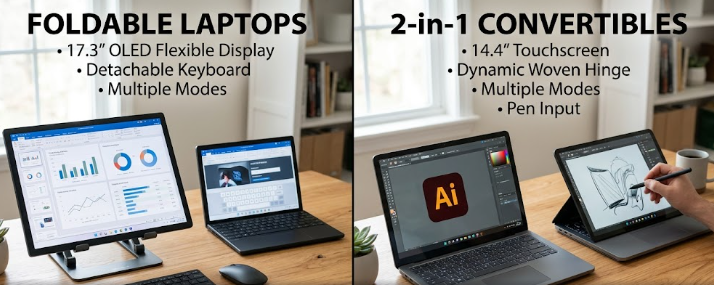
Are you searching for the perfect portable workstation? The tech world constantly evolves, offering incredible new tools for early adopters and productivity-focused users. Right now, a major debate dominates the market: foldable laptops vs 2-in-1 convertibles. Choosing between these two innovative designs can feel overwhelming. However, understanding their specific features will help you make a smart investment. In this article, we will break down a spec-by-spec comparison to guide your final decision. Therefore, you can quickly choose the device that perfectly matches your daily workflow.
Display Tech and Durability in Foldable Laptops vs 2-in-1 Convertibles
First, let us examine display technology. Manufacturers build foldable laptops with flexible OLED screens. These stunning displays fold completely in half, giving you a massive screen in a compact footprint. Conversely, 2-in-1 convertibles use traditional glass screens, usually featuring IPS or OLED touchscreen panels. While foldables offer a futuristic, seamless look, durability remains a valid concern for many buyers. Specifically, laptop makers test foldable hinges vigorously, often rating them for up to 300,000 folds. For instance, if you fold your device 50 times a day, the hinge should easily last over 16 years. On the other hand, the rigid glass on a 2-in-1 convertible provides better protection against scratches and daily bumps.
Weight and Thickness Differences
Next, we must compare the physical dimensions. Portability heavily influences the debate between foldable laptops vs 2-in-1 convertibles. When unfolded, a foldable laptop boasts incredible thinness, often measuring a mere 8 mm thick. However, when you fold it shut, the thickness instantly doubles to around 16 mm or more. Furthermore, foldables generally weigh less as standalone screens, often dropping below 1.5 kg (3.3 lbs). In contrast, standard 2-in-1 convertibles maintain a consistent thickness, usually around 14 mm to 16 mm. Because convertibles carry a permanently attached metal keyboard base, they typically weigh slightly more, averaging between 1.3 kg and 1.8 kg. Consequently, if you want a massive screen that fits in a small bag, foldables win.
Keyboard Solutions and Battery Specs
Additionally, the typing experience sharply divides these two categories. 2-in-1 convertibles feature integrated, 360-degree hinge keyboards. You simply flip the screen back to enter tablet mode, and the keyboard stays securely attached. This design provides a sturdy, traditional typing experience on your lap. Meanwhile, foldable laptops require a different approach. They rely on physical, attachable Bluetooth keyboards. Often, you place this thin keyboard over the bottom half of the folded screen. As a result, you must manage a separate battery for the Bluetooth keyboard. While these attachments charge magnetically, they still lack the firm rigidity of a classic laptop base. Therefore, if you type heavy documents on your lap, a 2-in-1 convertible might serve you better.
Port Selection for Foldable Laptops vs 2-in-1 Convertibles
Finally, we must look at port selection. Connectivity is crucial for any productivity-focused user. Unfortunately, foldable laptops often sacrifice I/O ports to achieve their ultra-thin, flexible designs. You will usually find just two USB-C ports on a foldable device. Therefore, you must carry external dongles to connect HDMI cables or older USB-A flash drives. Alternatively, 2-in-1 convertibles offer a much wider variety of ports. Because they feature a thicker, permanent base, manufacturers can easily include USB-A ports, HDMI slots, and SD card readers. Ultimately, if you despise carrying adapters, standard convertibles hold a significant advantage in this area.
In conclusion, both devices offer unique advantages for modern professionals. The choice ultimately depends on your specific workflow. If you want a massive OLED screen that shrinks into a tiny package, a foldable laptop is perfect. However, if you prioritize rigid keyboards, diverse ports, and glass screen durability, stick with a convertible. To explore more about the latest mobile computing trends and make an informed purchase, check out this comprehensive guide on laptop buying advice from PCMag.
References
- PCMag. (2025). The Best 2-in-1 Convertible and Hybrid Laptops.
- TechRadar. (2025). Foldable laptops: everything you need to know about the newest PC form factor.