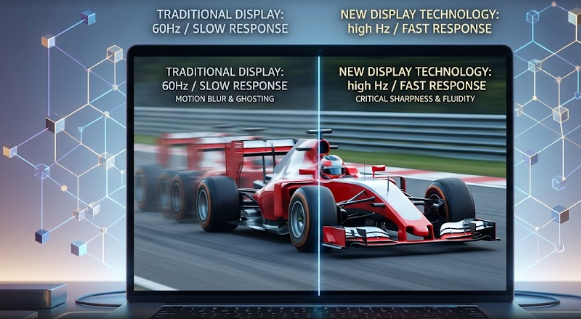
Display technology is changing faster than ever before. For years, laptop users had to choose between the fast speeds of older panels and the beautiful colors of premium screens. Now, a massive upgrade in hardware is coming to modern laptop displays. Major display manufacturers are moving away from older screen limitations to fix motion lag permanently. At the center of this big change is a new technology called Blue Phase Liquid Crystals. This innovation solves speed bottlenecks without causing the permanent screen damage known as burn-in. Therefore, it promises to completely change how we view our laptop screens.
Understanding Blue Phase Liquid Crystals and the Zero Alignment Layer
To understand this upgrade, we must first look at how standard screens work. Traditional liquid crystal displays (LCDs) require a physical rubbing process during manufacturing. Factory machines rub thin layers to create microscopic grooves, which align the liquid crystals in one direction. However, this mechanical process adds complexity and can cause production errors.
In contrast, Blue Phase Liquid Crystals use a completely different engineering design. Instead of straight lines, these crystals form a unique, three-dimensional cubic lattice structure. Because of this structure, the crystals are isotropic, meaning they look the same in all directions. Consequently, they respond directly to electric fields without needing any physical alignment layers. Engineers call this the “Zero Alignment” layer specification. As a result, tech factories can skip the complex rubbing step entirely, which cuts down manufacturing trouble and lowers production costs.
How Blue Phase Liquid Crystals Achieve Sub-Millisecond Response Times
The most exciting benefit for gamers and video editors is the incredible speed of this technology. Screen responsiveness matters because slow pixels create a trailing effect called ghosting. Traditional laptop panels often take several milliseconds to shift colors. Fortunately, displays using Blue Phase Liquid Crystals achieve an amazing switching speed of less than 0.5 milliseconds.
This sub-millisecond response time is up to ten times faster than legacy twisted nematic (TN) panels. Therefore, it completely removes annoying motion blur during fast-paced action. Whether you are playing a high-end PC game at a 240Hz refresh rate or watching a fast action movie, the image remains perfectly crisp. For example, when you spin your camera quickly in a game, the environment will stay sharp instead of turning into a muddy smear.
How Blue Phase Liquid Crystals Eliminate Color Filters
Beyond raw speed, this technology also changes how screens create colors. Standard displays use physical red, green, and blue filters over the pixels to show different hues. Unfortunately, these physical filters block a lot of light, which reduces the screen’s overall brightness and power efficiency.
Because Blue Phase Liquid Crystals switch position so quickly, they can use a method called field-sequential color (FSC). Instead of using permanent color filters, the display quickly flashes red, green, and blue backlights one after the other over time. Since human eyes combine these rapid flashes into a single image, we see full color without needing spatial filters. Consequently, this method instantly triples the display’s light efficiency and boosts the spatial resolution, making text and images look incredibly sharp.
Perfect Integration with Modern Mini-LED Backlights
Finally, this new panel technology works beautifully with other modern display features. Specifically, it pairs perfectly with Mini-LED backlighting systems. Manufacturers divide Mini-LED backgrounds into hundreds of small dimming zones to control light precisely.
When you combine the rapid switching speed of Blue Phase Liquid Crystals with local dimming zones, magic happens. The screen can turn off specific zones instantly to create deep black levels that rival expensive OLED panels. Meanwhile, the display can still maintain ultra-high peak brightness levels of over 2,000 nits. Thus, users get the best of both worlds: extreme contrast without any risk of permanent screen burn-in.
In conclusion, this hardware evolution will soon redefine high-performance laptops. By removing alignment layers, cutting down motion blur, and improving light efficiency, this tech sets a new standard for the industry. If you want to learn more about the engineering behind next-generation monitors and display standards, you can read detailed breakdowns on the VESA Official Website.
References
- Castellano, J. A. (2005). Liquid Gold: The Story of Liquid Crystal Displays and the Creation of an Industry. World Scientific.
- Chen, H. S., & Wu, S. T. (2014). Blue Phase Liquid Crystal Displays. Wiley.
- Society for Information Display (SID) Tech Papers on Field-Sequential Color Systems (2025).