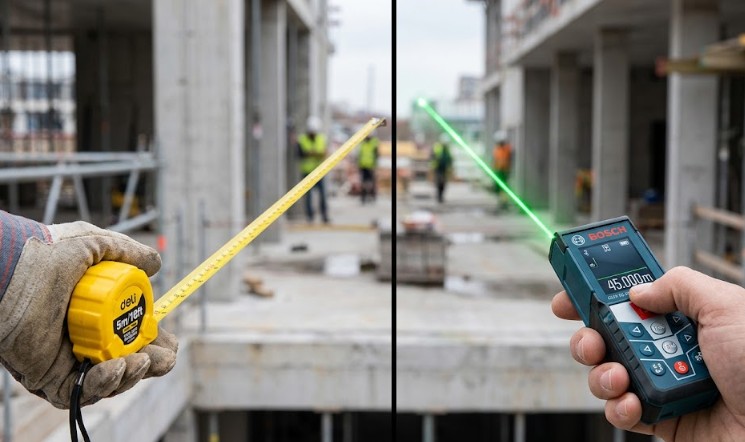
Laser Distance Measurers vs. Traditional Tapes
When comparing laser distance measurers vs traditional tapes, you must consider both speed and precision. A traditional tape measure is reliable for short distances, but it often sags over long spans. This sagging introduces small errors that can ruin a structural layout. In contrast, a laser measurer uses a light beam to calculate the distance to a target instantly.
In 2026, these digital tools provide accuracy that a manual tape simply cannot match over long distances. For instance, a high-quality laser device can measure a 100-meter span while you stand perfectly still. This capability eliminates the need for a second person to hold the other end of a tape.
Understanding Accuracy Specs and Margins
The most important specification to check is the accuracy margin. Most professional-grade lasers, like the Bosch GLM 50-27 CG, offer an accuracy of ±1.5mm. This means the measurement is almost always within a tiny fraction of the true distance. High-end models from Leica can even achieve an incredible accuracy of ±1.0mm.
In contrast, a traditional tape is subject to human error and environmental factors. For example, temperature changes can cause a steel tape to expand or contract slightly. Furthermore, reading a physical scale at an awkward angle often leads to “parallax error.” Laser measurers remove these risks by providing a clear digital reading on a backlit screen.
Bosch vs. Leica: Top Rated Models in 2026
If you are looking for the best tools, you will likely choose between Bosch and Leica. The Bosch GLM 150-27 C is a favorite for site engineers because it includes a digital viewfinder. This camera allows you to see exactly where your laser point is landing, even in bright sunlight. It also features a rugged IP65 rating to handle dust and rain.
Leica remains the “gold standard” with models like the Leica DISTO X6. This device uses Point-to-Point (P2P) technology, which allows you to measure the distance between two remote points from a single position. While Leica tools often cost more, their superior optics and build quality justify the investment for complex infrastructure projects.
Bluetooth Connectivity and Mobile Syncing
One of the biggest advantages of laser distance measurers vs traditional tapes is digital documentation. Most modern lasers feature Bluetooth connectivity that pairs with your smartphone. Bosch uses the MeasureOn app, while Leica offers the DISTO Plan app. These apps allow you to overlay measurements directly onto photos or floor plans.
Instead of writing dimensions on a piece of paper that might get lost, you can sync the data to the cloud instantly. This workflow ensures that your office team sees the site data the moment you take the measurement. Consequently, this reduces the time spent on manual data entry and prevents transcription errors.
Comparison Table: Laser vs. Traditional Tape
| Feature | Traditional Steel Tape | Laser Distance Measurer |
| Max Range | 5m – 30m | 50m – 250m+ |
| Typical Accuracy | ±2.0mm (Short range) | ±1.0mm to ±1.5mm |
| Operation | Usually needs 2 people | Solo operation |
| Data Storage | Manual note-taking | Bluetooth / Internal Memory |
| Durability | High (No batteries) | High (IP65/66 Ratings) |
Final Thoughts on Measuring Tools
Ultimately, the choice in the debate of laser distance measurers vs traditional tapes depends on the specific task. For measuring a small pipe diameter, a tape is still the quickest tool. However, for site layouts, room dimensions, and vertical heights, the laser is superior. Investing in a high-quality laser will save you hundreds of hours over a single construction season.
To explore the latest standards in construction measurement accuracy, you can visit the International Organization for Standardization (ISO).
References
- Bosch Professional. (2026). GLM Series User Manual and Technical Specifications.
- Leica Geosystems. (2026). Leica DISTO: The Power of P2P Technology.
- Engineering Surveying Journal. (2025). Comparing Digital vs Manual Measurement Errors in Large Scale Projects.
- NIST. (2025). Calibration Standards for Laser Distance Measurement Tools.