Malaria remains a widespread health challenge in many parts of the world, but understanding modern treatments for malaria helps patients recover quickly and safely. When a high fever strikes, many people immediately assume they have malaria. However, taking antimalarial drugs without proper medical testing can lead to wrong treatments, wasted money, and unwanted side effects.
Why Diagnostic Testing Precedes Modern Treatments for Malaria
First, medical professionals emphasize that you cannot diagnose malaria based on fever alone. Typhoid, dengue, and simple viral infections share almost identical early symptoms. Consequently, doctors must confirm the presence of malaria parasites in your bloodstream before prescribing any drugs.
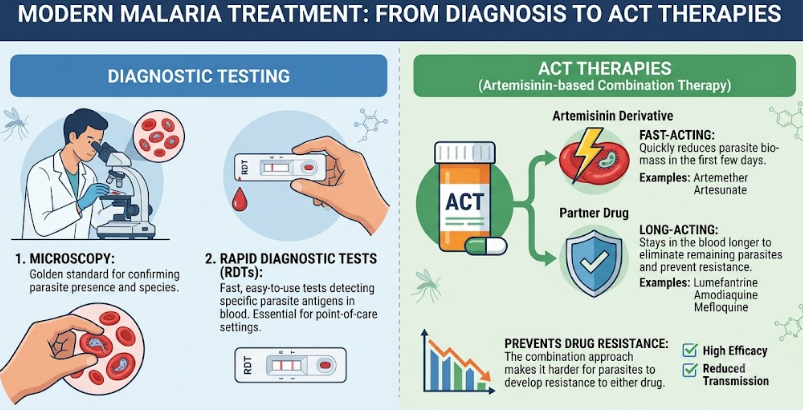
Healthcare workers rely on two primary diagnostic methods today:
- Rapid Diagnostic Tests (RDTs): These quick blood tests deliver results in roughly 15 minutes. They detect specific parasite proteins in a small drop of finger-prick blood. RDTs work exceptionally well in community clinics where full lab equipment is unavailable.
- Microscopic Blood Smears: Lab technicians stain a blood sample on a glass slide and examine it under a microscope. Furthermore, microscopy allows technicians to identify the exact parasite species and count how many red blood cells are infected.
Therefore, getting tested ensures that you receive the exact medication required for your specific condition.
Standard Modern Treatments for Malaria in Uncomplicated Cases
Once a test confirms uncomplicated malaria, doctors prescribe targeted oral medications. Uncomplicated malaria means you experience symptoms like fever, chills, and headaches, but your vital organs function normally.
Artemisinin-based Combination Therapies (ACTs)
Today, Artemisinin-based Combination Therapies (ACTs) serve as the gold standard recommendation from the World Health Organization (WHO), particularly for Plasmodium falciparum infections. ACTs combine two distinct active ingredients that attack parasites in different ways:
- The Artemisinin Component: This fast-acting drug rapidly clears the vast majority of parasites from your blood during the first few days.
- The Partner Drug: This slower-acting drug remains in your body longer to eliminate any remaining parasites.
For instance, common combinations like artemether-lumefantrine work together to destroy resistant parasites.
What About Older Drugs Like Chloroquine?
In the past, doctors widely prescribed single drugs like Chloroquine. However, malaria parasites gradually adapted and built strong resistance against Chloroquine across most regions. Today, medical guidelines reserve Chloroquine strictly for specific regions where delicate parasite species like Plasmodium vivax remain susceptible.
Hospital Care for Severe Malaria Cases
Occasionally, a malaria infection progresses to severe malaria. This emergency occurs when parasites block blood flow to vital organs, causing symptoms like breathing difficulty, severe anemia, persistent vomiting, or loss of consciousness.
Patients with severe malaria cannot absorb oral pills effectively. Consequently, doctors transition treatment to intravenous (IV) or intramuscular (IM) antimalarial medications inside a hospital setting. Healthcare teams typically inject IV artesunate immediately to rapidly reduce parasite levels. Once the patient stabilizes and can swallow, doctors transition them back to a standard oral ACT course to complete their recovery.
The Critical Rule: Completing Your Full Medication Dosage
Even when you start feeling energetic after two days, you must complete your full prescribed course of medication. Stopping treatment early leaves behind the strongest, most resilient parasites inside your body.
As a result, these surviving parasites multiply, causing a severe relapse that standard medications cannot easily cure. Furthermore, incomplete dosing accelerates drug resistance across entire communities. Always follow your doctor’s exact schedule to protect yourself and others.
For deeper insights into international treatment guidelines and global malaria prevention efforts, explore the official CDC Malaria Treatment Guidelines.
References
- World Health Organization. (2023). WHO guidelines for malaria. World Health Organization.
- Centers for Disease Control and Prevention. (2024). Treatment of Malaria: Guidelines for Clinicians. U.S. Department of Health and Human Services.
- White, N. J. (2019). Artemisinin-based combination therapies. The Lancet Infectious Diseases, 19(1), e23-e34.