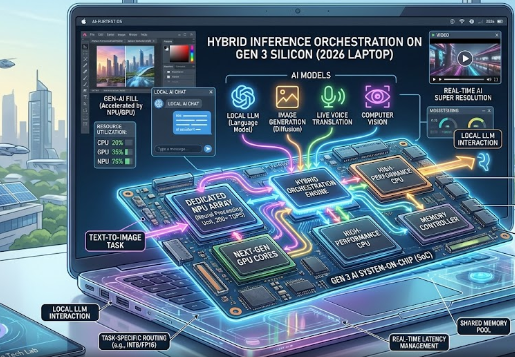
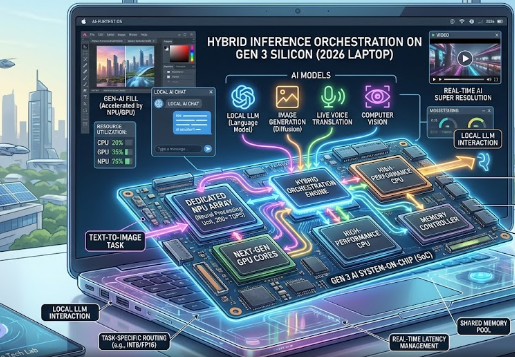
In 2026, laptops are no longer just simple computers. They are advanced local servers. Today, developers and tech enthusiasts talk constantly about Hybrid Inference Orchestration. This new technology completely changes how our devices handle Agentic AI. Previously, laptops struggled with complex tasks. Now, they manage them easily. Furthermore, this breakthrough ensures your private data stays safely on your machine.
The Infrastructure Problem with AI
First, we must understand the main infrastructure problem. Running complex, multi-step AI agents entirely in the cloud costs too much money. Additionally, it creates massive privacy risks for users. When you ask an AI to read your private emails, you certainly do not want that data leaving your device.
On the other hand, standard processors quickly buckle under continuous local reasoning tasks. They simply get too hot and drain your laptop battery rapidly. Consequently, the tech industry desperately needed a better solution to handle these heavy workloads efficiently.
Defining the Hybrid Inference Orchestration Spec
To solve this problem, engineers created a new architectural framework. They showcased this brilliant solution at Computex 2026. Experts officially call it the Hybrid Inference Orchestration spec.
For example, Perplexity recently demonstrated its hybrid local server engines running flawlessly on Intel Core Ultra and Arc Series 3 hardware. Essentially, this setup turns your laptop into a smart traffic controller. Instead of doing all the heavy lifting alone, the system smartly splits the work. Therefore, it perfectly balances processing power and battery efficiency.
Dynamic Task Routing in Hybrid Inference Orchestration
Next, let us look closely at dynamic task routing. When you give your computer a prompt, the local system software instantly evaluates it. The software checks the privacy tier, the token depth, and the required math layers.
If the task involves sensitive personal data, the laptop routes the background data preparation strictly to the on-device NPU (Neural Processing Unit). Conversely, if the task requires massive macro-reasoning steps, the system quickly sends those specific, non-private parts to hyperscale cloud servers. Thus, you get the absolute best of both worlds: ultimate privacy and unlimited computing power.
The 1:1 CPU-to-GPU Ratio Shift
Finally, we must examine the physical hardware changes inside the chassis. The rapid transition from simple chatbots to autonomous agents forced hardware architectures to shift their balance entirely. In the past, CPUs dominated the motherboard layout.
However, modern Agentic AI demands intense visual processing and parallel data handling. As a result, engineers now demand a strict 1:1 ratio of CPU orchestration to GPU rendering power inside the device. This crucial shift ensures your laptop never bottlenecks when running advanced AI models locally.
Conclusion
In conclusion, Hybrid Inference Orchestration represents the true future of personal computing. It fixes the cloud cost problem, protects your privacy, and upgrades your hardware. As a result, your 2026 laptop serves as a highly capable local AI server. If you want to dive deeper into how Gen 3 Silicon hardware components physically connect and communicate, please visit Tom’s Hardware for further reading on the topic.
References
- Intel Corporation. (2026). Computex 2026 Press Release: Gen 3 Silicon and the Future of AI.
- Perplexity AI. (2026). Architecture Whitepaper: Local