Are you curious about how modern buildings stay strong and stable? Understanding reinforced concrete slabs is essential because these horizontal structural elements form the floors and roofs we use every day. Without them, multi-story buildings and safe roofing systems would not exist in modern construction. Builders rely on these components to create flat, sturdy surfaces that support heavy loads safely.
What is a Structural Slab?
A structural slab is a flat, horizontal surface element typically used for floors, roofs, and foundations in buildings. Engineers design these vital elements to transfer loads securely to beams, columns, and walls. You can find them in almost every residential house, commercial skyscraper, and industrial warehouse. They provide a safe platform for people, furniture, and equipment while dividing a building into usable vertical levels.
How Composite Action Works
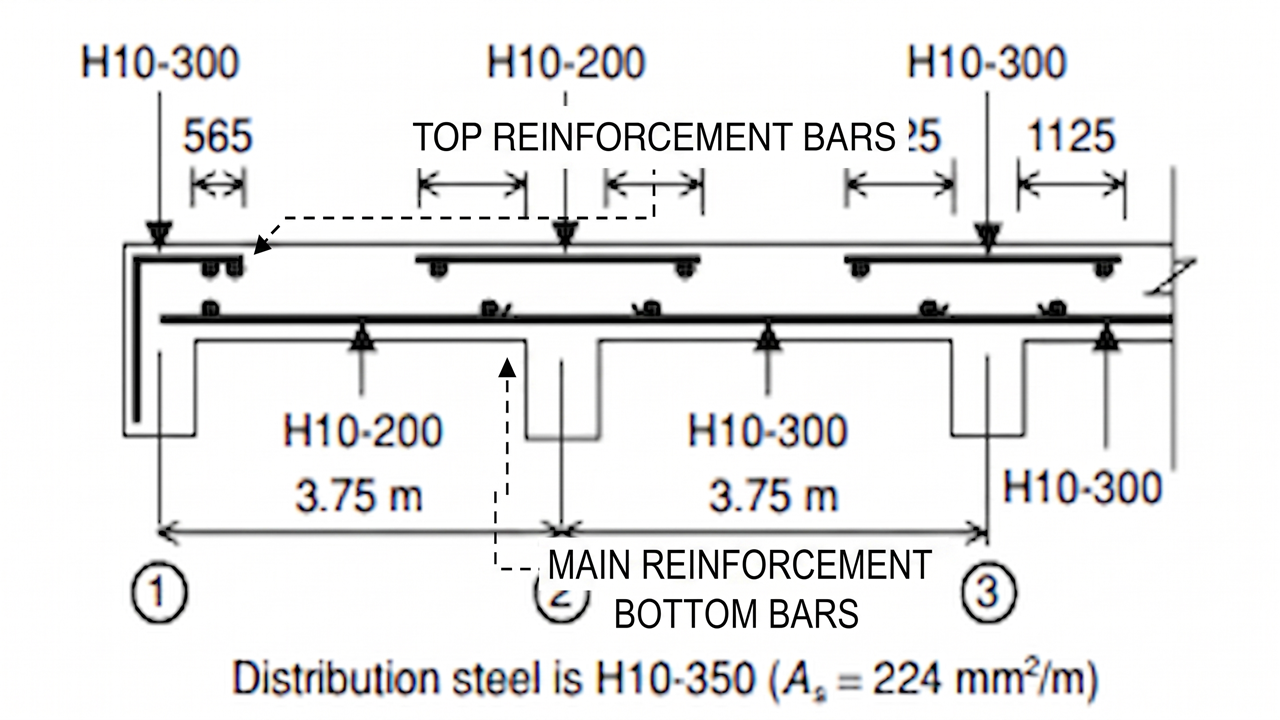
Understanding reinforced concrete slabs requires looking closely at how two different materials work together. Concrete handles high compressive forces exceptionally well, but it is weak when pulled or stretched. Steel reinforcement bars, placed inside the concrete, handle tensile stresses with ease. This combination is known as composite action. Together, the concrete and steel create a powerful structural material that resists both crushing and bending forces.
Common Applications in Construction
Builders use these versatile elements in many different areas of residential and commercial projects. For example, ground-supported slabs rest directly on compacted soil, which makes them ideal for warehouses and ground floors. Suspended floors span across open spaces between beams and columns in multi-story buildings. Furthermore, roof decks protect top-floor rooms from weather elements while providing a solid base for waterproofing and insulation layers.
Key Benefits of Reinforced Concrete Slabs
Buildings need strong materials to last for decades without failing. Understanding reinforced concrete slabs helps you appreciate their incredible durability against heavy weights and harsh weather. Furthermore, they offer excellent fire resistance, which keeps occupants safe during emergencies. These slabs also provide good acoustic insulation to block noise between floors, and their high rigidity prevents excessive shaking or bending under everyday loads.
Conclusion and Further Reading
In summary, these structural elements play a vital role in modern architecture and civil engineering. By combining the compressive strength of concrete with the tensile strength of steel, builders create safe, durable, and reliable horizontal surfaces. If you want to explore more about structural design standards and advanced building materials, you can check out detailed guides on The Constructor.
References
Nilson, A. H., Darwin, D., & Dolan, C. W. (2010). Design of Concrete Structures. McGraw-Hill Education.
Reynolds, C. E., & Steedman, J. C. (2008). Reinforced Concrete Designer’s Handbook. Taylor & Francis.
When you design building floors, understanding one-way vs two-way slabs is crucial for structural stability. Engineers constantly evaluate how loads travel across a floor plate to ensure safety and economy. Therefore, knowing how to classify these elements helps you design better structures. Let’s explore the core differences clearly.
What Defines One-Way vs Two-Way Slabs?
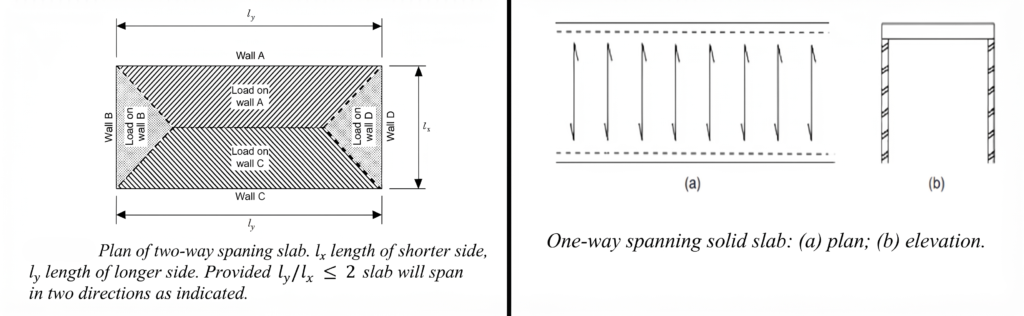
The primary classification depends entirely on the geometry of the panel. Specifically, engineers look at the aspect ratio rule, which compares the longer span to the shorter span. If you divide the longer span (Ly) by the shorter span (Lx), the resulting value determines the slab type. Consequently, this calculation dictates how structural loads travel to the supporting beams.
The Aspect Ratio Rule Explained
According to standard structural codes, a slab is considered a one-way slab when the ratio Ly / Lx is greater than or equal to 2. In this scenario, the panel is significantly longer in one direction. However, if the ratio Ly / Lx is less than 2, the slab functions as a two-way slab. Thus, the panel bends significantly in both directions because the side supports share the load more evenly.
Bending Behavior in One-Way vs Two-Way Slabs
Bending behavior defines how a structure reacts under gravity loads. For instance, one-way slabs bend principally along one direction, which is always parallel to the shorter span. Conversely, two-way slabs bend in both principal directions simultaneously. Because all four edges provide support in a two-way system, the load disperses across multiple paths rather than just taking the shortest route.
Reinforcement Detailing Differences
Reinforcement detailing ensures that concrete handles tensile forces properly. In a one-way layout, builders place main reinforcement bars primarily in the short direction. Secondary distribution steel goes in the long direction to control temperature cracking. Meanwhile, two-way systems require main reinforcement bars in both orthogonal directions to resist bending moments along both spans.
Practical Selection for Construction Projects
Choosing the right slab type depends heavily on room geometry and framing layout. Rectangular rooms with long spans usually demand one-way designs. On the other hand, square or nearly square rooms favor two-way designs for better material efficiency. Therefore, analyzing your architectural floor plan carefully will guide your final structural choice.
Conclusion and Further Reading
In summary, analyzing one-way vs two-way slabs involves checking aspect ratios, understanding bending behaviors, and detailing reinforcement correctly. Mastering these concepts ensures safe and cost-effective construction. If you want to dive deeper into advanced structural design techniques, you can explore detailed guides on The Constructor.
References
Nilson, A. H., Darwin, D., & Dolan, C. W. (2010). Design of Concrete Structures. McGraw-Hill Education.
MacGregor, J. G., & Wight, J. K. (2011). Reinforced Concrete: Mechanics and Design. Pearson.
Have you ever wondered why modern concrete floors and roofs do not crack and collapse under heavy loads? The secret lies in a brilliant partnership between two different building materials. The synergy of steel and concrete creates a powerful composite system that shapes modern civil engineering. Without this combination, large skyscrapers and durable bridges would simply fail. Let us explore why steel and concrete work so well together.
Strengths and Weaknesses of Individual Materials
To understand this partnership, we must first look at how each material behaves on its own. Concrete handles high compressive forces exceptionally well, meaning it resists crushing under heavy weights. However, concrete possesses a major weakness because it is very weak in tension and pulls apart easily. Therefore, engineers must add another material to handle the pulling forces.
The Crucial Role of Steel Rebar
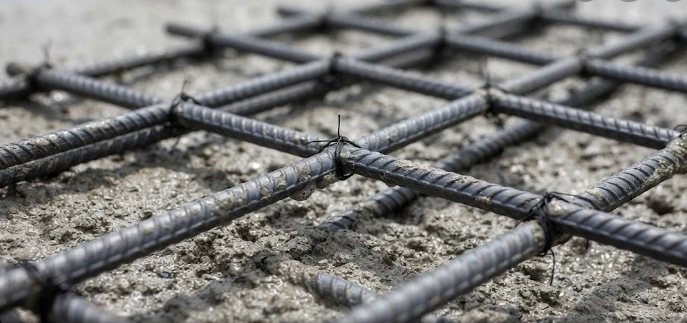
This is where steel reinforcement steps in to save the day. Steel rebar or welded wire mesh bridges this gap by absorbing tensile stresses efficiently. Furthermore, embedded steel bars prevent wide crack formation when heavy loads bend the slab downward. Consequently, the concrete takes the crushing loads while the steel handles the stretching forces.
Thermal Compatibility Benefits
Another amazing reason for this pairing involves how both materials react to temperature changes. Steel and concrete share nearly identical thermal expansion coefficients. Because they expand and contract at the exact same rate, they prevent internal stresses and cracking during extreme temperature fluctuations. Therefore, buildings remain structurally sound through hot summers and cold winters.
Bond Strength and Mechanical Grip
How do steel and concrete stay locked together without sliding apart? The ribbed texture of deformed steel bars ensures a strong mechanical grip within the hardened concrete matrix. As the wet concrete hardens around the textured rebar, it forms an unbreakable mechanical bond. Because of this strong grip, both materials act as a single unified unit under stress.
Conclusion and Further Reading
In summary, the synergy of steel and concrete relies on balancing compressive and tensile strengths, matching thermal expansion rates, and maintaining a strong mechanical bond. This engineering marvel makes our homes and offices safe and durable. If you want to dive deeper into advanced structural design techniques and material science, you can explore detailed guides on The Constructor.
References
Nilson, A. H., Darwin, D., & Dolan, C. W. (2010). Design of Concrete Structures. McGraw-Hill Education.
MacGregor, J. G., & Wight, J. K. (2011). Reinforced Concrete: Mechanics and Design. Pearson.
Have you ever walked across a floor and felt it bounce or sag beneath your feet? Determining the minimum thickness of reinforced concrete slabs is a critical task for every structural engineer. Without proper thickness, building floors can experience severe sagging or even structural failure. Therefore, calculating the correct depth keeps occupants safe and protects buildings from costly damages.
Deflection Control and Structural Safety
Many people assume that bending strength is the only factor in slab design, but deflection control actually governs minimum thickness rules. When heavy loads press down on a concrete floor, the slab wants to bend. If the slab is too thin, it will sag excessively over time. Excessive sagging creates an uncomfortable environment, damages ceiling finishes below, and cracks partition walls. Thus, engineers prioritize adequate depth to limit unwanted movement.
Span-to-Depth Ratios in Engineering Practice
How do engineers figure out the right depth quickly? They rely on standard engineering practice, such as building code guidelines, where thickness is calculated as a fraction of the clear span. For example, the required depth changes significantly depending on whether the slab is simply supported, continuous, or cantilevered. Continuous slabs span further with less thickness because adjacent spans share the load. Consequently, checking span-to-depth ratios ensures efficient and safe designs.
Key Factors Influencing Slab Thickness
Several important factors dictate adjustments to your baseline thickness calculations. First, imposed loads like heavy furniture, machinery, or crowds demand a thicker concrete section. Second, environmental exposure classes require extra concrete cover to protect embedded steel from moisture and corrosion. Finally, fire resistance ratings often force engineers to increase thickness so the structure can withstand high temperatures during an emergency.
Consequences of Insufficient Thickness
Ignoring proper design guidelines leads to dangerous consequences on site. Insufficient thickness triggers severe cracking, excessive vibrations under normal walking loads, and ultimate serviceability failure. Furthermore, fixing a sagging or cracked concrete floor costs a fortune. Therefore, determining the minimum thickness of reinforced concrete slabs prevents these disasters before construction even begins.
Conclusion and Further Reading
In summary, determining the minimum thickness of reinforced concrete slabs involves managing deflection limits, applying span-to-depth ratios, and accounting for external loads and environmental conditions. Mastering these rules ensures long-lasting and safe structures. If you want to explore more about structural design standards and code requirements, you can check out detailed guides on The Constructor.
References
Nilson, A. H., Darwin, D., & Dolan, C. W. (2010). Design of Concrete Structures. McGraw-Hill Education.
MacGregor, J. G., & Wight, J. K. (2011). Reinforced Concrete: Mechanics and Design. Pearson.
Are you building a strong foundation or a durable floor slab on your site? Concrete curing essentials are vital because proper moisture and temperature control determine whether your structure will last for decades. Without correct curing practices, even the highest-quality concrete mix will fail to reach its design strength. Therefore, every builder and engineer must master these fundamental techniques.
What is Curing?
Curing is the process of maintaining satisfactory moisture content and favorable temperatures in concrete during the early ages so that hydration reactions can fully develop. When workers pour fresh concrete, the chemical process of hardening begins immediately. If the surrounding air is too hot or dry, water evaporates too quickly from the surface. Consequently, curing protects the concrete and ensures it achieves its intended durability and structural capacity.
The Chemistry of Hydration
Many people mistakenly believe that concrete “dries” to harden, but this is a common myth. Instead, concrete undergoes a chemical reaction with water that requires time and moisture to gain strength. This complex process is known as cement hydration. As water reacts with cement particles, crystals grow and interlock to form a solid mass. Therefore, stopping this reaction early by withholding water severely weakens the final structure.
Risks of Poor Curing
Ignoring proper curing protocols leads to severe structural and aesthetic problems on site. For example, premature moisture loss causes heavy surface dusting, plastic shrinkage cracking, and a significant loss of ultimate compressive strength. Furthermore, poorly cured concrete remains porous and vulnerable to water seepage and chemical attacks. Thus, skipping this step ruins your hard work and creates costly repair projects.
Common Practical Methods Used on Site
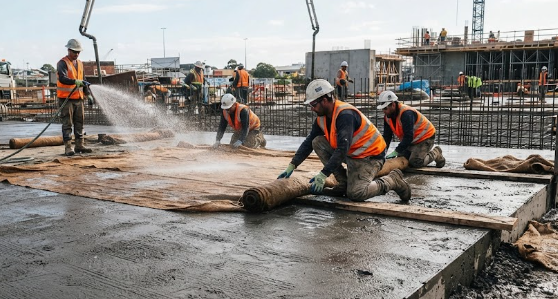
Builders use several effective techniques to keep fresh concrete moist and cool. First, water ponding creates shallow pools on flat slabs to keep surfaces continuously submerged. Second, continuous spraying and sprinkling work well for vertical walls and columns. Third, wet burlap coverings trap moisture against the concrete surfaces effectively. Finally, liquid membrane-forming curing compounds seal in moisture instantly after finishing.
Conclusion and Further Reading
In summary, concrete curing essentials involve maintaining ideal moisture and temperature levels to drive the hydration process forward. By avoiding premature drying and applying correct curing methods, you guarantee a strong and durable structure. If you want to explore more about advanced construction techniques and material testing, you can check out detailed guides on The Constructor.
References
Mindess, S., Young, J. F., & Darwin, D. (2003). Concrete. Prentice Hall.
Neville, A. M. (2011). Properties of Concrete. Pearson Education.
Malaria remains one of the greatest health challenges in West Africa, especially for young children and nursing mothers. However, using Insecticide-Treated Nets (ITNs) provides a simple and life-saving defense against mosquito bites. These specialized nets do not merely block insects physically; they also repel and kill them on contact. As a result, sleeping under a net significantly reduces malaria transmission across Nigerian households.
What Are Insecticide-Treated Nets (ITNs) and LLINs?
In simple terms, an insecticide-treated net is a fabric canopy coated with safe chemicals that kill or repel mosquitoes. Today, public health agencies primarily distribute Long-Lasting Insecticidal Nets (LLINs). Manufacturers weave the chemical treatment directly into the synthetic fibers during production. Consequently, these modern nets remain effective for up to three years or 20 washes without needing frequent re-treatment.
For example, when an infected mosquito flies toward a person sleeping under an LLIN, the net acts in two distinct ways. First, the mesh forms a physical wall that keeps the insect away from your skin. Second, the chemical treatment paralyzes the mosquito as soon as it touches the fabric. Therefore, the net protects the person inside and simultaneously lowers the total mosquito population in your bedroom.
Types of Nets and How to Choose the Right One
Health experts classify nets based on the active chemical ingredients they contain. Traditional models rely on pyrethroid-only insecticides. These nets worked extremely well for decades. However, mosquitoes in many parts of West Africa have developed chemical resistance against standard pyrethroids over time.
To solve this challenge, scientists created dual-active ingredient nets. These advanced nets combine pyrethroids with additional synergist chemicals like Piperonyl Butoxide (PBO) or Pyriproxyfen. For instance, PBO neutralizes the mosquito’s natural chemical defenses, allowing the primary insecticide to kill the insect efficiently. Therefore, if you live in an area with high mosquito resistance, you should select a dual-active ingredient net for maximum home protection.
How to Properly Hang Insecticide-Treated Nets (ITNs)
Hanging your net correctly ensures complete coverage and prevents fabric damage. Generally, you will find two main shapes in the market: rectangular nets and conical nets. Rectangular nets offer more internal space, making them ideal for double beds or family sleeping mats. On the other hand, conical nets require only a single ceiling hook, which makes them faster to set up in smaller rooms.
To hang a rectangular net, tie strong strings to the four corner loops and attach them securely to ceiling hooks or wall nails. Ensure the net hangs straight down without sagging over your face while you sleep. Furthermore, always tuck the bottom edges of the net underneath your mattress or sleeping mat before nightfall. This crucial step closes all gaps where crawling mosquitoes might enter.
Safety Steps Before Using a New Net
When you unpack a fresh net, you might notice a strong chemical odor. Furthermore, direct exposure to a brand-new net can cause mild skin tingling or eye irritation, particularly in newborn babies and nursing mothers. However, you can easily prevent these mild side effects with proper handling.
Before hanging a new net indoors, remove it from its plastic wrapper and air it out in a shaded, well-ventilated area for at least 24 hours. Do not place the fresh net directly in bright sunlight during this airing process, as heavy ultraviolet rays weaken the insecticide. After 24 hours of shade-airing, the chemical scent disappears, making the net completely safe for your entire family.
Cleaning and Maintaining Your Insecticide-Treated Nets (ITNs)
Proper maintenance keeps your net clean while preserving its active mosquito-fighting chemical layer. Wash your net only when it becomes visibly dirty, typically once every two to three months. In addition, always wash the net gently by hand in a basin of cool or lukewarm water using mild soap.
Avoid using harsh detergents, liquid bleaches, or rough washing boards because these aggressive products strip away the protective insecticide. Furthermore, never dry your net under direct sunlight or inside a heated machine dryer. Instead, flat-dry or line-dry the net in the shade. Shade drying protects the active ingredients and extends the overall usable lifespan of the fabric.
When Should You Replace Your Net?
Although LLINs last a long time, their protective qualities eventually wear down over time. You should inspect your bed nets regularly for physical tears or chemical exhaustion. For example, if your net develops multiple large holes that you cannot sew shut, mosquitoes will easily fly inside while you sleep.
Additionally, most nets lose their chemical strength after 20 washes or roughly three years of daily usage. Consequently, when your net reaches this limit, replace it immediately with a new unit to guarantee unbroken defense against malaria.
Conclusion: Protect Your Household Today
In conclusion, consistent use of treated bed nets remains the single most effective and affordable strategy to prevent malaria across West Africa. By choosing the right net type, hanging it securely, and following proper cleaning rules, you create a safe environment for your household every night.
Take proactive steps today to safeguard your family against mosquito-borne diseases. For more detailed clinical guidelines and global vector control strategies, visit the World Health Organization Malaria Guidelines.
References
World Health Organization (WHO). (2023). WHO Guidelines for Malaria Vector Control and LLIN Distribution. Geneva: World Health Organization.
Federal Ministry of Health Nigeria. (2022). National Malaria Elimination Programme (NMEP) Strategic Plan and Operational Manual. Abuja: FMOH.
Centers for Disease Control and Prevention (CDC). (2024). Insecticide-Treated Bed Nets: Choice, Care, and Safety. Atlanta: CDC.