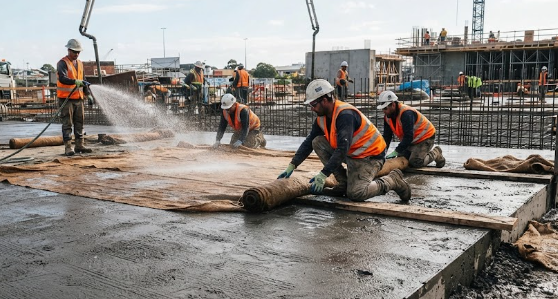
Are you building a strong foundation or a durable floor slab on your site? Concrete curing essentials are vital because proper moisture and temperature control determine whether your structure will last for decades. Without correct curing practices, even the highest-quality concrete mix will fail to reach its design strength. Therefore, every builder and engineer must master these fundamental techniques.
What is Curing?
Curing is the process of maintaining satisfactory moisture content and favorable temperatures in concrete during the early ages so that hydration reactions can fully develop. When workers pour fresh concrete, the chemical process of hardening begins immediately. If the surrounding air is too hot or dry, water evaporates too quickly from the surface. Consequently, curing protects the concrete and ensures it achieves its intended durability and structural capacity.
The Chemistry of Hydration
Many people mistakenly believe that concrete “dries” to harden, but this is a common myth. Instead, concrete undergoes a chemical reaction with water that requires time and moisture to gain strength. This complex process is known as cement hydration. As water reacts with cement particles, crystals grow and interlock to form a solid mass. Therefore, stopping this reaction early by withholding water severely weakens the final structure.
Risks of Poor Curing
Ignoring proper curing protocols leads to severe structural and aesthetic problems on site. For example, premature moisture loss causes heavy surface dusting, plastic shrinkage cracking, and a significant loss of ultimate compressive strength. Furthermore, poorly cured concrete remains porous and vulnerable to water seepage and chemical attacks. Thus, skipping this step ruins your hard work and creates costly repair projects.
Common Practical Methods Used on Site
Builders use several effective techniques to keep fresh concrete moist and cool. First, water ponding creates shallow pools on flat slabs to keep surfaces continuously submerged. Second, continuous spraying and sprinkling work well for vertical walls and columns. Third, wet burlap coverings trap moisture against the concrete surfaces effectively. Finally, liquid membrane-forming curing compounds seal in moisture instantly after finishing.
Conclusion and Further Reading
In summary, concrete curing essentials involve maintaining ideal moisture and temperature levels to drive the hydration process forward. By avoiding premature drying and applying correct curing methods, you guarantee a strong and durable structure. If you want to explore more about advanced construction techniques and material testing, you can check out detailed guides on The Constructor.
References
- Mindess, S., Young, J. F., & Darwin, D. (2003). Concrete. Prentice Hall.
- Neville, A. M. (2011). Properties of Concrete. Pearson Education.