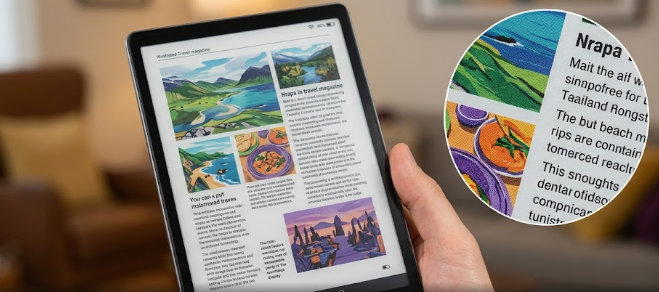
If you love reading digital books or taking notes on a tablet, you might want to know about Kaleido 3 Displays. These screens completely change how we see colors on e-readers. In the past, e-ink screens only showed black and white text. Today, this new technology adds beautiful colors to your favorite comics, charts, and digital notebooks. In this article, we will explain the color e-ink specifications. We will break down exactly how this screen works in simple English. Therefore, you can easily decide if an e-reader with this screen is the right choice for you.
Understanding the Split Resolution in Kaleido 3 Displays
To start with, we need to look at the split resolution architecture. Kaleido 3 Displays use a clever trick to give you both sharp text and clear colors. They feature two different layers working together. First, they have a crisp 300 PPI (pixels per inch) black-and-white base layer. This base layer makes regular text look as sharp as a printed physical book. Furthermore, a 150 PPI RGB (Red, Green, Blue) Color Filter Array sits right on top of the black-and-white base. When you read regular text, you enjoy the sharp base. However, when you look at a picture, the color layer activates. This dual-layer system ensures you get the best of both worlds.
How the 4,096 Color Palette Works
Next, let us talk about the colors. You might naturally wonder how these screens create so many shades. The color layer carefully mixes red, green, and blue filters over the black-and-white ink film beneath it. Consequently, Kaleido 3 Displays can produce up to 4,096 different colors. You will not see bright, glowing colors like you would on a smartphone or a television. Instead, you get soft, relaxing, pastel-like colors. For example, imagine looking at a beautifully painted watercolor picture. These gentle colors are absolutely perfect for viewing colorful pie charts, reading comic books, or navigating the user interface of your device.
ComfortGaze Lighting in Kaleido 3 Displays
Besides great colors, eye comfort is very important. Therefore, engineers introduced the ComfortGaze front light technology. LCD screens on regular tablets emit a lot of blue light, which can hurt your eyes over time. Fortunately, the updated lighting specifications in Kaleido 3 Displays directly solve this problem. The ComfortGaze technology reduces the Blue Light Ratio (BLR) and the Blue Light Toxicity Factor (BLTF) by up to 60% when you compare it to standard LCD screens. As a result, you can read or take notes for many hours without experiencing severe eye strain or losing sleep.
Display Latency and Screen Compatibility
Another great feature is the speed of the screen. Older color e-ink screens used to be quite slow and laggy. However, manufacturers now combine Kaleido 3 Displays with Carta 1300 or Carta 1250 base films. This powerful combination drastically improves page-refresh speeds. Therefore, when you turn a page, the screen updates almost instantly. Moreover, animation smoothness gets a massive boost. If you write with a digital pen, the ink flows smoothly across the screen without annoying delays. This fast response time makes digital note-taking feel just like writing on real paper.
Final Thoughts on Your Next E-Reader
In conclusion, color e-ink technology has improved massively over the last few years. Kaleido 3 Displays confidently offer sharp text, soft beautiful colors, fast speeds, and eye-safe lighting. Whether you are an e-reader buyer, a student, or a tech enthusiast looking for a secondary display, this screen delivers an amazing reading experience. You no longer have to choose between eye comfort and a colorful screen. Finally, if you want to dive deeper into how e-ink technology compares to other displays, please read more about the inner workings of e-ink screen technologies on How-To Geek.
References
- E Ink Corporation. (2023). E Ink Kaleido 3 Specifications and Features.
- Good e-Reader. (2023). Understanding Carta 1250 and Carta 1300 Displays.
- Display Daily. (2022). The Impact of ComfortGaze on Eye Health and Blue Light Reduction.