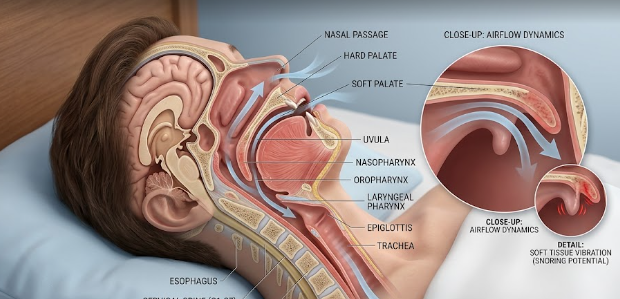
Almost everyone hears snoring at some point in life. Whether your partner snores or you wake yourself up, it remains a very common night sound. However, few people stop to learn the actual anatomy of a snore and understand what happens behind their neck muscles every night.
Understanding how your throat works during sleep helps you catch potential health issues early. In this article, we will break down the physical causes of snoring using clear and simple language.
Understanding the Anatomy of a Snore in Your Throat
When you drift into deep sleep, your entire body relaxes. Consequently, the muscles inside your head and neck loosen up as well. This includes the muscles in the roof of your mouth, your tongue, and your throat wall.
Normally, air flows smoothly from your nose and mouth directly into your lungs. However, when these throat tissues relax too much, they narrow your airway passage. Consequently, the incoming air must force its way through a much tighter space.
For example, think of a flexible garden hose. If you squeeze the middle of the hose, the water rushes through the tight spot faster and with more pressure. Similarly, as air moves through a narrowed throat, it moves faster and creates friction against surrounding soft tissues.
Why Throat Tissues Vibrates Rapidly
As fast-moving air squeezes past narrowed passages, it pulls on nearby relaxed tissues. Specifically, two main parts of your throat do most of the vibrating: the soft palate and the uvula.
The soft palate sits at the back section of the roof of your mouth. The uvula is the small, dangling tissue hanging at the back of your throat. When air forces its way past them, these soft structures flap violently against the back wall of your throat.
Therefore, this strong tissue vibration creates the sound we know as snoring. Additionally, gravity makes this situation worse when you sleep flat on your back, because your tongue sags backward into your airway.
From Simple Snoring to OSA: The Anatomy of a Snore Spectrum
Not all snoring indicates a dangerous medical condition. Doctors separate snoring into two primary categories: simple snoring and Obstructive Sleep Apnea (OSA).
Simple snoring occurs when moving air creates noise, but you continue to breathe without interruption. In this case, the anatomy of a snore involves vibrating tissue without any complete blockage of air. You might annoy your sleep partner, but your body still receives enough oxygen.
On the other hand, Obstructive Sleep Apnea happens when relaxed tissues completely block your airway. Instead of just vibrating, your throat wall collapses shut entirely. As a result, you temporarily stop breathing until your brain senses the danger and forces you to gasp for air.
Key Symptoms You Should Watch For
Because sleep apnea disrupts your body’s oxygen supply, you must learn to recognize its major warning signs. You should take action if you experience any of these common symptoms:
- Waking up choking or gasping for air during the night
- Feeling persistent daytime fatigue despite spending seven or more hours in bed
- Waking up with a very dry mouth or a sore throat every morning
- Experiencing restless sleep, constant tossing, or frequent nighttime waking
- Noticing morning headaches and sudden mood changes throughout the day
If you notice these warning signs regularly, your throat airway might be collapsing completely instead of just vibrating gently.
Taking Control of Your Sleep Health
Knowing the physical breakdown behind snoring helps you make better choices for your resting health. For instance, sleeping on your side prevents gravity from pulling your tongue into your airway passage. Furthermore, avoiding heavy meals or alcohol before bedtime stops your throat muscles from over-relaxing.
If your noisy breathing continues alongside extreme daytime fatigue, consult a qualified healthcare provider promptly. You can read more about sleep disorders and treatment options on the Sleep Foundation website to protect your long-term health.
References
- American Academy of Sleep Medicine. (2020). International Classification of Sleep Disorders (3rd ed.). Darien, IL: American Academy of Sleep Medicine.
- Mayo Clinic. (2023). Snoring: Symptoms and Causes. Mayo Foundation for Medical Education and Research.
- National Heart, Lung, and Blood Institute. (2022). What Is Sleep Apnea? U.S. Department of Health and Human Services.