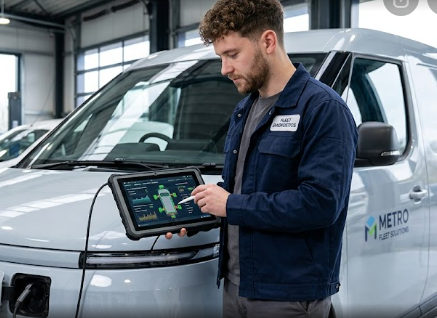
Advanced driver-assistance systems (ADAS) have reached peak market penetration. Therefore, automotive maintenance faces a massive new trend. Fleet owners now transition to Automated Perception Health Platforms. Today, modern vehicles integrate radar, lidar, and cameras into a single, complex safety array. Consequently, mechanics no longer rely on traditional alignment checks. Instead, they use real-time diagnostic loops to monitor the system on the move. Because of this rapid shift, fleets face a new calibration crisis. To solve this problem, mechanics must perform regular Sensor Fusion Health Checks. These checks ensure that all vehicle sensors work together perfectly. Furthermore, they help fleet operators maintain the highest safety standards on the road.
Why Sensor Fusion Health Checks Prevent Dynamic Misalignment
First, we must thoroughly understand the “Dynamic Misalignment” spec. A tiny error can cause massive problems. For example, imagine you drive a car at highway speeds. If a camera or radar module misaligns by just 1 degree, the system calculates an obstacle’s position incorrectly. At a distance of 100 meters, this tiny 1-degree error puts the object several meters away from its actual location. As a result, the car might brake too late or steer directly into danger. Thus, real-time calibration validation becomes a critical safety metric. Regular Sensor Fusion Health Checks catch these small misalignments before they cause severe accidents.
Automated Platforms for Sensor Fusion Health Checks
Historically, fleet operators needed massive, expensive physical calibration bays to align vehicle sensors. However, the industry has changed rapidly. Now, automotive startups build scalable, automated tools for modern vehicles. These new tools allow fleet managers and local workshops to perform automated perception health checks easily. Consequently, mechanics do not need huge garages to fix these high-tech vehicles. Instead, they simply plug into the vehicle’s diagnostic system and run detailed Sensor Fusion Checks instantly. Ultimately, this innovation saves valuable time and drastically reduces maintenance costs for large fleet owners.
OTA Re-calibration and Sensor Fusion Health Checks
Modern 2026 vehicles feature software-defined vehicle (SDV) architectures. This advanced technology allows cars to heal themselves digitally. For instance, suppose a driver hits a minor pothole. The sudden impact might cause a radar sensor to drift slightly out of place. Previously, the driver had to visit a mechanic immediately. Today, the car’s internal computer continuously runs internal Sensor Fusion Checks. If the system detects a drift, it applies a digital correction factor via an Over-the-Air (OTA) patch. Therefore, the vehicle fixes its own alignment digitally, and the driver avoids a forced trip to the mechanic.
Cybersecurity During Sensor Fusion Health Checks
Furthermore, we must seriously consider the cybersecurity aspect of these modern systems. Sensor arrays act as the primary data endpoints for autonomous braking. Malicious hackers could potentially intercept or spoof these crucial signals. Because of this severe risk, 2026 diagnostic tools must feature built-in ISO 21434 cybersecurity compliance tokens. These strict tokens verify that the incoming sensor signals remain authentic. During routine Sensor Fusion Health Checks, the system confirms that no bad actors have altered the data. Consequently, this robust cybersecurity layer protects the driver, the fleet, and the public from dangerous digital attacks.
The Future of Sensor Fusion Health Checks
In conclusion, the automotive industry must adapt to the fleet calibration crisis quickly. Traditional repair methods simply cannot handle modern radar, lidar, and camera systems. Fleet managers must adopt automated health platforms to keep their vehicles extremely safe. By running continuous Sensor Fusion Health Checks, vehicles can correct their own dynamic misalignments and block dangerous cyber threats effectively. If you want to learn more about how modern fleet managers handle high-tech vehicles and maintenance strategies, please visit Automotive Fleet Magazine for excellent further reading on this topic.
References
- Society of Automotive Engineers (SAE). (2025). Guidelines for ADAS Calibration and Sensor Fusion.
- International Organization for Standardization. (2021). ISO/SAE 21434: Road vehicles — Cybersecurity engineering.