Have you ever wondered how thin smartphones can zoom into far-away objects without a massive lens sticking out? Historically, optical zoom required thick camera bodies. However, the secret now lies in periscope zoom telephoto optics, a technology that mimics submarine periscopes to fit high-quality lenses inside a slim phone chassis. Smartphone makers use this clever engineering trick to deliver incredibly sharp, long-distance photos. Consequently, you can capture clear images of distant subjects without carrying a bulky DSLR camera. In this article, we will unpack how these advanced camera systems work, from sliced-down glass elements to tiny tilting mirrors.
How the Horizontal Light Path Works
To understand this technology, we must first look at how standard cameras function. Normally, light travels straight through the lens directly onto the camera sensor. Because optical zoom requires physical distance between lens elements, a standard telephoto lens would make your phone incredibly thick. Therefore, engineers had to redesign the entire camera layout.
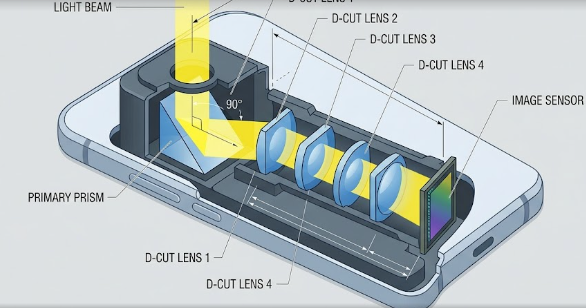
Instead of pointing the lens outward, periscope systems place the lenses sideways inside the phone body. First, a primary prism sits right behind the outer camera glass. This prism acts like a mirror, bending the incoming light at a sharp 90-degree angle. Next, the bent light travels horizontally down the width of the phone chassis.
As a result, the light passes through multiple lens elements before finally hitting the image sensor, which also sits vertically. This clever layout allows for a long focal path without creating a giant physical camera bump on the back of your device.
Saving Space with D-Cut Lens Specifications
Even with a horizontal layout, space inside a smartphone remains extremely tight. Smartphone manufacturers constantly fight to keep devices under 8 or 9 millimeters thick. A larger camera sensor requires wider lens elements to capture enough light. However, a perfectly round, wide lens would increase the thickness of the phone. To solve this problem, optical engineers developed the D-Cut lens.
A D-Cut lens is a standard circular lens element with its top and bottom edges physically sliced off. This modification changes the shape of the lens from a circle to a flat oval resembling a letter “D” on both sides. By cutting off the unused top and bottom portions of the glass, engineers can fit a wider diameter lens into a much thinner space.
Consequently, the camera can capture more light for better night photos without increasing the physical thickness of the phone. For example, a D-Cut lens allows a high-performance zoom lens to fit snugly inside a phone that is only 8 mm thick.
Advanced Stabilization with Prism OIS Tilt and VCM
When you zoom in on a subject at 5x or 10x magnification, even the tiniest shake of your hand can ruin the photo. Standard cameras use Voice Coil Motors (VCM) to shift the lens elements up, down, left, and right to counteract shaky hands. We call this process Optical Image Stabilization (OIS). However, shifting heavy, horizontal lenses inside a tight periscope module is incredibly difficult and slow.
To fix this, premium smartphones use prism-tilting OIS instead of traditional lens-shifting OIS. Instead of moving the entire lens array, a specialized VCM tilts the primary prism itself. Because the prism sits at the very front of the system, tilting it slightly can correct large amounts of movement.
Specifically, these systems use ultra-precise milliradian ($\text{mrad}$) tilt angles to keep the image stable. One milliradian represents a tiny fraction of a degree. For instance, a system might tilt the prism by just 10 to 15 $\text{mrad}$ to instantly cancel out your hand tremors, ensuring your handheld videos remain perfectly smooth.
Digital Sensor Cropping vs. True Optical Focal Length
Many smartphone brands advertise massive “100x zoom” capabilities on their spec sheets. However, smart buyers must distinguish between true physical zoom and digital tricks. True optical zoom relies on the physical distance between the lenses inside the periscope zoom telephoto optics system to change the focal length. This physical adjustment preserves the original resolution and clarity of the image sensor.
In contrast, digital zoom is simply sensor cropping. The phone’s software takes a standard photo, crops into the center, and uses artificial intelligence to fill in the missing pixels. While computational algorithms have improved, digital cropping always degrades the actual image quality and introduces digital noise.
When checking specifications, always look for the true focal length in millimeters (like 120 mm for a 5x zoom). If a phone claims a high zoom factor but lacks a long physical focal length, it is likely using digital cropping rather than real optical glass. Therefore, when you shop for your next smartphone, make sure to check the actual optical hardware details. For a deeper technical dive into mobile camera sensors and optical designs, you can read more on Android Authority, which offers excellent breakdowns of modern smartphone hardware.
References
- Android Authority. (2024). How periscope zoom cameras work on smartphones.
- GSMArena. (2023). Understanding mobile zoom: Optical, digital, and hybrid explained.
- Schmidt, M. (2022). Advanced Optoelectronics in Mobile Phone Cameras: D-Cut Lens Physics and Stabilization.