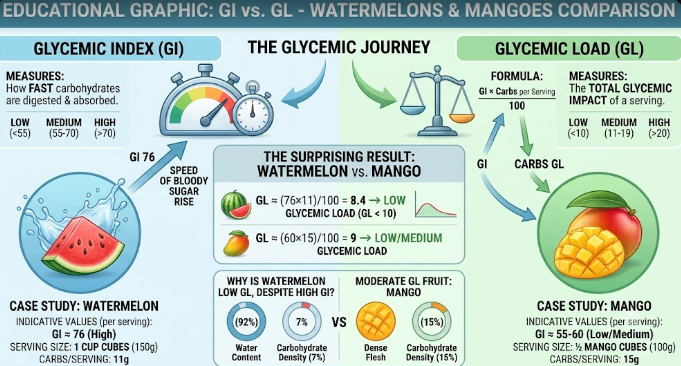
Many people with type 2 diabetes believe they must completely avoid sweet fruits like mangoes and watermelons. This common myth causes unnecessary stress and robs you of essential nutrients. To truly master your health, you need to understand the relationship between Glycemic Index vs Glycemic Load. These two metrics change how we view nutrition and diabetes management completely.
The Problem with the Fruit Myth
Doctors often tell patients with high blood sugar to watch their carbohydrate intake. Consequently, many individuals cut out delicious tropical fruits entirely out of fear. They worry that a single slice of papaya or watermelon will send their glucose levels soaring.
However, nature packs fruits with vital vitamins, minerals, and healthy fiber. Avoiding them altogether can actually hurt your overall nutritional balance. Therefore, you should look closer at the science before clearing out your fruit bowl.
Understanding Glycemic Index vs Glycemic Load
To manage your diet effectively, you must learn how your body processes sugar. The Glycemic Index (GI) measures how quickly a specific food increases your blood glucose levels. Scientists give foods a rating from 0 to 100 based on this speed. Pure glucose sits at the top with a score of 100.
Foods that digest fast score high on the chart, while slow-digesting foods score low. However, the GI chart only tells half of the story. It does not consider how many carbs are actually in a normal serving of that food. This is where comparing Glycemic Index vs Glycemic Load becomes highly critical for blood sugar control.
The Glycemic Load (GL) solves this problem by factoring in the real-world portion size. It multiplies the GI value by the amount of carbohydrates in a standard serving, then divides by 100. For instance, a food might raise blood sugar fast if you ate a massive amount of it. But if a normal serving contains very few carbs, the actual impact on your body remains tiny. Therefore, GL gives you a much more accurate picture of how a fruit affects your health.
A Practical Fruit Comparison
Let us look at a real-world example to see how this works in daily life. Watermelon has a high Glycemic Index of 72, which scares many people. However, watermelon consists mostly of water and fiber. A standard 120-gram serving actually contains very few carbohydrates.
Consequently, the Glycemic Load of watermelon is only about 5, which counts as very low. Your body handles this easily in moderate portions. The following table highlights this difference for several popular fruits so you can make informed choices.
| Fruit | Glycemic Index (GI) | Glycemic Load (GL) per Serving | Real Impact on Blood Sugar |
| Watermelon | 72 (High) | 5 (Low) | Very Low |
| Mango | 51 (Low-Medium) | 13 (Medium) | Moderate |
| Papaya | 60 (Medium) | 7 (Low) | Low |
| Apple | 36 (Low) | 5 (Low) | Low |
Smart Tips for Eating Fruits Safely
You do not have to give up your favorite tropical treats. Instead, you can use smart pairing strategies to control your insulin response. When you eat a higher-GI fruit, always pair it with healthy fats or proteins. For example, grab a handful of unsalted almonds, walnuts, or pumpkin seeds with your melon slice.
The healthy fats and proteins slow down your digestion process significantly. As a result, your body absorbs the fruit sugar much more gradually over time. Moreover, this trick keeps you full for a longer period and prevents dangerous energy crashes. Portion control also plays a massive role, so always stick to standard serving sizes.
Conclusion
Mastering the balance between Glycemic Index vs Glycemic Load allows you to enjoy nature’s candy safely. You can eat a varied, joyful diet while keeping your diabetes under perfect control. For more detailed scientific data on carbohydrate counting and blood sugar metrics, you can check out the comprehensive nutrition guides on the Harvard T.H. Chan School of Public Health.
References
- Harvard T.H. Chan School of Public Health. “Glycemic Index and Glycemic Load.” The Nutrition Source.
- American Diabetes Association. “Fruit and Diabetes Management Strategies.” Diabetes Care Journal.