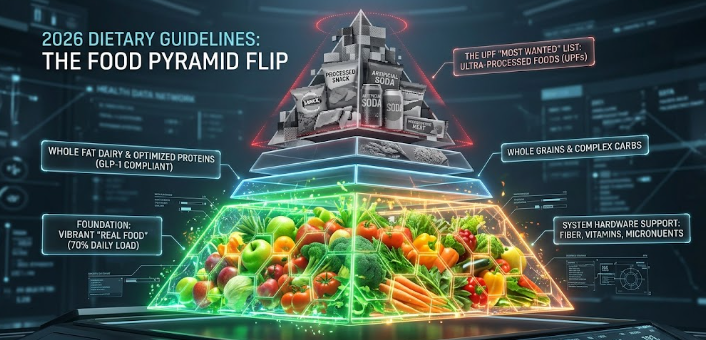
Your old food pyramid just got a forced software update. In April 2026, health officials finalized the 2026 Dietary Guidelines Flip, changing how we view human “fuel” forever. This update moves away from confusing numbers like “grams of fat” and focuses on the actual source of your hardware’s energy. Consequently, the government has officially put ultra-processed foods (UPFs) on the “Most Wanted” list for causing system-wide health failures.
For decades, the “Everything in Moderation” mantra was the standard operating procedure. However, the new guidelines delete that old code. Instead, they introduce a direct, food-based warning system. If you want your body to run without glitches, you must understand these new technical specifications.
The New Real Food Hardware Specs
The most significant change in the 2026 Dietary Guidelines Flip is the foundation of the pyramid. For the first time, bread and grains no longer occupy the base. Instead, fruits, vegetables, and high-quality proteins now make up nearly 70% of the recommended daily intake. Think of this as upgrading your hard drive to an SSD; it is the essential foundation for speed and reliability.
Furthermore, these “Real Food” foundations provide the fiber and micronutrients that keep your internal systems running smoothly. When you prioritize these whole foods, you reduce the risk of chronic inflammation. This shift ensures that your body receives high-quality data (nutrients) rather than just empty storage (calories).
Ending the Moderation Glitch
In the past, experts said you could eat a little bit of everything. The 2026 Dietary Guidelines Flip explicitly ends this era. Health officials now use aggressive language to describe certain ultra-processed foods. They state that snacks containing artificial colors, preservatives, and low-calorie sweeteners are “actively harming” the population.
These chemicals act like malware in your system. Instead of being “empty calories,” they interfere with your metabolic hormones and brain signaling. Consequently, the government suggests avoiding these “Most Wanted” items entirely rather than eating them in moderation. This is a major patch for a public health system that has struggled with rising obesity rates for years.
Whole-Fat Dairy: A System Optimization
You might remember being told to choose low-fat or skim milk. The 2026 Dietary Guidelines Flip introduces a surprising spec change by recommending whole-fat dairy with no added sugar. Researchers now acknowledge that natural fats in dairy help with satiety, which is the feeling of being full.
When you remove fat from dairy, you often lose the ability to absorb certain vitamins. Additionally, manufacturers frequently add sugar to low-fat versions to improve the taste. By sticking to whole-fat “original equipment manufacturer” (OEM) dairy, you maintain better metabolic health and keep your energy levels stable throughout the day.
High-Protein Requirements for Weight Loss Hardware
As millions of people use GLP-1 medications for weight loss, the guidelines have updated the protein specs. The new standard suggests a protein intake of 1.2 to 1.6 grams per kilogram of body weight. This higher protein requirement is a mandatory “spec” to prevent the loss of muscle mass while losing fat.
If you do not meet these protein targets, your body may “uninstall” your muscle tissue to find energy. Therefore, whether you are on medication or not, prioritizing lean meat, eggs, and legumes is essential. This ensures that your weight loss comes from fat stores rather than your functional hardware (muscles).
Solving the Processing Paradox
It is important to distinguish between “processed” and “ultra-processed” foods. The 2026 Dietary Guidelines Flip explains that processing is not always the enemy. For example, canned beans and frozen spinach are “processed,” but they are still high-quality hardware components. They are simple, stable, and healthy.
In contrast, ultra-processed foods usually contain more than 20 ingredients, many of which you cannot find in a home kitchen. These include emulsifiers and refined carbohydrates that cause your blood sugar to spike. To optimize your health, focus on foods that are as close to their original state as possible.
For more technical insights on how nutrition affects your long-term health, check out the latest updates on the Harvard Nutrition Source.
References
- U.S. Department of Health and Human Services (2026). Dietary Guidelines for Americans 2025-2030.
- Journal of Metabolic Health (2026). The Impact of Ultra-Processed Additives on Human Hardware.
- Clinical Nutrition Update (2026). Protein Specs for GLP-1 Users.