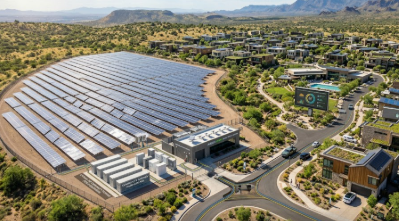
As we approach the major Lagos Real Estate Fest later this month, exciting new data has emerged. Residential estates that offer centralized solar mini-grids now fetch a massive 25% premium in valuation. Buyers eagerly pay this extra amount compared to traditional grid-dependent or diesel-reliant neighborhoods. Consequently, modern developers are completely changing how they build communities. They now rely heavily on off-grid power architecture to meet buyer demands. This new energy setup provides consistent electricity and protects residents from national grid failures. Ultimately, reliable power forms the foundation of modern luxury living in Africa.
The Centralized BESS Hub in Off-Grid Power Architecture
Modern estate developers currently abandon individual property generators. Instead, they deploy a centralized containerized Lithium Iron Phosphate ($LiFePO_4$) battery bank. Engineers carefully link this large battery bank to a unified solar array. For example, instead of 100 houses running 100 noisy generators, a single central hub powers the entire estate. Therefore, this off-grid power architecture drastically reduces the headache of maintaining personal engines. Furthermore, a centralized battery energy storage system (BESS) manages power far more efficiently. The system stores abundant daytime sunshine and releases it smoothly during the night.
Smart Metering Infrastructure and Off-Grid Power Architecture
To manage this central power effectively, developers install Bi-Directional Smart Utility Meters. These intelligent meters form the backbone of any off-grid power architecture. They allow the estate’s management to dynamically track electricity usage across all homes. In addition, facility managers can easily allocate peak-hour power quotas to prevent system overloads. Most importantly, these smart meters flow both ways. If a homeowner installs extra solar panels on their roof, they can sell excess power back to the estate’s micro-grid. As a result, residents become power producers, which significantly lowers their monthly utility bills.
The Zero-Noise Luxury Experience
We must look past the financial return on investment to understand the true market appeal. Developers now market lifestyle hardware as a premium benefit. By eliminating individual diesel generators, estates successfully drop residential ambient noise levels below 45dB. This drastic reduction in noise radically shifts the luxury status of the property. For instance, residents can enjoy a peaceful evening on their patios without the deafening roar of a neighbor’s engine. Consequently, off-grid power architecture creates a serene environment that wealthy buyers eagerly seek. Silence has officially become the new standard for luxury.
Lower Costs Through Off-Grid Power Architecture
Moreover, this reliable energy model offers massive long-term financial benefits for the whole community. Localized mini-grids slash estate facility maintenance fees by up to 60%. Traditional centralized infrastructure models simply cannot compete with these impressive savings. Because solar hubs lack complex moving parts, they require very little physical maintenance. Homeowners no longer worry about daily diesel deliveries or frequent oil changes. Therefore, this efficiency renders old power systems completely obsolete for high-end African property development. Off-grid power architecture clearly provides a cheaper, cleaner, and smarter way to manage estate utilities.
Conclusion and the Future of Off-Grid Power Architecture
In conclusion, the African real estate market clearly favors sustainable and independent energy solutions. Buyers confidently pay top dollar for properties that guarantee zero noise, lower maintenance fees, and uninterrupted power. Off-grid power architecture will undoubtedly continue to dominate estate planning for decades to come. If you want to learn more about how sustainable energy transforms global infrastructure, please read this comprehensive guide on renewable energy impacts and global power systems.
References
- Lagos Real Estate Fest 2026 Preliminary Valuation Data.
- International Energy Agency (IEA) Reports on Micro-Grid Efficiencies in Sub-Saharan Africa.
- World Bank Energy Overview: Sustainable Power and Infrastructure.