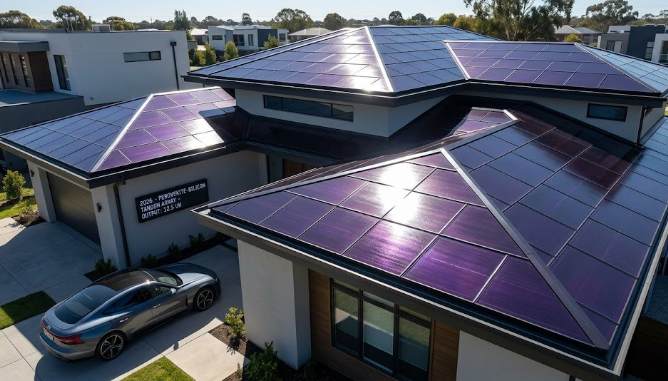
For several decades, standard silicon panels have been the primary choice for homeowners. However, as of May 2026, we are witnessing a massive shift in the industry. Perovskite-Silicon Tandem Cells have officially moved from specialized laboratories into the residential market. These advanced cells offer a way to generate significantly more electricity from the same amount of sunlight.
Engineers and homeowners alike are excited because this technology finally breaks the performance limits of traditional solar. While standard panels stayed around 20% efficiency for a long time, these new tandem cells change the game completely. Consequently, people can now power their entire homes with fewer panels on their roofs.
Breaking the 25% Efficiency Barrier
In 2024, most premium solar panels peaked at an efficiency of about 22.8%. This meant that a large portion of the sunlight hitting the panel simply went to waste. Today, in 2026, commercial Perovskite-Silicon Tandem Cells are hitting 25% to 27% efficiency in real-world conditions.
This jump in performance provides a massive advantage for homeowners with limited roof space. For example, if you needed ten standard panels to run your air conditioner in the past, you might only need eight panels today. Furthermore, this 20% reduction in the number of panels lowers the total weight on your roof structure.
How Perovskite-Silicon Tandem Cells Work
You might wonder how these cells achieve such high numbers. The secret lies in the “tandem” design, which uses two different layers to catch light. In a standard setup, silicon often misses certain colors of light. However, Perovskite-Silicon Tandem Cells use a top layer of perovskite to capture high-energy blue light waves.
Underneath that, a traditional silicon layer captures the low-energy red and infrared light. By working together, the two layers harvest a much wider spectrum of sunlight. Imagine two different sized nets catching different types of fish in the same pond; you will naturally catch more fish than someone using only one net.
Lightweight and Flexible Solar Solutions
Standard silicon cells are usually thick and brittle, which requires heavy glass protection. On the other hand, the layers in Perovskite-Silicon Tandem Cells are incredibly thin. Because these layers use less material, manufacturers are now producing ultralight, flexible panels.
These flexible modules are perfect for curved roofs or RVs. You no longer have to sacrifice power for portability. For instance, a small van can now generate as much power as a small residential array used to produce a few years ago. Additionally, these panels are much easier to transport and install due to their reduced weight.
Ensuring Stability and Longevity
In the past, the main concern regarding perovskite was its durability. Early versions often broke down when exposed to moisture or extreme heat. Fortunately, 2026 models feature revolutionary encapsulation technology. This protective coating seals the Perovskite-Silicon Tandem Cells perfectly from the environment.
Manufacturers now provide a 20-year lifespan guarantee for these modules. This matches the longevity of pure silicon panels that we have trusted for years. Therefore, you can invest in this high-efficiency technology without worrying that the panels will stop working after just a few summers.
The Future of Your Home Power
This is a turning point for sustainable building design. We are moving toward a future where every surface can generate high-quality electricity efficiently. Perovskite-Silicon Tandem Cells represent the most significant leap in solar technology in our generation. If you are planning a solar installation this year, these cells offer the best return on your investment. You can learn more about the technical specifications and chemical makeup of these cells at the National Renewable Energy Laboratory.
References
- International Journal of Photoenergy (2025). “Advances in Tandem Cell Encapsulation.”
- Solar Power World (2026). “Market Trends: The Rise of Perovskite in Residential Areas.”
- Global Energy Review (2026). “Efficiency Records in Commercial Solar Modules.”