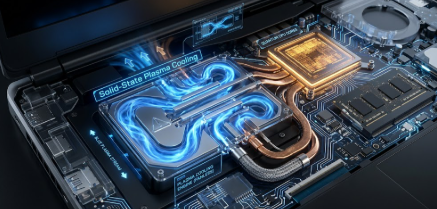
As we move through May 2026, the laptop industry is witnessing a massive shift in how we keep our devices cool. For decades, we relied on spinning plastic blades to push hot air out of our computers. However, the first successful consumer integration of Solid-State Plasma Cooling is finally here. Companies like YPlasma have showcased this “Ion Wind” technology in ultralight laptops, promising a future where your computer never makes a sound.
The Physics of the Ion Wind Spec
You might wonder how a system moves air without a spinning motor. Solid-State Plasma Cooling works through a process called “Corona Discharge.” Inside the cooling unit, the system applies a high-voltage electrical field to a series of tiny emitters. These emitters strip electrons from nitrogen and oxygen molecules in the air, creating charged ions.
Because these ions have an electrical charge, the system can “push” them toward a grounded surface using an electric field. As these ions race through the laptop, they collide with neutral air molecules. This creates a powerful, steady stream of air known as “Ion Wind.” This bulk flow of air carries heat away from the CPU just as effectively as a fan, but it does so without a single moving part.
Why Zero Decibels Matters for Users
The most immediate benefit for anyone visiting SpecsFinder is the “Zero Decibel” spec. Traditional fans use bearings and motors that eventually wear out or rattle. Because Solid-State Plasma Cooling is entirely electronic, it operates in total silence. You can push your laptop to its limit during a video edit or a heavy gaming session, and you will hear absolutely nothing.
Furthermore, this technology solves the common issue of dust-related failure. Mechanical fans often trap hair and dust, which eventually slows them down or causes them to break. Since there are no moving blades to get stuck, these plasma systems are much more reliable over long periods. This makes them perfect for professionals who need a machine that lasts for years without maintenance.
Solving the Corona Discharge Challenge
While the technology is impressive, engineers had to overcome a significant hurdle: ozone production. When you ionize air to create Solid-State Plasma Cooling, the process can produce trace amounts of ozone gas ($O_3$). In the past, this was a safety concern for indoor use.
However, the 2026 production models feature a clever solution. Manufacturers have integrated internal filtration catalysts directly into the airflow channels. These catalysts instantly convert any ozone back into breathable oxygen before it leaves the laptop chassis. Consequently, these machines meet all modern safety and regulatory standards, making them perfectly safe for daily use in your home or office.
Thinner Profiles for Future Laptops
This cooling breakthrough is also changing how laptops look. Traditional fans require a certain amount of vertical space to allow blades to spin and air to circulate. Because Solid-State Plasma Cooling components are flat and solid, they fit into much tighter spaces.
We are now seeing “Pro” laptops reach thicknesses under 10mm. These machines maintain high sustained performance because the plasma flow is more precise than a bulky fan. Engineers can now direct “Ion Wind” exactly where the heat is most intense. This synergy between thin design and thermal efficiency is why many experts believe the era of the mechanical fan is officially ending.
References
- YPlasma Technical Whitepaper (2026): Advances in Atmospheric Ionization for Thermal Management.
- Journal of Electronic Cooling: Comparative Analysis of Piezoelectric vs. Plasma Cooling in Consumer Electronics.
- Global Tech Standards: Ozone Filtration Requirements for Ion-Driven Computing Devices.
For more information on the latest hardware trends, you can read more about future cooling technologies at TechRadar.