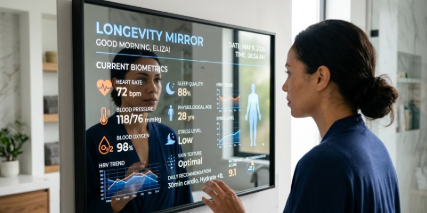
Health tracking has come a long way from the days of simply stepping on a scale. While your weight provides one data point, it rarely tells the full story of what is happening inside your body. In 2026, a new technology is taking over bathrooms worldwide. Longevity Mirrors are now the new health-check standard, replacing basic scales with advanced artificial intelligence that scans your face to measure your internal health.
What is Transdermal Optical Imaging?
At the heart of these devices lies a high-tech process called Transdermal Optical Imaging. Most Longevity Mirrors use a high-resolution camera paired with powerful AI to see things the human eye cannot. When your heart beats, blood flows through the tiny vessels in your face. These mirrors detect nearly invisible changes in facial blood flow patterns to gather data.
In less than 60 seconds, the mirror processes this light information. It uses the data to estimate your physiological age, heart rate, and even your blood pressure. You no longer need to wrap a cuff around your arm to get a quick cardiovascular update. This hardware makes daily health monitoring as simple as brushing your teeth.
Understanding the Face-to-Health Specs
The beauty of Longevity Mirrors lies in the sheer volume of data they provide. Modern units, like the NuraLogix model, can track over 30 different health metrics. Users get instant feedback on their metabolic efficiency and arterial stiffness. These “specs” tell you how well your body processes energy and how flexible your blood vessels are.
By moving the morning check-up from a weight scale to a screen, you gain a comprehensive cardiovascular screen. For example, if you had a high-sodium dinner, the mirror might show a slight increase in your blood pressure or facial puffiness the next morning. This immediate feedback helps you make better lifestyle choices throughout the day.
Detecting Early Health Warning Signs
One of the most exciting features of Longevity Mirrors is their ability to spot “subtle health” flags. The AI analyzes facial skin biomarkers that act as early warning signs for serious conditions. This technology can highlight risks for hypertension or diabetes before you even feel any symptoms.
Imagine a scenario where your mirror notices a slight change in your blood flow over a week. It might suggest that your stress levels are impacting your heart health. Because it detects these invisible biomarkers early, you can consult a doctor long before a minor issue becomes a major medical emergency. This proactive approach is why many experts call these mirrors a “clinic in the bathroom.”
Privacy and Local AI Processing
As we move further into 2026, privacy is a top priority for tech users. Many people worry about their sensitive health data leaking online. Fortunately, the latest Longevity Mirrors address this by using local AI processing. This means the mirror handles all the complex calculations directly on its own hardware.
Your facial data stays inside the device rather than being uploaded to a cloud server. This “on-device” approach ensures that your biometric information remains private. You get all the benefits of high-tech health tracking without the fear of your personal data being sold or hacked. This focus on security is a major reason why these devices have gained widespread trust.
The Future of Daily Wellness
Integrating Longevity Mirrors into your daily routine marks a shift toward preventive medicine. Instead of waiting for an annual check-up, you get a daily report on your body’s performance. This constant stream of information empowers you to take control of your aging process.
As these devices become more affordable, they will likely become a standard fixture in every modern home. They offer a level of insight that a traditional scale simply cannot match. If you want to learn more about the science of facial blood flow analysis, check out this detailed guide on Transdermal Optical Imaging technology.
References
- NuraLogix Corporation. (2026). The Science of Anura: How Transdermal Optical Imaging Works.
- Consumer Electronics Show (CES). (2026). Health Tech Trends: The Rise of the Smart Mirror.
Journal of Biomedical Optics. (2025). AI-Driven Facial Biomarkers in Preventive Healthcare.