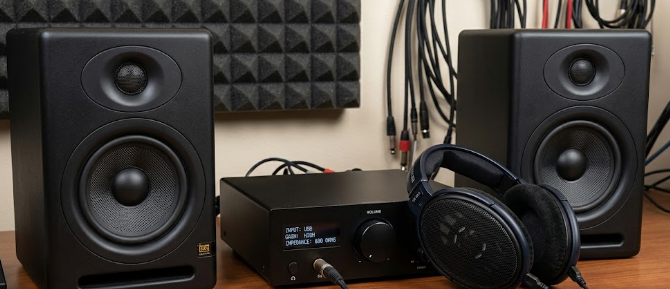
When you dive deep into the world of high-fidelity audio, you quickly run into a wall of technical specifications. Among these numbers, High-Z over-ear headphone impedance stands out as one of the most critical factors. Many music lovers purchase premium headphones only to find that they sound quiet or hollow when plugged directly into a phone.
To prevent this disappointment, you must understand how electrical resistance impacts your audio gear. This guide will break down the science of impedance and explain how it shapes your listening experience.
Defining the Impedance Metric
In basic terms, impedance measures how much a circuit resists an alternating current (AC) electrical signal. We measure this resistance in Ohms ($\Omega$). In the audio world, headphones span a massive spectrum.
Low-impedance models usually range from 16 to 32 Ohms. Manufacturers design these lower values specifically for mobile devices, laptops, and wireless earbuds. Consequently, these devices can easily drive low-resistance gear using very little battery power.
On the other hand, studio legends and audiophile gear feature high impedance, which we often call “High-Z”. These headphones range from 250 Ohms up to a massive 600 Ohms. Because they resist electrical current so strongly, consumer devices simply cannot supply enough power to make them perform well. Therefore, you need specialized source gear to unlock their true sonic potential.
The Physics of Voice Coil Wire Architecture
To understand why manufacturers build high-impedance headphones, we must look inside the driver. The heart of a dynamic headphone is the voice coil. This coil consists of wrapped wire that reacts to magnetic fields to move the headphone speaker cone.
[Audio Source] —> [Thinner Voice Coil Wire (More Windings)] —> [Stronger Magnetic Field] —> [Precise Cone Movement]
To achieve high impedance, engineers wrap the voice coil with thousands of turns of ultra-fine copper wire. Because this wire is incredibly thin, it naturally creates higher electrical resistance. However, this thin wire also has a massive advantage because it is extremely lightweight.
This reduced weight minimizes the moving mass of the speaker driver. Consequently, the driver can react to audio signals with lightning-fast speed. Audiophiles call this a fast “transient response.” Ultimately, this physical design results in incredibly clear sound and lower acoustic distortion.
The Sensitivity Floor: Ohms Are Only Half the Story
While understanding High-Z over-ear headphone impedance is vital, you cannot ignore sensitivity. Sensitivity measures how efficiently a headphone converts an electrical signal into actual acoustic volume. Manufacturers usually state this in decibels per milliwatt ($\text{dB/mW}$) or decibels per Volt ($\text{dB/V}$).
If a headphone has high impedance and a low sensitivity floor, it behaves like a heavy door with a stiff hinge. To swing it open, you need a high-voltage push. This physical reality mathematically demands a high voltage swing from your audio source.
$$\text{Power (Watts)} = \frac{\text{Voltage}^2}{\text{Impedance}}$$
As the formula shows, when impedance rises, you need much more voltage to maintain the same power output. Standard smartphones output less than 1 Volt. Because of this limitation, a dedicated desktop amplifier is absolutely necessary to reach comfortable, dynamic listening volumes without distorting the music.
Damping Factor and Output Impedance Matching
When pairing your headphones with a source, you must follow the audio industry’s “1/8th rule.” This guideline ensures that your source’s output impedance is at least eight times lower than your headphone’s nominal impedance.
For example, if your headphones are 250 Ohms, your amplifier’s output impedance should ideally be lower than 31 Ohms. Keeping this ratio correct ensures a high damping factor. This electrical relationship allows the amplifier to tightly control the physical movement of the headphone driver.
If you violate this rule, the amplifier will struggle to stop the speaker cone’s movement efficiently. As a result, you will experience a muddy, boomy bass response and a distorted frequency curve. Properly matching your gear ensures that you get the tightest bass and cleanest highs possible.
References
- To learn more about the technical math behind headphone power and voltage requirements, check out the detailed calculator guides on Headphonesty.
- Baxandall, P. J. (2001). Audio Power Amplifier Design Handbook. Newnes.
- Toole, F. E. (2018). Sound Reproduction: The Acoustics and Psychoacoustics of Loudspeakers and Rooms. Routledge.