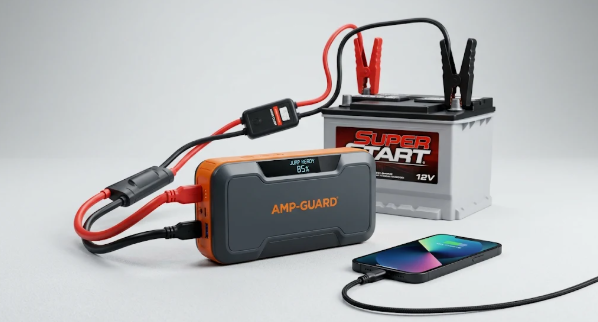
Summary of Key Points
- Dual-function lithium devices jump-start dead vehicle batteries and charge personal mobile electronics.
- Compact lithium-ion technology replaces bulky traditional lead-acid booster packs.
- Essential safety features include reverse-polarity protection and short-circuit prevention.
- Matching peak current ratings to your vehicle engine size ensures reliable starting power.
Introduction
A dead car battery can ruin your schedule in an instant. Fortunately, modern technology offers a convenient solution for drivers everywhere. This portable lithium car jump starter and power bank 2-in-1 guide explains how a single compact device can boost your vehicle engine and charge your mobile devices on the go.
In the past, heavy lead-acid boosters dominated the emergency gear market. However, lithium-ion technology has transformed roadside assistance tools. Modern drivers now carry sleek, powerful devices in their glove boxes without adding unnecessary weight.
Why Choose a 2-in-1 Portable Jump Starter and Power Bank?
Traditional jumper cables require another vehicle to supply electrical power. If your battery dies in an isolated location, you must wait for roadside assistance. A dual-purpose lithium device eliminates this dependency entirely.
Furthermore, these gadgets serve multiple roles during daily commutes and long road trips. You can power your smartphone, laptop, or tablet through fast-charging USB ports. Consequently, you receive constant value from your investment rather than leaving the tool unused in your trunk.
Key Features in This Portable Lithium Car Jump Starter and Power Bank 2-in-1 Guide
Selecting the right emergency device requires an understanding of basic technical specifications. Below, we break down the most important features to evaluate before buying your next unit.
Peak Current and Battery Capacity
Peak current determines the initial surge of electrical power delivered to start your engine. Gasoline engines generally require less current than heavy-duty diesel engines. Therefore, you should match the peak amperage rating to your specific engine size.
Battery capacity, measured in milliampere-hours (mAh), indicates how much total energy the unit holds. Higher capacity allows you to charge smartphones multiple times or deliver several engine jump starts on a single charge.
Safety Clamps and Built-in Protections
Safety remains a top priority when handling vehicle batteries. Premium devices feature smart clamps that detect polarity automatically. If you accidentally connect the clamps to the wrong terminals, the unit prevents dangerous electrical sparks.
Additionally, quality jumpers include protection against over-current, over-voltage, and thermal overheating. These protective circuits safeguard both your vehicle electronics and the jumper unit itself.
How to Use Your 2-in-1 Device Step-by-Step
Operating a modern jump starter involves simple steps that anyone can perform safely. First, turn off your vehicle ignition and all electronic accessories like lights and the radio. Next, plug the smart jumper cables into the designated port on your lithium power bank.
Attach the red positive clamp to the positive terminal of your car battery. Afterward, attach the black negative clamp to an unpainted metal surface on the car frame or the negative terminal. Once the indicator light on the clamp turns green, start your vehicle engine. Finally, remove the clamps immediately after the engine starts running, starting with the negative clamp.
Maintenance and Long-Term Care Tips
To keep your lithium power unit ready for emergency situations, recharge it every three to six months. Extremely cold or hot temperatures can drain battery capacity over time. Therefore, store the unit in a temperate location inside your vehicle whenever possible.
For deeper technical insights into automotive electrical safety standards, check out guidelines provided by SAE International.
References
SAE International. Surface Vehicle Recommended Standards for Portable Battery Boosters.
National Highway Traffic Safety Administration (NHTSA). Emergency Roadside Preparedness Guidelines.