Have you ever wondered about the basics of sickle cell disease? First, we must understand that it is not a virus or a contagious infection. Instead, sickle cell disease (SCD) is an inherited group of blood disorders. Parents pass this genetic condition down to their children. Consequently, the disease fundamentally changes how blood moves through the human body. To fully grasp the basics of sickle cell disease, you must look closely at our red blood cells. These tiny cells carry vital oxygen to every single organ. However, a genetic mutation alters their normal shape and behavior. As a result, the body struggles to function correctly. Let us explore exactly how this mutation happens.
Healthy Cells vs. Sickle Cells
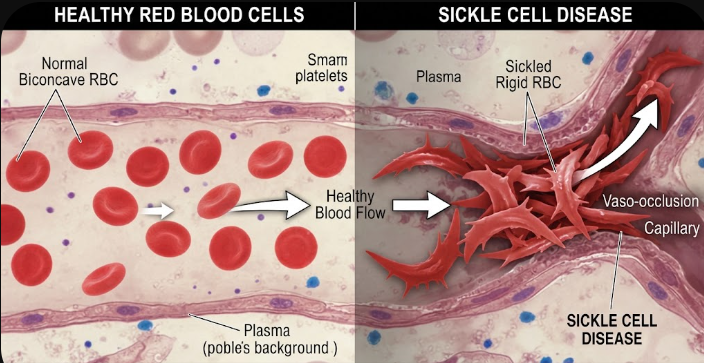
Normally, healthy red blood cells look like round, flexible doughnuts without holes in the middle. Because they are incredibly flexible, they glide smoothly through even the smallest blood vessels. For example, think of them as soft water balloons slipping easily through a narrow pipe. On the other hand, the basics of sickle cell disease involve a stark contrast. The mutation forces these cells to become rigid, sticky, and shaped like a farm tool called a sickle, or the letter “C.” Furthermore, they lose all their flexibility. Therefore, instead of gliding, these hard, misshapen cells struggle to move through tight spaces. This simple change in cell shape sets the foundation for many serious physical problems.
Traffic Jams in Blood Vessels
What happens when these rigid cells travel through your body? Because they are sticky and stiff, sickle cells often clump together. Subsequently, they create massive roadblocks inside your blood vessels. Imagine a sudden traffic jam on a busy highway. Cars cannot pass through, and everything comes to a complete halt. Similarly, these clumping cells block normal blood flow. Consequently, vital organs and tissues do not receive the oxygen they desperately need. This blockage triggers sudden, severe pain episodes known as pain crises. Moreover, over time, the constant lack of oxygen can permanently damage major organs like the kidneys, liver, and spleen.
Premature Cell Death
Another critical physical consequence involves the lifespan of the cells themselves. Healthy red blood cells typically live for about 120 days before the body naturally replaces them. However, sickle cells die much faster. In fact, they often break apart and die in just 10 to 20 days. Because the cells die prematurely, the human body simply cannot produce new ones fast enough to replace them. As a result, the person suffers from a constant shortage of healthy red blood cells. Doctors call this condition anemia. Therefore, individuals with this disease frequently feel weak, tired, and deeply fatigued. Ultimately, this constant cycle of cell death and oxygen deprivation causes the daily symptoms patients experience.
Wrapping Up the Basics of Sickle Cell Disease
In conclusion, learning the basics of sickle cell disease helps us understand the real physical struggles of patients. The condition always starts with a simple genetic mutation. Next, this mutation transforms soft, doughnut-like cells into rigid, sticky “C” shapes. Consequently, these damaged cells block blood vessels and die prematurely. If you want to learn more about how genetics play a role or explore treatment options, you can always read further. For more detailed medical insights on this inherited disorder, please visit this comprehensive guide on sickle cell disease from the Mayo Clinic.
References
- Centers for Disease Control and Prevention (CDC). “What is Sickle Cell Disease?”
- Mayo Clinic. “Sickle Cell Anemia – Symptoms and Causes.”