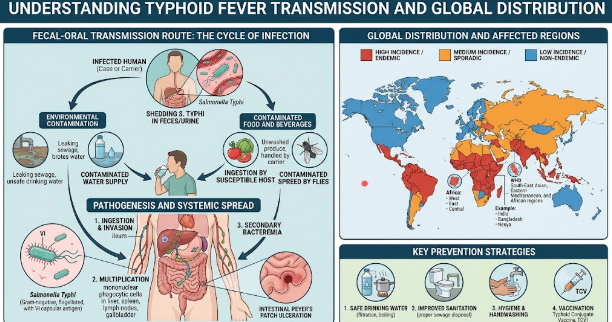
Start understanding typhoid fever today, because this severe illness affects millions of people across the globe every year. Typhoid fever is a life-threatening bacterial infection that spreads rapidly in places with limited public infrastructure. Specifically, a dangerous bacterium called Salmonella enterica serotype Typhi (Salmonella Typhi) causes this disease. Although modern medical treatments exist, the infection continues to pose a huge public health challenge worldwide. Therefore, recognizing how the bacteria operate inside the human body represents the first step toward effective prevention.
When Salmonella Typhi bacteria enter your system, they invade your bloodstream and intestinal tract. Consequently, infected individuals experience high fever, severe fatigue, stomach pain, headache, and loss of appetite. Furthermore, some patients develop a flat, rose-colored rash across their chest or abdomen. Without prompt antibiotic treatment, the bacteria can cause severe complications, such as intestinal perforation or dangerous internal bleeding. Thus, learning about the biological root of the disease is vital for protecting vulnerable communities.
How Transmission Works in Understanding Typhoid Fever
Understanding typhoid fever requires a clear look at how the infection spreads from person to person. The bacteria travel through the fecal-oral route, which means a person ingests food or water contaminated with infected human waste. For instance, when an infected person uses the bathroom and does not wash their hands thoroughly with soap, they transfer the bacteria onto clean surface areas, raw meals, or drinking vessels. As a result, anyone who consumes those contaminated items can easily contract the fever.
Additionally, chronic carriers play a huge role in spreading the disease. Some individuals recover from the illness but continue to carry Salmonella Typhi in their intestinal tract or gallbladder for years. Because these carriers do not feel sick, they unknowingly pass the bacteria to others through everyday food preparation. Consequently, unhygienic street food vendor stalls and municipal water systems with broken pipelines frequently act as major spreaders in crowded urban areas.
Key Risk Factors that Accelerate Infection Rates
Several environmental and behavioral conditions significantly increase the likelihood of local outbreaks. Above all, poor sanitation infrastructure creates ideal conditions for the bacteria to multiply and spread. When municipal systems mix untreated human sewage with household drinking water, whole neighborhoods face immediate exposure. Furthermore, a general lack of clean drinking water forces residents to use unsafe water sources for cooking, bathing, and washing dishes.
Unsafe food handling practices also magnify the risk within crowded communities. For example, eating raw vegetables washed in untreated water or consuming street food prepared without proper hygiene can lead directly to infection. Furthermore, living in close physical contact with active patients or asymptomatic carriers raises your chances of exposure. Therefore, improving basic sanitation standards remains the single most effective barrier against widespread outbreaks.
High-Risk Geographic Regions and Global Hotspots
While typhoid fever occurs around the world, certain endemic regions face a disproportionately heavy burden. Primarily, countries in South Asia, including India, Pakistan, and Bangladesh, record some of the highest case numbers annually. Additionally, large parts of Sub-Saharan Africa and Southeast Asia experience recurring outbreaks due to dense urban populations and developing sanitation facilities.
Furthermore, parts of Central and South America continue to fight localized outbreaks in rural and low-income communities. Travelers visiting these high-risk regions must take extra precautions, such as getting vaccinated and drinking bottled water. Ultimately, understanding typhoid fever helps global health organizations direct resources where communities need them most. For comprehensive medical guidelines and global outbreak updates, you can read more on the official World Health Organization Typhoid Page.
References
- World Health Organization. (2023). Typhoid Fever Fact Sheet. WHO Guidelines and Data.
- Centers for Disease Control and Prevention. (2024). Typhoid Fever and Paratyphoid Fever Information. CDC Global Health Division.
- Parry, C. M., Hien, T. T., Dougan, G., White, N. J., & Farrar, J. J. (2002). Typhoid fever. New England Journal of Medicine, 347(22), 1770-1782.