Typhoid fever is a serious bacterial infection caused by Salmonella Typhi. When a person receives prompt medical care, antibiotics clear the bacteria quickly. However, ignoring the symptoms leads to severe untreated typhoid fever complications that can permanently damage vital organs and threaten human life.
How Untreated Typhoid Fever Attacks the Small Intestine
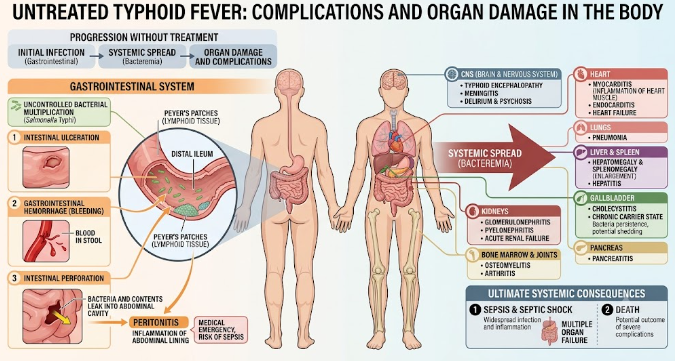
The small intestine serves as the primary battleground for Salmonella Typhi. After a person consumes contaminated food or water, the bacteria pass into the digestive tract. They rapidly invade the lymphatic tissue lining the small intestine, specifically targeting small clusters called Peyer’s patches.
As the bacteria multiply inside these tissues, they create intense inflammation. Consequently, the local tissue loses its blood supply and dies. This process leads to deep ulcers along the intestinal wall. For example, patients often experience severe stomach pain, persistent diarrhea, or bloody stools as these ulcers grow larger over time.
Impact on the Liver, Spleen, and Gallbladder
Furthermore, the bacteria do not remain confined to the gut. They travel through the bloodstream to enter other vital digestive organs, particularly the liver and the spleen.
- Liver and Spleen Enlargement: The immune system tries desperately to clear the infection. As immune cells flood the liver and spleen, both organs swell significantly. Doctors call this condition hepatosplenomegaly. As a result, patients feel severe tenderness and discomfort in the upper abdomen.
- Gallbladder Infection: Additionally, the bacteria frequently settle inside the gallbladder. The gallbladder provides an ideal sanctuary where Salmonella Typhi can hide from immune cells. Even after a patient recovers from initial symptoms, the bacteria can persist here for years. Consequently, the person becomes an asymptomatic chronic carrier who continuously spreads the infection to others through unwashed hands or contaminated food.
Critical Untreated Typhoid Fever Complications in Weeks 3 and 4
If the infection progresses into its third or fourth week without proper treatment, the risk of fatal complications rises dramatically. The deep intestinal ulcers formed earlier begin to erode major blood vessels and bowel tissues.
- Severe Gastrointestinal Hemorrhage: The growing ulcers can tear through blood vessels in the gut. As a result, massive internal bleeding occurs, causing sudden weakness, pale skin, rapid heart rate, and black or bloody stools.
- Intestinal Perforation: Even more dangerously, the ulcers can burn completely through the wall of the small intestine. This creates small holes, allowing digestive fluids and bacteria to spill directly into the abdominal cavity. This leads to peritonitis, a painful and life-threatening abdominal infection that requires immediate emergency surgery.
Systemic Failure and Severe Complications
Beyond the digestive tract, the bacteria circulate freely throughout the entire body. Therefore, untreated typhoid fever complications can spread to almost every major organ system, leading to widespread systemic failure.
- Septic Shock: Bacterial toxins in the blood cause blood pressure to drop dangerously low, depriving vital organs of oxygen.
- Myocarditis: The infection inflames the heart muscle, leading to irregular heartbeats and potential heart failure.
- Encephalopathy: Toxins entering the central nervous system trigger high fever, extreme confusion, delirium, and coma.
- Pneumonia and Kidney Failure: The lungs become inflamed, making breathing difficult, while the kidneys fail to filter body waste efficiently.
Prognosis, Fatality Rates, and Prevention
Fortunately, modern medical treatment makes typhoid fever highly manageable. Early antibiotic treatment resolves the infection rapidly and lowers the overall fatality rate to less than 1%.
However, delaying medical care creates extreme danger. Without treatment, up to 20% of typhoid cases result in death due to severe internal bleeding, bowel perforation, or septic shock. Therefore, early diagnosis and complete antibiotic courses remain crucial for preventing permanent organ damage. For comprehensive health guidelines and clinical updates on managing bacterial infections, visit the World Health Organization.
References
- World Health Organization (WHO). Typhoid Health Topic and Fact Sheet. WHO Guidelines on Bacterial Infections.
- Centers for Disease Control and Prevention (CDC). Typhoid Fever and Paratyphoid Fever Information for Health Professionals.
- Parry, C. M., Hien, T. T., Dougan, G., White, N. J., & Farrar, J. J. (2002). Typhoid fever. New England Journal of Medicine, 347(22), 1770-1782.
- Bhan, M. K., Bahl, R., & Bhatnagar, S. (2005). Typhoid and paratyphoid fever. The Lancet, 366(9487), 749-762.