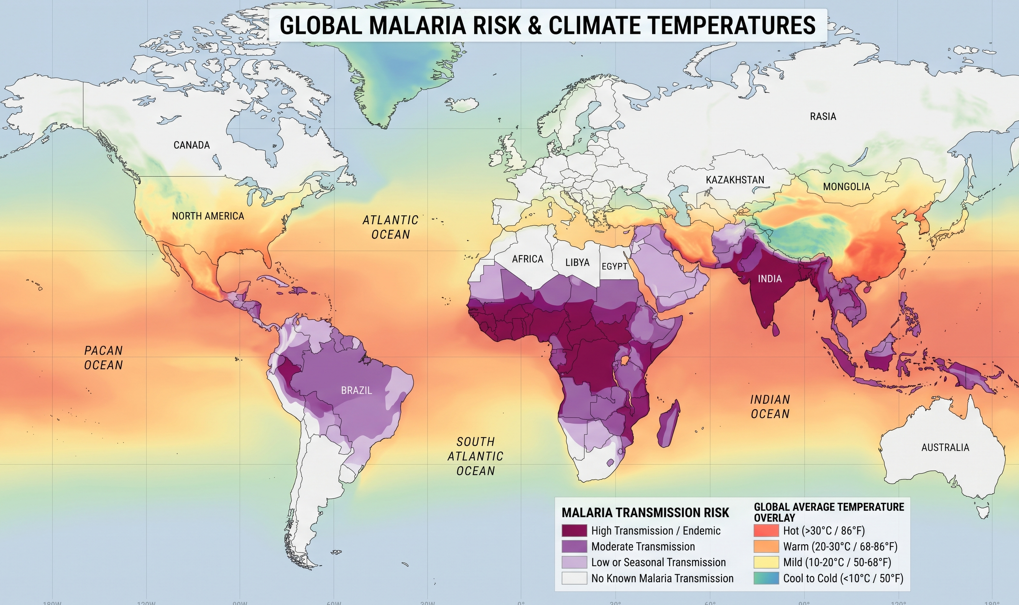
When you plan international travel, checking the global malaria risk map is a critical safety step. Malaria remains a major health threat around the world, but it does not affect every country equally. Mosquitoes transmit this severe blood infection through single bites. Consequently, your geographic location plays a massive role in your overall infection risk. By looking at updated risk maps, travelers and health experts can easily spot danger zones across different continents.
Understanding this global distribution helps you prepare properly before entering endemic regions. For example, you can pack preventive medications or take extra precautions like sleeping under insecticide-treated bed nets. Furthermore, weather patterns heavily shape where mosquitoes thrive and multiply. Therefore, studying the global malaria risk map allows us to see how climate and geography combine to spread this disease.
Why Sub-Saharan Africa Dominates the Global Malaria Risk Map
Sub-Saharan Africa stands out as the primary hotspot on the global malaria risk map. In fact, health organizations report that this single region accounts for over 95% of global malaria cases and deaths. Several severe factors cause this heavy burden. First, the region harbors Anopheles gambiae, which is one of the most efficient malaria-transmitting mosquito species on Earth. Second, the deadly parasite strain Plasmodium falciparum dominates transmission in African countries. This specific strain causes the most severe and fatal cases of the disease.
In addition, the tropical climate in Sub-Saharan Africa creates ideal breeding conditions all year long. Warm temperatures and steady rainfall allow mosquitoes to breed continuously in standing water. As a result, transmission remains high across many African nations throughout the year. Consequently, residents and visitors in this region must take consistent protective measures against mosquito bites.
Secondary Regions on the Global Malaria Risk Map
Although Sub-Saharan Africa bears the heaviest burden, other regions also display significant danger on the global malaria risk map. Secondary risk zones include parts of Southeast Asia, Central America, South America, and Oceania. For instance, nations like Papua New Guinea experience strong transmission cycles due to warm, moist environments. However, the dominant parasite strain in many of these secondary zones differs from Africa.
In regions like Latin America and parts of Asia, Plasmodium vivax is far more prevalent than Plasmodium falciparum. Interestingly, Plasmodium vivax tolerates lower average temperatures much better. As a result, transmission can happen in cooler or more seasonal environments. Moreover, this parasite strain can hide inside the human liver for months before triggering a relapse. Therefore, travelers visiting these secondary zones still require tailored preventive treatment.
Climate Drivers Behind the Global Malaria Risk Map
Weather conditions directly dictate where malaria can exist. Specifically, three environmental drivers determine mosquito survival and parasite growth: temperature, humidity, and rainfall. For example, temperatures must remain above 20°C (68°F) for Plasmodium falciparum to complete its growth cycle inside the mosquito. If temperatures drop below this threshold, the parasite simply cannot mature before the mosquito dies.
Furthermore, high humidity prolongs the life span of female mosquitoes, giving them more time to bite human hosts. Seasonal rainfall creates abundant pools of standing water, which serve as perfect mosquito nurseries. Because global temperatures are rising, some cooler highland areas are now becoming warmer. Consequently, climate change is shifting malaria hotspots into brand-new geographic regions.
Low-Risk Zones and Excluded Areas
Fortunately, malaria does not exist everywhere on Earth. Certain natural barriers and artificial environments create safe, low-risk zones. High altitudes represent a classic natural barrier. Because temperatures decline as elevation increases, cold mountain air stops parasite maturation entirely. Similarly, dry desert regions lack the standing water necessary for mosquito larvae to survive.
In addition, winter seasons in temperate climates naturally interrupt malaria transmission cycles. Furthermore, modern urban centers with advanced drainage systems, air conditioning, and window screens rarely report local transmission. Therefore, travelers spending time strictly within well-developed cities face a far lower risk compared to rural adventurers.
Vulnerable Groups Facing Severe Malaria Risk
Even within high-risk territories, malaria does not affect every individual in the exact same way. People who lack natural immunity face the greatest danger of developing life-threatening complications. Non-immune international travelers fall squarely into this high-risk category because their bodies have never encountered the parasite before. As a result, an infection can escalate rapidly into a medical emergency.
Similarly, young children under five years old and pregnant women represent exceptionally vulnerable groups within local populations. Young children have not yet built up partial immunity, while pregnancy naturally weakens a woman’s immune response. Therefore, health organizations prioritize delivering bed nets and preventive therapies directly to these vulnerable populations.
Final Thoughts on Managing Malaria Risks
Understanding global transmission patterns empowers you to protect your health whenever you travel. By recognizing climate hotspots, seasonal cycles, and vulnerable groups, you can make informed choices about medication and insect repellent. Although climate change continues to alter insect habitats, taking proactive steps remains your best defense against mosquito-borne infections.
Always inspect the latest global malaria risk map before traveling to international destinations so you can stay fully informed. To explore detailed destination guidelines and updated country travel notices, visit the official Centers for Disease Control and Prevention Malaria Prevention Guide for further reading.
References
- Centers for Disease Control and Prevention (CDC). “Where Malaria Occurs.” CDC Health Information, https://www.cdc.gov/malaria/data-research/index.html.
- World Health Organization (WHO). “World Malaria Report.” WHO Global Malaria Programme, https://www.who.int/teams/global-malaria-programme/reports.
- Medicines for Malaria Venture (MMV). “Malaria Facts & Statistics.” MMV Resources, https://www.mmv.org/malaria/about-malaria/malaria-facts-statistics.