Many people search for practical ways to reduce snoring without buying expensive medical equipment. If your nighttime breathing sounds like a loud motor, you are not alone. Heavy snoring frustrates bed partners, and it also leaves the snorer feeling exhausted every morning.
Before you spend money on medications or noisy machines, you should understand how snoring happens. Snoring occurs because of a simple biomechanical blockage in your throat. When you fall asleep, your throat muscles, soft palate, and tongue completely relax. As air pushes through this narrowed throat space, the relaxed tissues vibrate and make noise.
Fortunately, you can use simple physics and body adjustments to reduce snoring tonight. You can easily modify your bedroom setup to keep your airway open naturally without any pills.
Master Side Sleeping to Reduce Snoring
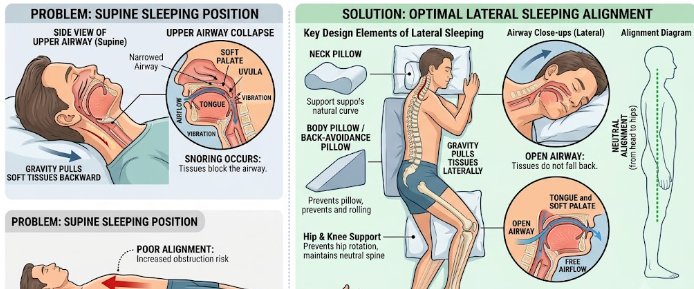
Sleeping flat on your back is the single biggest cause of night noise. Doctors call this flat position the supine posture. When you lie face-up, gravity constantly pulls your tongue and soft palate downward toward the back of your throat. As a result, this movement narrows your breathing canal, forcing air through a tiny gap.
Supine (Back) Sleeping: Gravity → Tongue falls back → Airway narrows → Snoring
Lateral (Side) Sleeping: Gravity → Tissues fall sideways → Airway stays open
To fix this problem, you must switch to lateral sleeping, which simply means sleeping on your side. Side sleeping rotates your airway 90 degrees. Consequently, gravity pulls throat tissues sideways instead of backward into your airway.
You can use a body pillow barrier to stay on your side all night. Hug a long body pillow in front of your chest, and place a firm pillow behind your back. This setup creates a cozy physical channel that prevents you from rolling onto your spine. Furthermore, make sure your head pillow matches your shoulder width so your neck stays straight.
Raise Your Upper Body to Reduce Snoring Overnight
If you cannot stay on your side, flat head positioning is usually the main culprit. Lying horizontal allows fluid to gather in your neck tissues overnight. Therefore, these heavy, inflamed tissues collapse easily under gravity and block your throat.
You can easily fix this issue by using the incline principle. Elevating your upper body stops fluid from pooling in your neck. In addition, gravity pulls your upper breathing tissues forward, away from your airway passage.
First, you can install heavy-duty bed risers under the top two legs of your bed frame. Elevating the head of your bed by 4 to 6 inches creates a gentle slope that uses gravity to reduce snoring. Alternatively, you can use a firm 30-degree wedge pillow. Make sure the wedge supports your entire upper body from the waist up so your neck does not bend.
Use Mandibular Devices to Reduce Snoring at the Source
Beyond basic body posture, targeted physical tools can keep your throat clear while you rest. A Mandibular Advancement Device (MAD) is a special anti-snoring mouthpiece that fits like a dental retainer.
This device gently holds your lower jaw slightly forward during sleep. Because your tongue connects directly to your lower jaw, moving the jaw forward physically pulls the tongue away from your throat. Therefore, air moves freely without causing heavy tissue vibrations.
Open Your Nasal Passages to Reduce Snoring Fast
If your snoring starts in your nose because of allergies or narrow nostrils, your body automatically switches to mouth-breathing. Unfortunately, mouth-breathing greatly increases throat collapse and amplifies noise.
Flexible nasal strips offer a fast solution to this common issue. These sticky strips attach across the outside of your nose and spring outward. Consequently, they manually expand your nasal valves, reducing air resistance instantly so you can breathe easily through your nose.
| Target Area | Mechanical Hack | Primary Biomechanical Benefit |
| Position | Side sleeping + Body pillows | Prevents tongue and palate from collapsing backward |
| Incline | 4–6 inch bed risers or 30° wedge | Prevents neck fluid pooling & tissue collapse |
| Jaw & Tongue | Mandibular Advancement Device (MAD) | Moves lower jaw forward to clear throat space |
| Nasal Passages | External flexible nasal strips | Opens nasal valves to lower breathing resistance |
Action Steps to Reduce Snoring Tonight
You can start your anti-snoring routine tonight by following three simple steps. First, place 4 to 6-inch risers under your top bed legs or set up a wedge pillow. Second, anchor yourself with a body pillow so you do not roll onto your back. Finally, apply a nasal strip across your nose before turning off the lights.
By taking these small mechanical steps, you can keep your airway open and enjoy quiet, restful sleep. For a comprehensive overview of how sleep posture impacts overall sleep quality and health, you can read this detailed guide on sleep health and posture at Sleep Foundation.
References
- Sleep Foundation. (2023). Best Sleeping Positions for Snoring and Sleep Apnea.
- American Academy of Dental Sleep Medicine. (2022). Oral Appliance Therapy for Snoring and Sleep Apnea.
- Journal of Clinical Sleep Medicine. (2020). Positional Therapy for Obstructive Sleep Apnea and Snoring: A Review.