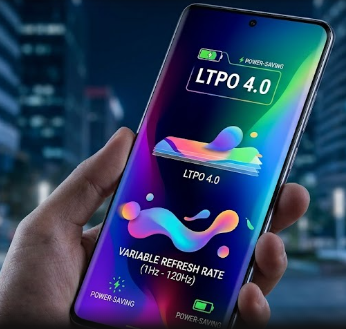
Modern flagship phones look stunning, but their power-hungry screens can drain your battery in a few hours. If you love gaming or want a phone that lasts all day, you need to understand display technology. Fortunately, LTPO 4.0 technology is here to solve the battery drain issue while keeping your screen incredibly smooth.
This fourth-generation display tech allows your phone screen to change how fast it refreshes. It can shift anywhere from a super-fast 144Hz down to a static 1Hz. In this article, we will break down exactly how this engineering marvel works in simple terms.
What is the Hybrid Backplane in LTPO 4.0?
To understand this new technology, we must look at the backplane of the screen. The backplane is simply the physical circuit board behind the pixels. In the past, screens used Low-Temperature Poly-Silicon (LTPS) thin-film transistors (TFTs) to turn pixels on and off.
While LTPS is very fast and responsive, it leaks a lot of electrical current when displaying still images. Because of this, engineers created a hybrid backplane that combines LTPS with Indium Gallium Zinc Oxide (IGZO) TFTs. We call this combination Low-Temperature Polycrystalline Oxide, or LTPO.
The LTPO 4.0 design uses the fast LTPS transistors to handle rapid screen movements like gaming or scrolling. At the same time, it uses the highly efficient Oxide transistors to handle slow or still images. This hybrid system gives you the absolute best of both worlds.
The Power-Saving Math Behind the 1Hz Extreme Floor
The most impressive feature of this new display is its ability to drop its refresh rate down to just 1Hz. This means the screen only updates its image once per second. This is perfect for when you are reading an e-book or using the Always-On Display (AOD) mode.
Let us look at the simple math behind this power-saving feature. A standard modern phone screen refreshes 120 times every single second (120Hz). If you are looking at a still photo, a 120Hz screen is wasting energy by redrawing that same photo 120 times per second.
When your phone drops from 120Hz down to 1Hz, it reduces the number of display cycles by over 99%. In terms of raw numbers, dropping to a 1Hz floor reduces the display’s power consumption by up to 80% during those idle windows. This massive drop in energy consumption keeps your phone cool and saves your battery.
How Dynamic Refresh Rate Scaling Works
Your phone does not just stay at one speed; instead, it uses a smart hardware logic controller to scale the refresh rate. This controller monitors what is happening on your screen in real-time. It then changes the speed of the display to match the exact frame rate of your app.
For example, the screen will dynamically step between different speeds based on your activity:
- 1Hz: Always-on display or reading a static page.
- 24Hz to 30Hz: Watching cinematic movies or YouTube videos.
- 60Hz: Standard social media browsing or basic apps.
- 120Hz: Fast system scrolling and standard mobile games.
- 144Hz: Intense, competitive mobile gaming.
By matching the screen speed directly to the software, the controller eliminates visual stutter. You will never notice the screen changing speeds because the transitions happen instantly.
Solving the Flicker and Brightness Shift Problem
Older variable screens had a major issue with screen flicker. When a screen jumps instantly from 1Hz to 120Hz, it experiences a sudden change in electrical voltage. This sudden voltage delta causes rapid shifts in the screen’s brightness, which we call gamma flicker.
Gamma flicker is highly annoying and causes severe eye strain. Fortunately, LTPO 4.0 introduces advanced luminance compensation specs to solve this problem. The display’s controller predicts these voltage jumps and applies precise electrical corrections in milliseconds.
This hardware compensation ensures that the screen’s brightness remains perfectly stable, even when jumping from 1Hz to 144Hz. You get a seamless, flicker-free viewing experience that is incredibly gentle on your eyes during long gaming sessions.
Summary of Key Display Specifications
To help you compare, here is a quick breakdown of how these display generations differ:
| Feature | Older LTPS Screens | Early Gen LTPO | LTPO 4.0 Screens |
| Refresh Rate Range | Fixed 60Hz or 120Hz | 10Hz to 120Hz | 1Hz to 144Hz |
| Power Savings | Low (Heavy drain) | Moderate (~50% max) | High (Up to 80% at 1Hz) |
| Gamma Flicker | None (Fixed rate) | Noticeable during jumps | Fully eliminated (Compensated) |
| Best Used For | Budget phones | Early flagships | Premium flagship & gaming phones |
Ultimately, this display technology is a must-have feature for anyone buying a high-end mobile device today. It ensures you do not have to choose between extreme gaming performance and multi-day battery life. For a deeper technical dive into the evolution of mobile screens, you can read this detailed guide on the history of mobile display panels on DisplayMate.
References
- OnePlus Official Specs & ProXDR Technology (2024).
- “Understanding LTPO Displays: How Hybrid Backplanes Save Battery” – Compare and Recycle.
- “The Physics of Low-Temperature Polycrystalline Oxide (LTPO) in OLEDs” – Display Technology Journal.