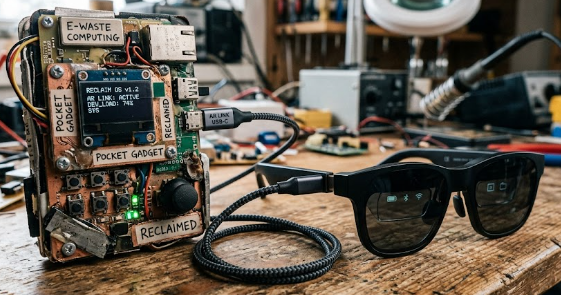
Technology moves incredibly fast, leaving behind a massive trail of discarded devices. However, hardware modders and sustainable tech advocates now use reclaimed e-waste computing to build powerful, environmentally friendly new gadgets. This process takes perfectly good processors and motherboards from broken devices and gives them a second life. Instead of throwing away a portable gaming console with a shattered screen, engineers extract the motherboard and build a brand-new, minimalist device. Consequently, this practice saves money, prevents pollution, and protects the environment.
The Screenless Form Factor
Furthermore, the most exciting part of this trend is the screenless form factor. Modern designers now decouple processing hardware from integrated screens entirely. For example, some DIY hardware modders take broken Steam Deck motherboards and turn them into dedicated pocket compute blocks. Since the original built-in screen no longer works, they remove it from the design. As a result, the new device becomes a tiny, powerful computer that easily fits in your pocket. This approach completely changes how we think about mobile gaming and portable computing.
AR Glasses Tethering Specs in Reclaimed E-Waste Computing
How do you use a portable computer without a screen? You connect it directly to augmented reality (AR) glasses. Therefore, the physical input/output (I/O) specifications of these devices focus heavily on modern USB connections. These minimalist computing shells completely omit traditional built-in display controllers. Instead, they rely strictly on alt-mode DisplayPort over USB-C to transmit visual data.
In addition, this single USB-C cable feeds high-quality images directly into wearable AR optics, such as Xreal or Rokid frames. Because the device does not need to power an internal screen, the internal wiring becomes much simpler. You simply plug your AR glasses into the pocket compute block, and a massive virtual screen appears right in front of your eyes. Thus, reclaimed e-waste computing works perfectly with modern wearable displays.
Amazing Thermal Design Advantages
Moreover, removing the built-in screen offers massive physical engineering benefits. Traditional portable devices struggle with heat. An integrated LCD or OLED display, along with its bright backlight, generates a massive amount of heat inside the device shell. In fact, removing the display eliminates up to 40% of the device’s total internal heat generation.
Consequently, this massive drop in heat allows engineers to install highly compact cooling loops. Without the extra heat from a screen, the cooling system focuses entirely on the main processor. As a result, the primary System on Chip (SoC) runs at peak boost clocks indefinitely without overheating. Gamers enjoy smoother frame rates, and the device stays perfectly cool in your hands or pocket.
Circular Manufacturing Metrics and Reclaimed E-Waste Computing
Ultimately, this minimalist architecture sets new standards for global sustainability. Builders heavily utilize post-consumer recycled (PCR) plastics to create the hard outer shells for the new devices. They combine these recycled plastics with reclaimed silicon architectures to create a fully circular manufacturing process.
Therefore, analysts can establish a clear benchmark for analyzing a device’s total lifecycle carbon cost per compute cycle. Reclaimed e-waste computing drastically lowers this carbon cost because it reuses existing, energy-intensive components instead of manufacturing new ones from raw materials. This approach proves that high-performance mobile gaming hardware can also be highly sustainable.
Conclusion and Further Reading
In conclusion, reclaimed e-waste computing represents the future of sustainable, high-performance portable technology. By dropping the built-in screen and relying entirely on external AR glasses, these gadgets offer better cooling, faster processing, and a much lower environmental footprint. If you want to dive deeper into how circular electronics manufacturing impacts global sustainability, you can read more about it at the World Economic Forum’s Circular Economy page.
References
- World Economic Forum. (2019). A New Circular Vision for Electronics: Time for a Global Reboot.
- Xreal & Rokid Hardware Documentation. (2025). Alt-Mode DisplayPort over USB-C Specifications for Wearable Optics.