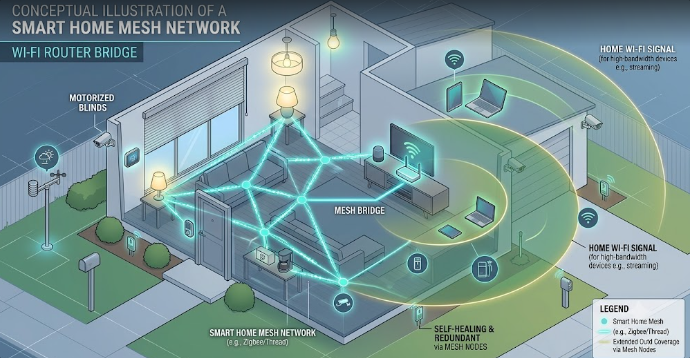
Smart home enthusiasts often face a frustrating problem when setting up their devices. You buy a smart bulb from one brand and a motion sensor from another, only to find they cannot talk to each other. Fortunately, the new Thread 1.4 specification is here to solve these fragmented ecosystem headaches completely. This major upgrade transforms how your smart gadgets communicate, creating a truly unified experience for every homeowner.
What is the Thread 1.4 Specification?
To understand this update, you must first understand how older smart homes operate. In the past, different manufacturers created their own closed wireless networks. As a result, your gadgets constantly competed for bandwidth, which slowed down your entire home network.
The Thread 1.4 specification fixes this issue by standardizing device trust protocols across all brands. Consequently, Matter-certified devices from Apple, Google, Amazon, or Samsung can now join a single, unified mesh network. Instead of fighting for signals, your devices work together to pass data along the fastest route.
Standardizing Device Trust Protocols
Security often becomes a major concern when you mix different device brands. Thankfully, the new protocol introduces strict, universal security checks for every gadget. When you add a new smart plug to your home, the network verifies its identity instantly using these shared rules.
Therefore, you no longer need to worry about one weak device compromising your whole setup. This unified trust system ensures that a smart lock from one company securely communicates with a hub from another company. Ultimately, this creates a reliable and safe environment for your smart home DIY projects.
Cloud Connectivity and the Thread 1.4 Specification
In older versions, smart home hubs often struggled to communicate with the internet without specific manufacturer software. However, the Thread 1.4 specification provides a clearly defined and standardized path to the internet for all Border Routers. This means your internet connection becomes a shared highway for every smart device in your home.
Because of this direct routing, your smart gadgets can now receive remote software updates automatically. Furthermore, this seamless internet path enables dynamic cloud features without requiring proprietary hubs. For instance, your smart blinds can look up local weather data online and adjust themselves automatically to keep your living room cool.
Out-of-Home Control Made Simple
Controlling your smart home while you are away used to require multiple, expensive bridge devices. Now, this latest upgrade simplifies out-of-home control by utilizing standard internet protocols. You can turn off your lights or check your security cameras from across the world using a single app.
Since the system does not rely on a single manufacturer’s cloud server, you experience less lag and fewer connection drops. Consequently, your smart home becomes much more dependable, giving you peace of mind whether you are at work or on vacation.
Enhancing Signal Reach with Thread Over Infrastructure
Perhaps the most exciting addition to this update is a feature called “Thread over Infrastructure.” Typically, low-power mesh networks struggle to send signals through thick concrete walls or across large backyards. To solve this, the Thread 1.4 specification allows the mesh network to bridge itself over your home’s existing high-bandwidth wiring.
Specifically, the network can now use your current Wi-Fi routers and Ethernet cables to transmit data. This integration combines the power-saving benefits of a mesh network with the incredible speed and range of your home internet wiring. As a result, your smart home network expands naturally without needing extra signal boosters.
Connecting Distant Edge Devices Successfully
This infrastructure bridging drastically improves reliability for distant edge devices. For example, you can easily install an outdoor security sensor at the far edge of your driveway. Even if the sensor is far from your central hub, it can send data to a nearby Wi-Fi access point.
That access point then carries the message through your home’s Ethernet cables straight to your smart speaker. Therefore, you get an instant alert the moment someone approaches your property. IoT developers and DIYers can now build larger, more robust automation systems without worrying about signal dead zones.
Final Thoughts on the New Smart Home Standard
The Thread 1.4 specification marks a massive leap forward for smart home automation. By uniting different ecosystems, improving cloud routing, and expanding signal range through existing wiring, it removes the biggest frustrations of modern IoT setups. If you want to dive deeper into the technical details of this networking standard, you can read the official announcement on the Thread Group Website.
References
- Thread Group. (2024). Thread 1.4 Specification Announcement.
- Matter Protocol Architecture and Smart Home Integration Standards (2025).